

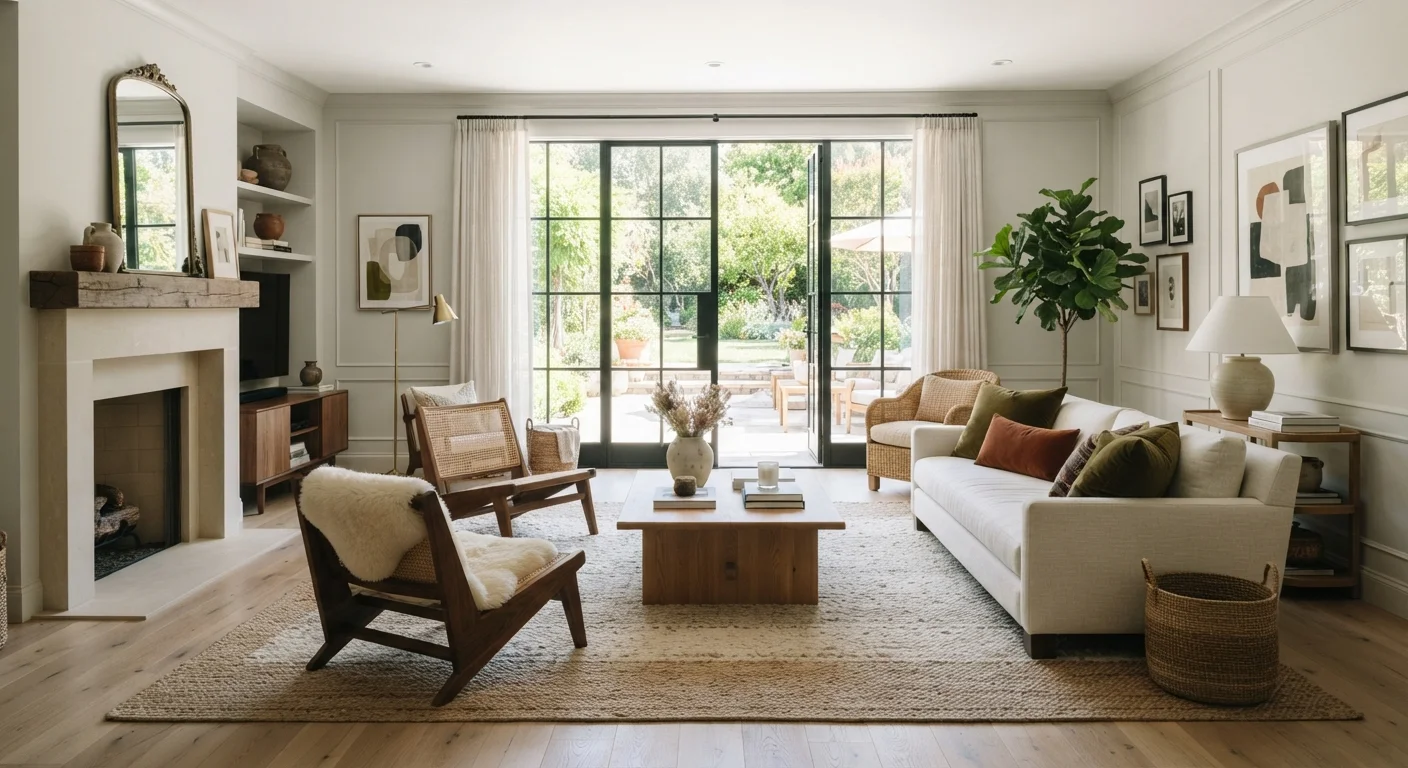
Why Design Vocabulary Matters for Homeowners
You don't need a design degree to create a home you love - but knowing a few core terms dramatically sharpens your instincts. When you can name what's wrong with a room, you can fix it. When you understand why something works, you can repeat it.
Interior designers use a shared vocabulary to communicate quickly and precisely about space. Homeowners who learn even a handful of these concepts make faster, more confident decisions - whether rearranging a living room or choosing between two rugs. This guide covers the terms you'll encounter most often, with plain explanations you can apply right away. For color-specific concepts, our introduction to color theory for living spaces picks up where this article leaves off.
68%
Homeowners who find decorating decisions stressful
According to a Houzz survey, the majority of homeowners report feeling uncertain or overwhelmed when making decorating choices for their homes.
1 in 3
Rooms cited as feeling 'off' but unfixable
Industry research suggests a large share of homeowners sense a room isn't working but lack the vocabulary to diagnose or address the issue.
Scale, Proportion, and Balance
Scale describes how an object's size relates to the room around it. A king-sized bed in a small bedroom is out of scale - it dominates the space and leaves nowhere to move. Proportion is a related but distinct idea: it describes how objects relate to each other. A pair of petite side tables next to a deep, oversized sectional is disproportionate even if both items suit the room individually.
Balance distributes visual weight throughout a space so it feels stable. Symmetrical balance places identical or mirrored elements on either side of a focal point - think matching lamps flanking a bed. Asymmetrical balance uses different objects that carry similar visual weight, which can feel more dynamic and modern. A large framed print might balance a grouping of three smaller frames across the room.
Test proportion before you buy
Use painter's tape on the floor to outline the footprint of a rug or sofa before purchasing. This low-effort step reveals immediately whether an item will be in proportion with surrounding furniture and the room's dimensions - saving you a costly return.
These concepts are especially high-stakes in compact rooms. Our guide to decorating a small apartment shows how scale and proportion choices dramatically affect how spacious a room feels.
Focal Point, Rhythm, and Negative Space
A focal point is the natural anchor of a room - the first place the eye lands. It might be a fireplace, a statement sofa, or a large piece of artwork. Every well-designed room has one. Without a focal point, the eye wanders and the room feels unsettled. Design decisions radiate outward from this anchor.
Rhythm in interior design refers to repeating elements - colors, shapes, textures, or patterns - that create visual flow and a sense of intentionality. Repeating a terracotta accent in throw pillows, a ceramic vase, and a small rug ties a room together without matching everything exactly.
Negative space is one of the most underused tools available to homeowners. It's the deliberate emptiness around and between objects - a blank section of wall, an open corner, a clear surface. Negative space gives the eye a place to rest and prevents rooms from feeling cluttered. Editing a space down often does more than adding to it. This connects closely to common misconceptions about filling every surface - see decorating myths that lead homeowners astray for a closer look.
Putting the Concepts Into Practice
These principles work in any space, at any budget. A renter furnishing a temporary apartment uses the same framework as a homeowner renovating a forever home. If you're working with a space you don't own, personalizing a rented space is a natural next step - most design adjustments require zero permanent changes.
Start by identifying one principle that applies to a room that feels off. Does the furniture feel too large or too small? Check scale. Does one side of the room feel heavier than the other? Look at balance. Does it feel chaotic or busy? Introduce more negative space by removing, not adding. Over time, these observations become second nature.
“Design is not just what it looks like and feels like. Design is how it works.”
— Steve Jobs, Co-founder of Apple, frequently cited in discussions of functional design thinking
This article is for informational and educational purposes only. Always verify local building codes and consult a licensed professional before undertaking any structural or regulated home improvement work.
Frequently Asked Questions
Scale refers to how the size of an object relates to the room itself, while proportion describes how items relate to each other. A sofa can be appropriately scaled to a large living room, but poorly proportioned if paired with a tiny coffee table.
Negative space is the intentional empty area around and between objects in a room. It gives the eye a place to rest and prevents a space from feeling cluttered or overwhelming. Think of blank wall sections or an unadorned corner as purposeful breathing room.
Balance can be symmetrical (matching elements on either side of a focal point) or asymmetrical (using different objects of similar visual weight). Start by identifying your room's focal point, then distribute furniture and decor to avoid loading one side too heavily.
Absolutely. Principles like scale, proportion, and negative space are especially useful in small spaces because mistakes in those areas are amplified. Many of these adjustments - rearranging furniture, editing accessories, choosing the right rug size - require no permanent changes.
No formal training is needed. These are observational frameworks that sharpen your instincts over time. Most people already sense when something feels 'off' - learning the vocabulary just helps you identify why and make a targeted fix.
The content on this site is for informational purposes only and is not a substitute for professional advice. Always consult a qualified professional for guidance specific to your situation.