

Why Most Shelf Arrangements Fall Apart
Bookshelf styling advice floods social media, but many of those arrangements survive only long enough to be photographed. Books get pulled out and not replaced carefully, new objects appear without a plan, and within weeks the whole thing looks chaotic. The problem isn't the homeowner's taste - it's that most styling tutorials skip the structural thinking that makes arrangements durable.
A bookshelf that holds up in real life is designed around your actual habits: how often you reach for books, whether kids or pets interact with it, and how much time you realistically want to spend maintaining it. Decor principles matter, but they only work when they accommodate the way you live. Before diving into technique, consider what the shelf is really for - storage, display, or both - because that shapes every decision that follows.
If you're also rethinking how a room fits together beyond the shelf, the room layout planning checklist is a useful starting point for evaluating scale and flow before moving anything.
Core Principles for a Shelf That Stays Organized
These practices work together. Apply all of them rather than cherry-picking, and your arrangement will resist entropy far better.
Zone each shelf by purpose before placing any objects
Without designated zones, shelves fill randomly and become harder to use and style. Deciding upfront which shelves hold frequently accessed books versus decorative-only items prevents daily use from disrupting the display.
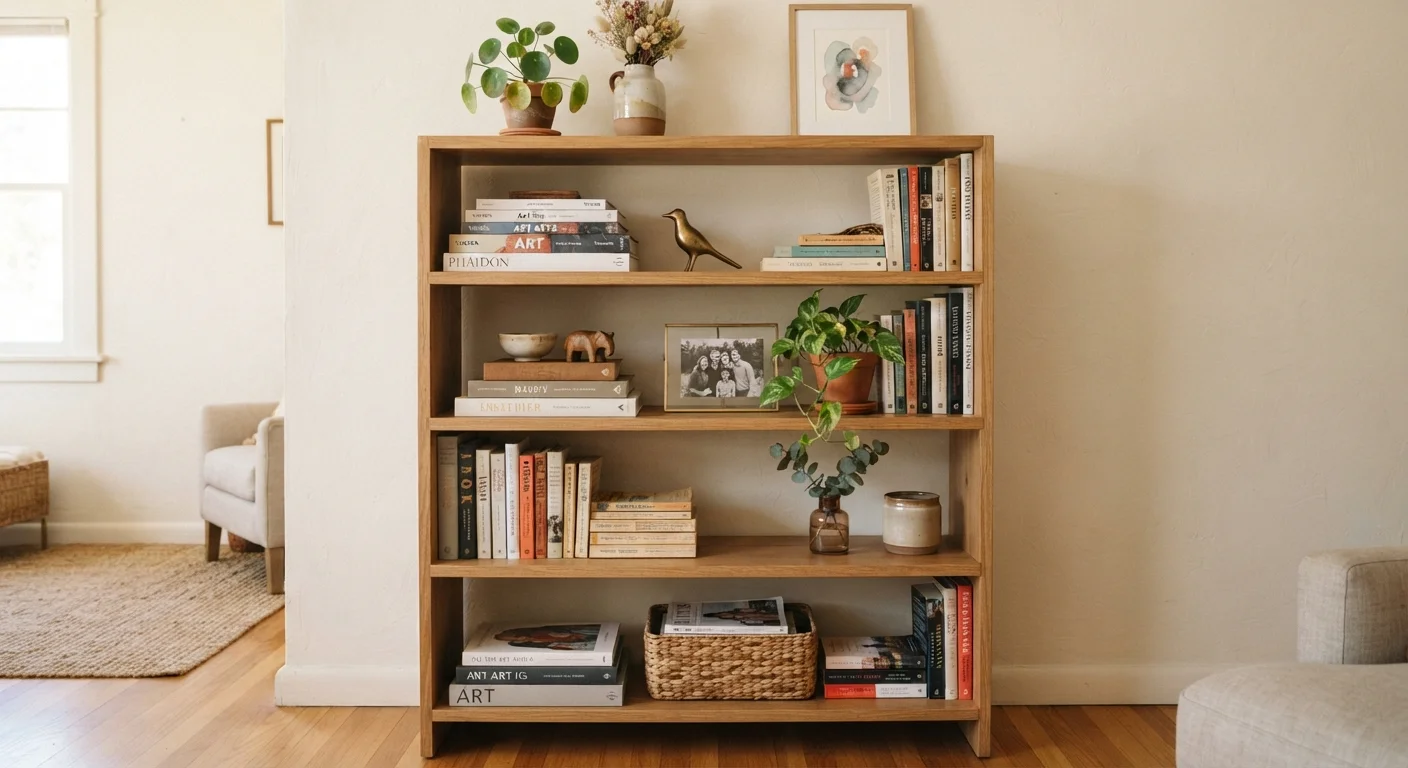
Alternate book orientations to create visual rhythm
A wall of vertical spines reads as flat and monotonous. Mixing stacked horizontal books into sections creates height variation and natural resting points for the eye, making the overall arrangement feel more dynamic.
Preserve deliberate empty space on at least one shelf
Empty space is not wasted space - it gives the eye somewhere to rest and makes surrounding objects read more clearly. Overcrowded shelves make it hard to see any single item and feel stressful rather than inviting.
Limit your object palette to three colors per shelf
Too many competing colors fragment the eye's path across the shelf. Staying within a constrained palette - including book spines - creates cohesion without requiring everything to match perfectly.
Use objects of varying heights within each shelf section
Uniform height across a shelf section creates a flat horizon line that reads as unfinished. Varying heights - a tall vase next to a low stack of books next to a mid-height object - produces the layered quality that makes styled shelves look considered.
Edit ruthlessly - remove anything that doesn't earn its place
A common mistake is treating the shelf as a catch-all for objects that have no other home. Each item should either be actively loved or actively useful; anything else competes for visual attention without adding value.
Color plays a larger role in shelf harmony than most people realize. Spines in clashing hues create visual noise even when objects are well-placed. For a deeper understanding of how to use hue and contrast intentionally, see the color theory guide for living spaces.
Quick Wins You Can Do Today
You don't need to overhaul everything at once. These targeted actions produce an immediate improvement and set the foundation for longer-lasting arrangements.
Living in a compact home? Shelves do extra duty as both storage and display surfaces. The small apartment decorating guide covers how to use vertical real estate without overwhelming a room.
The Rule of Negative Space
If you can't tell at a glance where one object ends and another begins, your shelf needs more breathing room. A good test: photograph the shelf and review the image - the camera doesn't lie about visual clutter the way a familiar eye does. Aim for each object to be readable on its own before deciding it fits within the arrangement.
What Keeps Arrangements Looking Intentional Over Time
Even a well-designed shelf drifts. Books accumulate, objects migrate, and dust changes how things read visually. The fix isn't a full reset every month - it's building in small maintenance habits.
Set a loose rule: any time you pull a book off the shelf, take five seconds to straighten adjacent items when you return it. Once a season, step back and identify one or two shelves that feel off, and adjust only those. This keeps the arrangement from requiring a top-to-bottom overhaul.
It's also worth being skeptical of the "rules" that seem universal. Prescriptions like always grouping in odd numbers or never mixing verticals and horizontals are repeated often but don't fit every space or collection. The decorating myths article challenges several of these assumptions with useful nuance.
Shelf Arrangements Drift - That's Normal
No arrangement stays perfectly styled on its own indefinitely, especially in active households. Designing for resilience - using objects that are easy to reposition, groupings that are forgiving of small changes - is more practical than trying to achieve a fragile perfection. A shelf that takes five minutes to reset after a busy week is a success.
A shelf that functions well and reflects your actual reading habits and taste will always outlast one styled purely for a photograph. The goal is an arrangement that looks considered on an ordinary Tuesday - not just the day you set it up.
The content on this site is for informational purposes only and is not a substitute for professional advice. Always consult a qualified professional for guidance specific to your situation.