

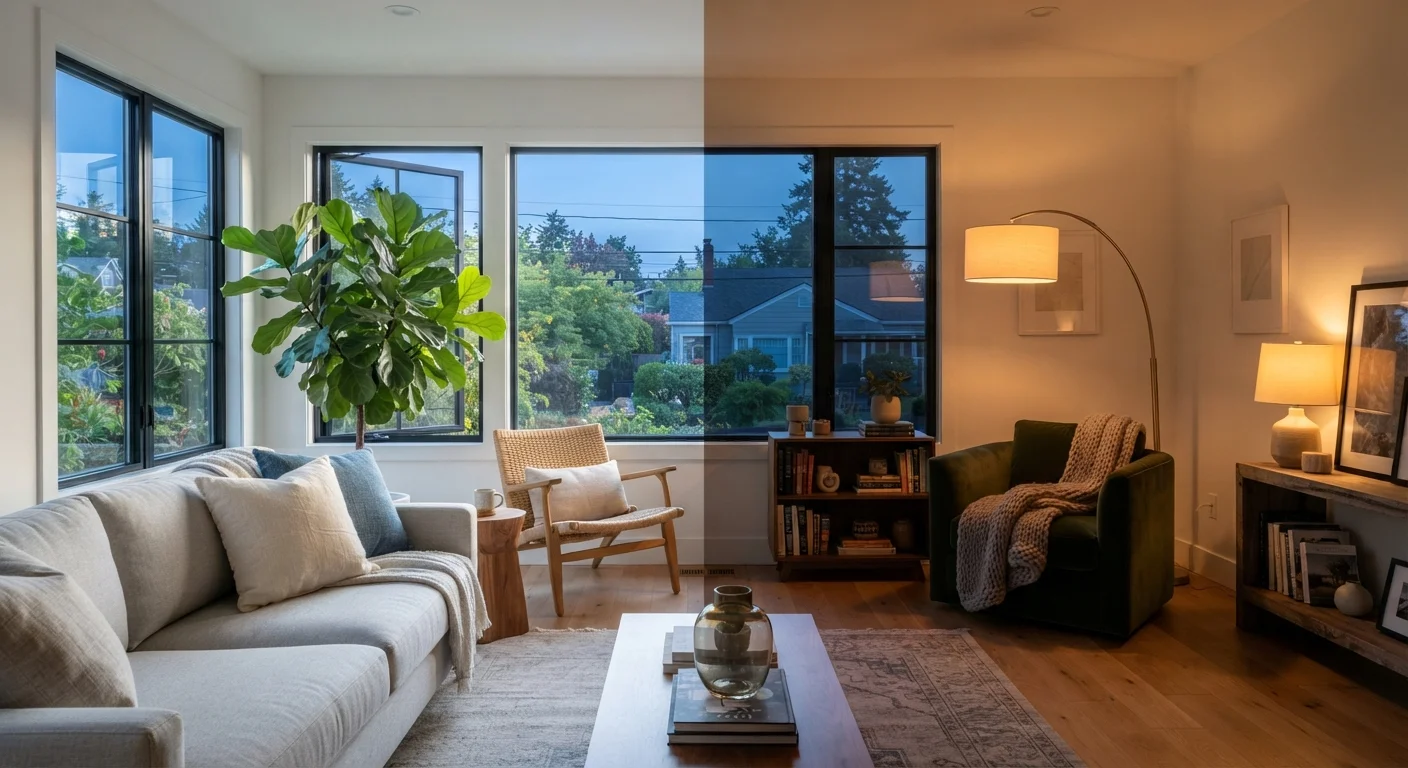
Option A
Natural Light
The dynamic, health-supportive foundation of any well-lit room.
Best for: Homeowners who want an energizing, color-accurate environment that shifts naturally throughout the day.
Option B
Artificial Lighting
The controllable, consistent layer that makes every hour livable.
Best for: Anyone needing reliable, task-specific illumination independent of weather, season, or time of day.
How Each Light Source Actually Works in a Room
Natural light enters a room as a broad-spectrum source that shifts in color temperature and angle across the day. Morning light tends toward cooler, bluer tones; late afternoon shifts warmer and golden. This movement affects how wall colors read, how furniture appears, and how occupants feel - often without anyone consciously noticing. Understanding your room's solar orientation (north-facing rooms stay cooler and more diffuse; south-facing rooms get stronger, more sustained brightness) is the starting point for any lighting decision.
Artificial lighting, by contrast, is entirely human-controlled. It operates on a spectrum from about 2700K (warm, candle-like) to 6500K (cool, daylight-mimicking). Incandescent and warm LED bulbs sit at the lower end, creating intimacy; cool-white and daylight LEDs sit higher, promoting alertness. Understanding color temperature helps explain why a room can feel welcoming under one bulb and clinical under another. See our guide to warm and cool-toned interiors for a deeper look at how these tonal differences play out day to day.
| Criterion | Natural Light | Artificial Lighting |
|---|---|---|
| Availability | Daytime only; weather-dependent | On demand, 24 hours |
| Color accuracy (CRI) | Highest (CRI ~100) | Varies by bulb (CRI 80-98) |
| Color temperature | Shifts throughout the day | Fixed per bulb; dimmable options available |
| Mood impact | Energizing, spacious, uplifting | Customizable from cozy to clinical |
| Cost to add more | High (window/skylight installation) | Low to moderate (fixtures, bulbs) |
| Control | Limited; managed via window treatments | Full control via dimmers and switches |
| UV and heat risk | Can fade fabrics; adds summer heat | LEDs emit minimal UV and heat |
Mood, Function, and the Case for Layering
Neither source alone is sufficient for a well-designed room. Natural light is energizing and beautiful, but it disappears at night, varies with weather, and can cause glare or UV fading on fabrics and flooring. Artificial lighting fills those gaps - but relying solely on a single overhead fixture produces flat, shadowless illumination that reads as institutional rather than comfortable.
The professional approach is layering: ambient lighting (general fill), task lighting (focused and bright for reading, cooking, or work), and accent lighting (directional, highlighting art or architectural features). When layered thoughtfully, artificial lighting complements whatever daylight is present rather than competing with it. This is especially valuable in smaller spaces - our article on decorating a small apartment covers how strategic lighting choices can visually expand a compact room.
~90%
Time Americans spend indoors
According to EPA estimates, Americans spend approximately 90% of their time indoors, making interior lighting a significant factor in daily wellbeing.
2700K-3000K
Ideal bedroom bulb temperature range
Lighting designers generally recommend warm-white bulbs in this Kelvin range for relaxation spaces to support winding down before sleep.
3x
Light reflection gain from mirrors
Interior designers commonly note that a well-placed mirror can effectively multiply perceived natural light levels in a room by reflecting daylight across the space.
Managing Natural Light: Windows, Treatments, and Reflection
Maximizing natural light doesn't always mean removing all window coverings. It means controlling the quality and direction of light entering the room. Sheer curtains diffuse harsh midday sun into soft, even brightness. Reflective surfaces - mirrors, glass-topped tables, high-gloss paint - bounce light into darker corners without adding fixtures. Light-colored walls and ceilings act as secondary light sources by reflecting what comes in through windows.
For rooms where direct sun causes glare or heats the space uncomfortably, curtains and blinds offer different trade-offs in light diffusion, privacy, and aesthetics. North-facing rooms, which receive little direct sun, benefit most from maximizing openness - minimal window coverings, pale finishes, and strategically placed mirrors.
Smart Lighting and Automated Controls
Smart bulbs and dimmable LED systems now allow homeowners to program lighting to shift color temperature throughout the day - warmer in the evening, cooler in the morning - mimicking natural light cycles. These systems can be managed via app or integrated into broader smart home setups. Explore options through our Home Tech & Smart Devices hub if you're considering an automated approach. Always verify electrical compatibility with your existing fixtures before purchasing smart lighting hardware.
Putting It Together: A Room-by-Room Approach
Different rooms call for different balances. Kitchens and home offices benefit from cooler, brighter artificial light (4000-5000K) combined with as much natural light as possible to reduce eye strain. Bedrooms and living rooms typically suit warmer artificial sources (2700-3000K) layered under natural light during the day. Bathrooms are tricky: natural light is flattering for grooming, but most bathrooms have limited windows, making high-quality, color-accurate artificial lighting essential.
When choosing paint colors or finishes, always evaluate swatches under both lighting conditions - the color that looks perfect in the store under fluorescent light may shift significantly in your naturally lit room. Our introduction to color theory for living spaces explains exactly how light interacts with hue and saturation so your color choices hold up at all hours. And if you've ever heard that certain rules - like "dark colors make a room feel small" - apply universally, our piece on decorating myths that lead homeowners astray offers a useful reality check on how lighting changes everything.
The content on this site is for informational purposes only and is not a substitute for professional advice. Always consult a qualified professional for guidance specific to your situation.