
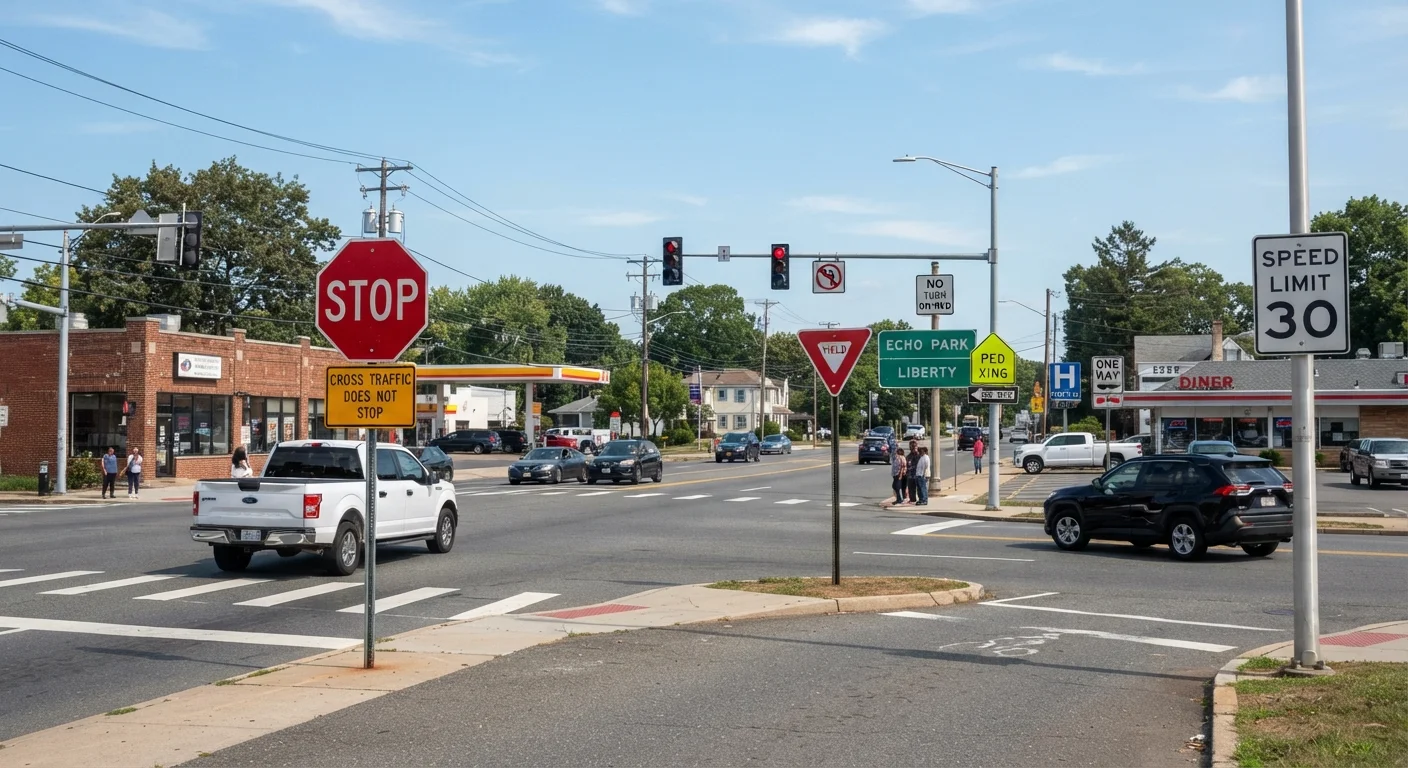
The Logic Behind Road Sign Design
US road signs are not designed arbitrarily. Every shape and color combination follows a standardized system governed by the Manual on Uniform Traffic Control Devices (MUTCD), published by the Federal Highway Administration (FHWA). This national standard ensures that a driver crossing state lines encounters the same visual language they learned at home.
The system works on two layers: shape communicates urgency and category at a glance - even before you can read the text - while color narrows down the type of message. Understanding both layers gives you a significant advantage in low-visibility conditions, unfamiliar areas, and high-speed driving situations.
| Governing standard | Manual on Uniform Traffic Control Devices (MUTCD) (Federal Highway Administration) |
| Number of distinct sign colors | 8 official colors (MUTCD, current edition) |
| Shape reserved for STOP | Octagon - used for no other US sign (MUTCD) |
| Shape used for warnings | Diamond (MUTCD) |
| Color for construction zones | Orange (MUTCD) |
| Color for motorist services | Blue (MUTCD) |
Just as your vehicle's onboard alerts have a consistent visual grammar, so does the road itself. For an inside look at vehicle-level warnings, see our dashboard warning lights guide.
Sign Shapes and What Each One Signals
Shape is the fastest cue your brain processes when approaching a sign. Here is what each shape communicates:
MUTCD
The Manual on Uniform Traffic Control Devices is the federal standard that defines design, placement, and meaning of all traffic signs, signals, and pavement markings in the United States. It is published and maintained by the Federal Highway Administration.
Regulatory sign
A sign that communicates a legally enforceable rule drivers must follow, such as speed limits, turn prohibitions, or lane assignments. Violations can result in traffic citations.
Warning sign
A sign that alerts drivers to upcoming hazards or changing road conditions. These are advisory in nature but ignoring them can significantly increase crash risk.
Advisory speed
A recommended speed shown on a supplemental plaque below a warning sign, indicating a safe speed for a specific condition such as a curve. Advisory speeds are not legally enforceable limits.
Guide sign
A sign providing directional, distance, or destination information to help drivers navigate. Guide signs are typically green or brown and do not impose legal requirements.
- Octagon (8 sides): Reserved exclusively for the STOP sign. No other US road sign uses this shape, making it identifiable even when obscured by snow or damage.
- Equilateral triangle (point down): Used only for YIELD. The inverted triangle is internationally recognized as a give-way indicator.
- Diamond: Warning signs. These alert drivers to road conditions, hazards, or changes ahead - such as curves, merges, or pedestrian crossings.
- Rectangle (vertical): Regulatory signs that communicate rules drivers must follow, including speed limits, turn restrictions, and lane controls.
- Rectangle (horizontal): Guide signs providing directional, distance, or informational data.
- Pentagon (5 sides, point up): School zone and school crossing advance warning signs.
- Crossbuck (X shape): Marks railroad grade crossings.
Because shape encodes meaning independently of text, learning the shapes allows you to react appropriately even when a sign's lettering is faded or partially blocked.
Sign Colors and Their Meanings
Color adds a second layer of meaning, narrowing the category of information each sign conveys:
8
Official road sign colors in the US
The FHWA's MUTCD defines eight distinct background colors, each tied to a specific category of road information.
1 shape
Reserved exclusively for STOP signs
The octagon is used for no other sign type in the US road sign system, ensuring instant recognition even under adverse conditions.
50 states
Required to follow MUTCD standards
Federal law requires all states to adopt the MUTCD, creating a uniform sign language across every US roadway.
- Red: Prohibition or a required stop - Stop, Yield, Do Not Enter, Wrong Way.
- Yellow: General warning. Yellow diamond signs alert you to upcoming conditions requiring caution.
- Orange: Temporary traffic control - construction zones, detours, and road work areas. Treat orange signs with the same urgency as yellow.
- Green: Guide information such as highway exits, distances, and street name signs.
- Blue: Motorist services - rest areas, fuel, food, lodging, and hospitals accessible from the roadway.
- Brown: Recreational areas and cultural points of interest such as national parks and scenic routes.
- White: Regulatory information, including speed limit signs and lane-use controls.
- Fluorescent yellow-green: High-visibility warning for pedestrian crossings, school zones, and bicycle routes.
Pairing shape and color gives you a near-complete message before you read a single word. A yellow diamond means road hazard ahead. A red octagon means stop - without exception.
Understanding posted speed limits is closely tied to reading sign colors correctly. Learn how speedometer data and posted signs work together for safer driving decisions.
Common Sign Combinations Drivers Misread
Even experienced drivers occasionally misinterpret certain sign combinations. A few worth knowing:
- Flashing yellow vs. flashing red: A flashing yellow light means proceed with caution; a flashing red means treat the intersection as a full stop.
- White rectangle with black text: These are regulatory - rules you must follow, not suggestions. Speed limit signs fall into this category.
- Yellow vs. fluorescent yellow-green: Standard yellow warns of general hazards; the brighter fluorescent version specifically marks school zones and pedestrian crossings and may be mounted on a pentagon-shaped sign.
- Advisory speed plaques: Small yellow signs below warning signs showing a speed (e.g., "25 MPH" on a curve) are advisory, not legally enforceable limits - though ignoring them in poor conditions significantly increases crash risk.
Advisory Speeds Are Not Posted Limits
Small yellow plaques showing a speed below a warning sign - such as on a sharp curve - indicate a recommended safe speed for that specific condition. They are not the same as white regulatory speed limit signs and are not legally enforceable in the same way. That said, driving faster than an advisory speed in poor weather or on unfamiliar roads substantially increases your risk of losing control.
Drivers who decode tire sidewall markings apply similar pattern-recognition skills to vehicle information. See how to read a tire sidewall for another layer of road-safety literacy.
The content on this site is for informational purposes only and is not a substitute for professional advice. Always consult a qualified professional for guidance specific to your situation.