
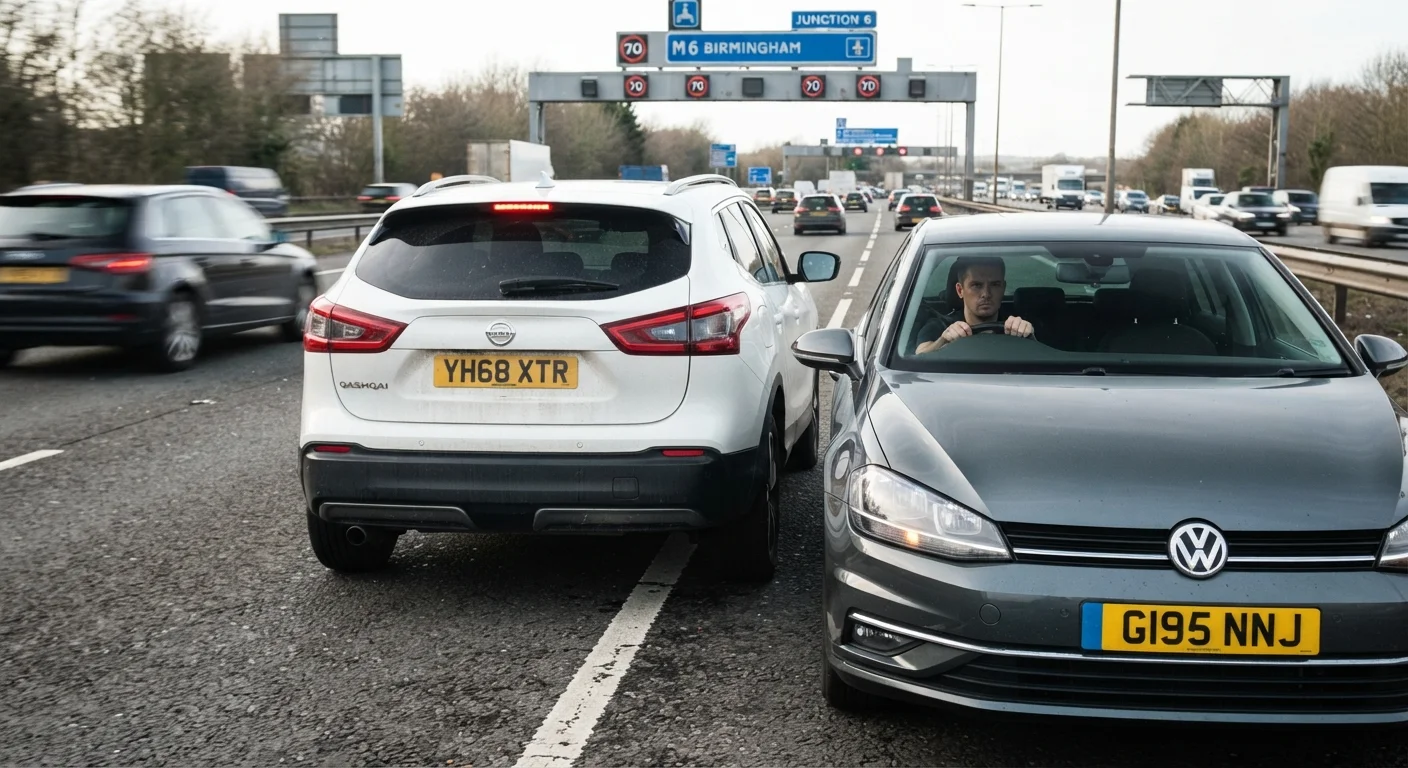
Why Following Distance Matters More Than You Think
Most drivers focus on speed when thinking about road safety - yet the gap between your vehicle and the one ahead is equally critical. Following too closely, commonly called tailgating, eliminates the buffer you need to respond to sudden braking, debris, or a collision ahead. Because crashes unfold in fractions of a second, even a small reduction in that gap can mean the difference between stopping safely and a rear-end impact.
Federal crash data consistently identifies rear-end collisions as one of the most common crash types on U.S. roads. A significant portion of those crashes involve inadequate following distance. Understanding the science - and the common mistakes drivers make - is the foundation of defensive driving that genuinely reduces risk.
~33%
Of all U.S. crashes involve rear-end impacts
According to NHTSA data, rear-end collisions consistently represent roughly one-third of all traffic crashes reported in the United States.
1.5 sec
Average driver perception-reaction time
Research in traffic safety engineering commonly cites 1.5 seconds as a typical perception-reaction time - meaning a tailgating driver may begin braking after the gap is already gone.
Common Tailgating Mistakes and How to Correct Them
Tailgating rarely stems from a single bad habit. It reflects several distinct errors in judgment, habit, and environmental awareness. Recognizing each one is essential before any driver can reliably correct their following distance.
Using a distance-based gap instead of a time-based one.
Why it happens: Drivers often estimate safety by car lengths, but a fixed physical gap means much less at highway speeds than at city speeds.
Unconsciously closing the gap when traffic compresses.
Why it happens: In heavy traffic, gaps fill quickly and drivers instinctively match the flow without actively monitoring their following distance.
Maintaining the same gap regardless of road conditions.
Why it happens: Drivers calibrate their sense of a 'safe' distance in familiar, favorable conditions and don't adjust when weather or visibility changes.
Tailgating while distracted, without realizing the gap has shrunk.
Why it happens: Cognitive distraction - including phone use - redirects attention from ongoing gap management. The driver may not notice they've crept too close until braking becomes urgent.
Assuming the vehicle ahead will brake predictably.
Why it happens: Drivers build a mental model of 'normal' braking based on routine driving and underestimate how abruptly a vehicle can stop in an emergency.
Conditions That Make Following Distance Even More Critical
The three-second rule - picking a fixed roadside marker and counting three seconds from when the vehicle ahead passes it to when you do - is a widely taught minimum under dry, daylight, good-weather conditions. That baseline must expand significantly whenever road conditions change.
Wet pavement can double stopping distance. Ice or packed snow can increase it fourfold or more. Poor visibility, whether from rain, fog, or darkness, compounds the problem because hazards appear later in your field of view. Night driving introduces unique hazards that push the safe following gap well beyond the three-second baseline.
Fatigue is another underappreciated variable. A tired driver's reaction time can degrade to the point where even a generous gap becomes insufficient. Drowsy driving impairs judgment in ways that interact directly with following distance - a driver who can't react quickly needs more space, not less.
Adjust Your Gap for Every Condition Change
The three-second rule applies only under ideal conditions - dry pavement, good visibility, and an alert driver. In rain, fog, or heavy traffic, experts recommend extending that gap to four to six seconds or more. On ice or snow, even that may not be sufficient. Never treat a fixed time gap as a universal standard regardless of conditions.
Also consider the vehicle you're driving. Larger, heavier vehicles require longer stopping distances than passenger sedans. If you've recently switched from a compact car to a truck or SUV, your previous following distance habits may no longer be adequate. Keeping your vehicle's brakes and tires in good condition is equally important - visit our car maintenance hub for practical guidance on keeping your stopping systems reliable.
Distraction plays a compounding role. Cognitive load - including hands-free phone conversations - delays the moment a driver perceives a hazard, effectively shrinking the usable gap. Safe following distance and attentive driving are not separate practices; they reinforce each other.
The content on this site is for informational purposes only and is not a substitute for professional advice. Always consult a qualified professional for guidance specific to your situation.