
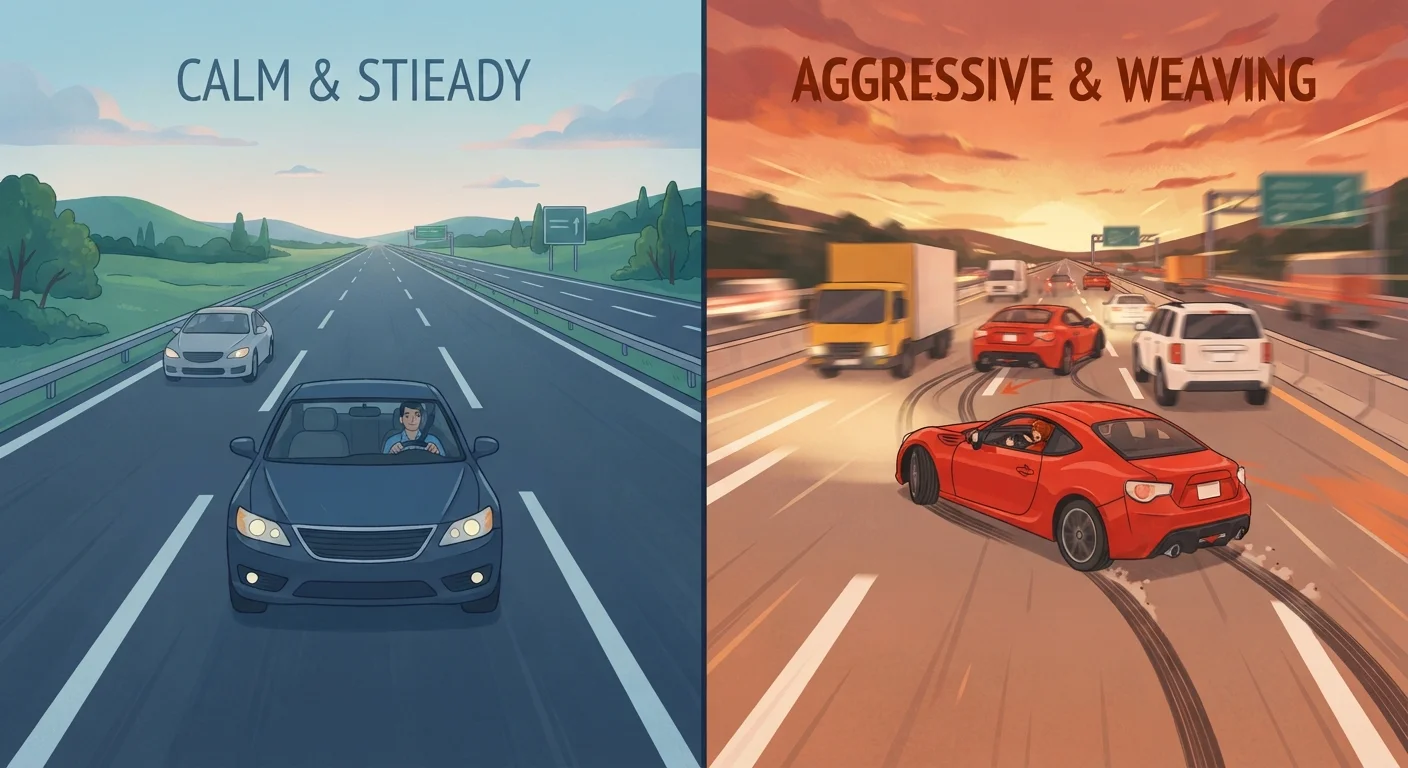
Option A
Defensive Driving
The calculated, anticipatory approach to road safety.
Best for: Drivers who want to reduce crash risk, protect passengers, and stay in control across all road conditions.
Option B
Aggressive Driving
The high-risk, reactive style that increases danger for everyone nearby.
Best for: No responsible use case - understanding it helps drivers recognize and avoid its patterns.
Defining Each Approach
Defensive driving is a set of techniques designed to reduce crash risk by anticipating hazards before they develop. A defensive driver maintains a safe following distance, scans the road well ahead, checks mirrors frequently, and continuously adjusts speed and position to account for other road users - including those making mistakes. The approach treats unpredictability as the norm rather than the exception.
Aggressive driving, by contrast, is characterized by behaviors that prioritize speed or personal frustration over safety. The National Highway Traffic Safety Administration (NHTSA) defines aggressive driving as operating a vehicle in a manner that endangers or is likely to endanger persons or property. Common patterns include excessive speeding, unsafe following distances, abrupt lane changes, running red lights, and blocking other drivers. These behaviors are reactive and often emotionally driven.
The difference isn't just philosophical - it's measurable in outcomes. Defensive drivers are positioned to respond; aggressive drivers force others to respond to them.
Key Behavioral Differences Side by Side
Comparing the two styles across specific driving decisions illustrates just how different they are in practice:
| Criterion | Defensive Driving | Aggressive Driving |
|---|---|---|
| Following distance | 3+ seconds; expands in poor conditions | Minimal; often tailgating |
| Speed management | Adjusted to conditions and flow | Frequently exceeds posted limits |
| Lane changes | Signaled, deliberate, with clear gaps | Abrupt, minimal signaling |
| Reaction to others' errors | Anticipated; space already created | Reactive; limited margin for error |
| Emotional state | Calm and focused | Often frustrated or impatient |
| Intersection behavior | Scans before entry; yields when uncertain | May run yellow/red lights |
| Crash risk | Reduced through habit and anticipation | Elevated; multiple compounding factors |
Each of these behaviors compounds risk. Tailgating, for instance, dramatically reduces stopping time - a problem explored in depth in our look at following distance science. Aggressive drivers often underestimate how quickly multiple unsafe choices stack into a crash scenario.
The Real-World Consequences of Aggressive Driving
Aggressive driving is not a minor annoyance - it is a documented public safety problem. According to NHTSA data, speeding alone has consistently contributed to roughly one-third of all US traffic fatalities in recent years. Behaviors like running red lights and unsafe lane changes add further to that toll.
~33%
Of US traffic fatalities linked to speeding
NHTSA data consistently shows speeding as a factor in roughly one-third of annual US traffic deaths.
66%
Of drivers who report experiencing aggressive driving
A AAA Foundation for Traffic Safety survey found two-thirds of drivers considered aggressive driving a serious threat to personal safety.
7 seconds
Average time saved by aggressive highway tactics
Research suggests aggressive lane-changing on congested highways yields minimal time gains while significantly raising crash exposure.
Beyond crash risk, aggressive driving can escalate into road rage - a pattern with its own psychological roots and legal consequences. Our related guide on what triggers road rage and how to stay calm explains how frustration behind the wheel becomes dangerous, and what drivers can do before that line is crossed.
Legally, aggressive driving can result in traffic citations, license suspension, increased insurance costs, and - in cases involving injury - criminal charges. The financial and personal stakes extend well beyond the immediate moment on the road.
Building Defensive Habits That Stick
Defensive driving isn't an innate talent - it's a practiced discipline. A few core habits form its foundation:
- Maintain a minimum three-second following gap under normal conditions, expanding to four or more seconds in wet or low-visibility situations.
- Scan 10-15 seconds ahead on open roads and through intersections, not just the car directly in front of you.
- Anticipate the errors of others - assume a merging driver may not see you, that a pedestrian may step off the curb unexpectedly.
- Manage your own emotional state. Fatigue, stress, and distraction impair judgment just as surely as they affect reaction time. Our article on drowsy driving risks highlights how impairment can creep in unnoticed.
These habits apply differently across environments. Urban streets demand heightened attention to pedestrians and stop-and-go patterns, while rural roads bring sightline and speed challenges of their own - a contrast covered in detail in our urban vs. rural driving comparison.
Driving risk also shifts with life stage. Teen drivers building habits, middle-aged commuters managing stress, and older adults adapting to changing reaction times each face unique challenges covered in our guide on safe driving across every life stage.
Defensive driving doesn't guarantee immunity from accidents - no approach can - but it consistently and meaningfully reduces exposure to the conditions in which crashes occur.
The content on this site is for informational purposes only and is not a substitute for professional advice. Always consult a qualified professional for guidance specific to your situation.