
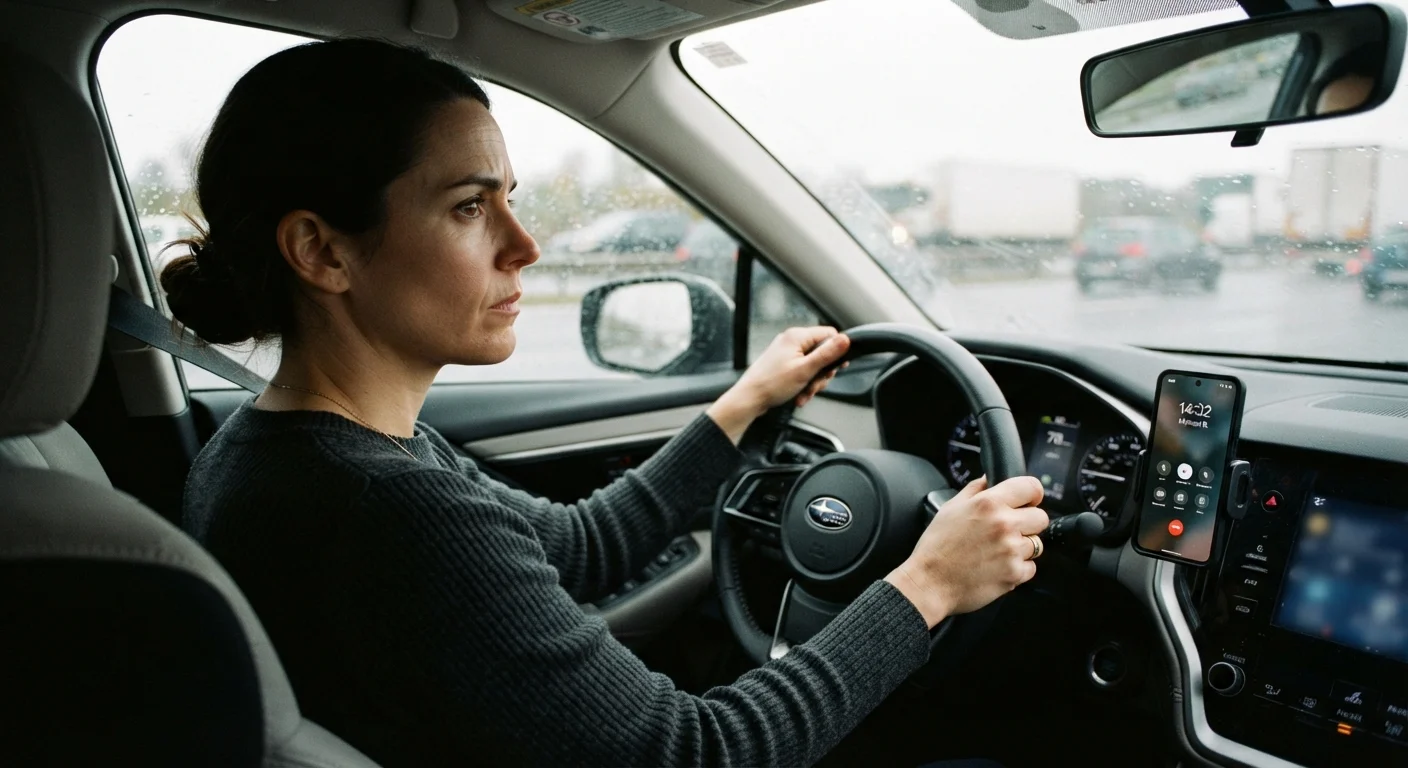
Why the Hands-Free Assumption Feels So Logical
The reasoning seems airtight: if your hands are on the wheel and your eyes are on the road, you must be driving safely. This intuition is why hands-free calling became the widely accepted compromise when concerns about phone use behind the wheel emerged. It is also, research suggests, largely incorrect.
Driving safety involves three distinct demands - manual (physical control), visual (where your eyes point), and cognitive (where your mind is focused). Hands-free technology addresses only the first. The other two remain vulnerable every time a phone conversation begins.
Understanding this distinction matters for every driver. Driving risk shifts across a lifetime, but cognitive distraction affects attention regardless of experience level.
Myth
As long as my hands are on the wheel, talking on the phone is safe.
Fact
Hands-free calls still impose significant cognitive load, reducing hazard detection and reaction time.
Manual control is only one component of safe driving. Cognitive attention - the brain's capacity to process road conditions in real time - is heavily taxed during any phone conversation, regardless of how the call is handled physically. Studies show that drivers engaged in phone conversations can miss visual cues they appear to be looking directly at, a phenomenon called inattention blindness.
Myth
Talking to a passenger is just as distracting as a phone call, so there's no real difference.
Fact
Passenger conversations are generally less distracting because passengers naturally pause during hazards and share the driver's visual context.
A passenger in the vehicle can see traffic conditions and instinctively stop talking when a complex situation arises. A remote caller has none of that shared awareness - they continue speaking regardless of what's happening on the road. Research has consistently found this distinction makes passenger conversation meaningfully less disruptive than phone conversations in comparable conditions.
Myth
If hands-free calling were truly dangerous, it would already be illegal everywhere.
Fact
Law reflects political and practical compromise, not always the current state of safety research.
Most US states restrict or ban handheld phone use while driving, but relatively few extend that prohibition to hands-free calls. Legislation often lags behind research, and enforcement of cognitive distraction is inherently difficult. Legal permissibility does not equal safety. Drivers should not treat the absence of a law as evidence that a behavior is risk-free.
Myth
Experienced drivers can handle the distraction better than new drivers.
Fact
Experience reduces some driving errors but does not meaningfully protect against cognitive distraction.
Experienced drivers do automate certain physical tasks - lane-keeping, smooth braking - more efficiently than beginners. However, cognitive distraction research shows that attention is not a skill that scales with experience in the same way. When mental bandwidth is occupied by a phone conversation, hazard detection slows in both novice and experienced drivers. Overconfidence in one's own ability to multitask is itself a documented risk factor.
Myth
Voice-to-text and in-car assistants eliminate the distraction problem entirely.
Fact
Voice-activated systems reduce manual and visual demand but still create measurable cognitive distraction.
Composing or listening to messages using voice commands still requires the brain to formulate language, monitor system responses, and process the content of communication. Studies examining in-car voice systems have found they reduce - but do not eliminate - cognitive load compared to handheld interaction. Complex voice interactions, such as correcting errors or navigating menus verbally, can actually rival the distraction of a manual task.
The Science Behind Cognitive Distraction
Researchers use the term cognitive distraction to describe the mental load that pulls attention away from driving even when a driver appears to be watching the road. Studies from institutions including the AAA Foundation for Traffic Safety and the National Safety Council have documented that phone conversations - handheld or hands-free - measurably reduce a driver's ability to detect hazards, process traffic signals, and react in time.
One key finding: drivers on phone calls tend to develop what researchers call inattention blindness, where the eyes scan the road but the brain fails to register and process what they see. This is different from glancing at a screen. The distraction is internal, making it harder to self-diagnose in the moment.
~20%
Slower reaction times during phone calls
Research cited by the National Safety Council estimates reaction time can slow by roughly 20% during phone conversations, affecting braking distance and hazard response.
4x
Crash risk increase while using a phone
The National Safety Council reports that drivers using cell phones - handheld or hands-free - are approximately four times more likely to be involved in a crash.
37%
Of US drivers admit to phone use while driving
AAA Foundation for Traffic Safety surveys have consistently found a significant share of drivers acknowledge using a phone while driving despite knowing the risks.
Fatigue compounds the problem significantly. Impaired attention from a late-night call combines poorly with reduced alertness - an intersection explored in our look at drowsy driving risks. Similarly, following distance becomes critical when reaction time is already slowed by distraction.
Hands-Free Is Not the Same as Risk-Free
Many drivers rely on hands-free calling as a safe alternative, but cognitive distraction persists regardless of how a call is handled physically. If you find yourself losing track of your surroundings during a call - missing exits, feeling surprised by traffic ahead - treat that as a signal to end the conversation. No call is worth a collision.
What Drivers Can Actually Do
Awareness is only useful if it leads to changed behavior. A few practical approaches can meaningfully reduce phone-related distraction without requiring you to be unreachable at all times.
- Use Do Not Disturb While Driving modes. Most smartphones include a setting that automatically silences notifications and calls while the device detects movement. Enabling this removes the temptation to engage.
- Pull over when a call cannot wait. If a conversation is genuinely urgent, find a safe place to stop rather than continuing to drive. The discomfort of the detour is far less consequential than the alternative.
- Let calls go to voicemail. Most non-emergency calls can wait five or ten minutes. Voicemail exists precisely for this situation.
- Inform regular callers of your policy. Setting an expectation with family or coworkers that you won't take calls while driving removes social pressure in the moment.
Night driving already reduces reaction margins considerably - adding phone distraction in low-visibility conditions compounds the risk further.
This article is for informational and educational purposes only. Driving safety guidance reflects general research findings and does not substitute for applicable traffic laws in your state, which vary. Always consult your state's DMV or a legal professional for jurisdiction-specific rules.
The content on this site is for informational purposes only and is not a substitute for professional advice. Always consult a qualified professional for guidance specific to your situation.