

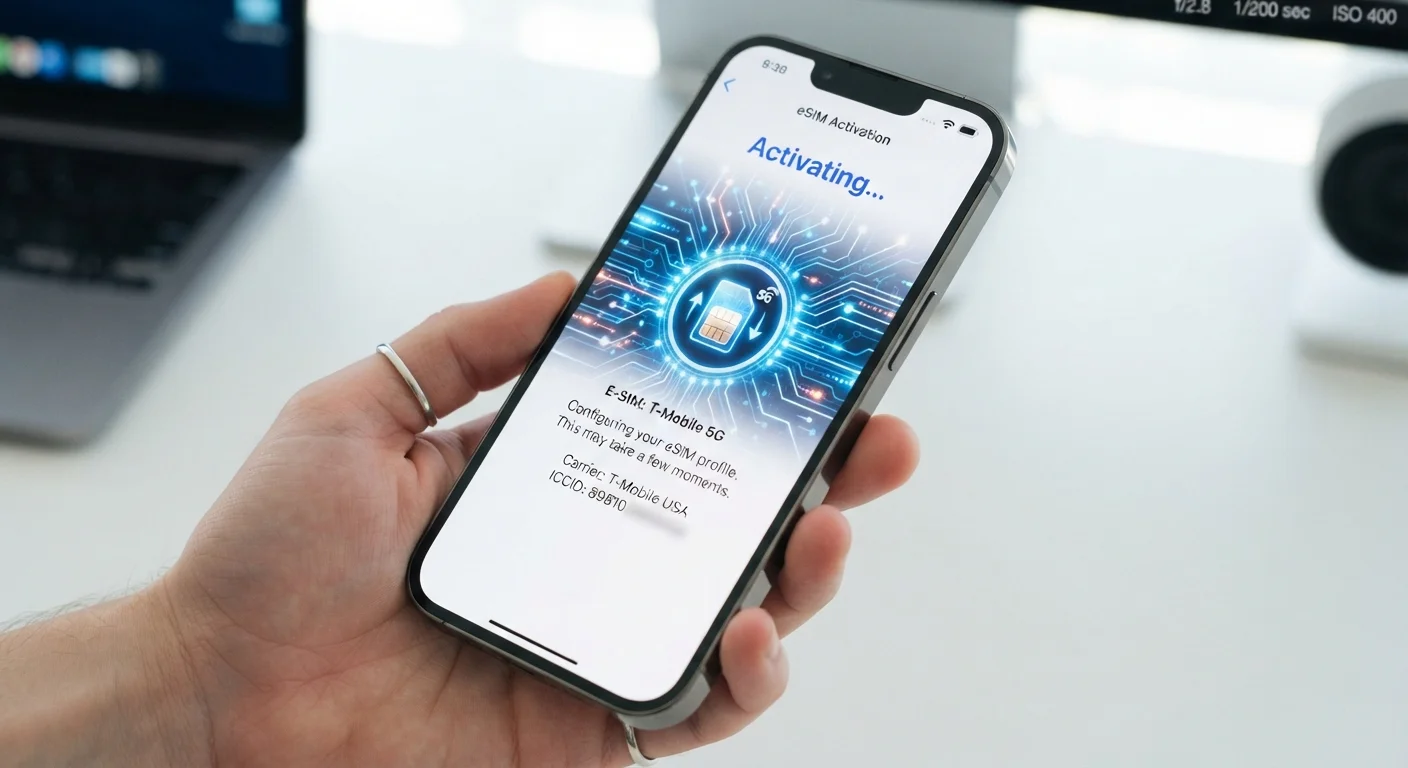
How eSIM Works Under the Hood
A traditional SIM card is a small removable chip programmed with your carrier's network credentials. When you switch carriers or travel, you physically swap it out. An eSIM replaces that removable chip with a permanently soldered component inside your device - but the key difference is that its programming is entirely software-based.
When you sign up with a carrier that supports eSIM, they provide a carrier profile - essentially a secure digital package of credentials. You download this profile either by scanning a QR code, using a carrier app, or navigating through your device's settings. Once downloaded, your device registers with the carrier's network just as it would with a physical card.
The embedded chip itself, called an eUICC (embedded Universal Integrated Circuit Card), can hold multiple carrier profiles at once. You choose which one is active, and switching is handled entirely in your phone's settings menu - no tools, no tray, no card to misplace.
eSIM and Device Locking
An eSIM profile downloaded from one carrier will not automatically work with another carrier if your device is locked. Carrier-locked devices restrict which network credentials can be activated, regardless of whether they use a physical SIM or eSIM. Contact your carrier to unlock your device before attempting to activate a competing carrier's eSIM profile.
Which Devices Support eSIM
eSIM support has become standard across most flagship smartphones, cellular-capable tablets, smartwatches, and even some laptops. The technology is also appearing in an expanding range of connected devices - a trend that fits naturally alongside the broader shift toward software-defined hardware that you can read about in our smartphone specs guide.
Smartwatches were among the earliest consumer devices to adopt eSIM, since their compact form left no room for a SIM card tray. Cellular-connected tablets followed, and flagship phones began broadly incorporating eSIM support in the late 2010s. Some device models released in certain markets are eSIM-only, with no physical SIM tray at all.
To verify whether your device supports eSIM, check its technical specifications or navigate to the cellular settings menu. Carrier compatibility is a separate consideration - even if your hardware supports eSIM, your carrier must also offer eSIM provisioning for your specific plan.
Over 200
Carriers worldwide offering eSIM support
According to GSMA intelligence data, eSIM-capable networks have expanded significantly across North America, Europe, and Asia-Pacific regions.
2 profiles
Typical simultaneous active eSIM profiles per device
Most consumer smartphones with dual SIM support allow one active eSIM profile alongside one physical SIM, though some models support two simultaneous eSIM profiles.
Minutes
Time to activate a new carrier plan via eSIM
Carrier profile downloads are typically completed in under five minutes, compared with days for physical SIM delivery by mail.
When eSIM Makes a Real Difference
For most everyday domestic users, eSIM and a physical SIM deliver an equivalent experience. The practical advantages become clear in specific situations:
- International travel: Instead of hunting for a local SIM card at an airport kiosk, you can purchase and activate a local data plan remotely before or after landing - directly from your phone.
- Dual-number setups: Running a personal and a work number on one device without carrying two phones is straightforward with eSIM-plus-physical-SIM or dual-eSIM configurations.
- Quick carrier switching: If you want to trial a different carrier, you can activate a new profile without committing to a physical card - and revert just as easily.
- Device size constraints: For compact wearables and ultra-thin devices, eliminating the SIM tray frees up meaningful internal space for battery or other components.
It's worth understanding that eSIM is fundamentally a connectivity management tool. Like the distinction between local and cloud-dependent processing explored in our guide to local vs. cloud-dependent devices, the underlying network infrastructure still determines real-world performance.
Traveling Internationally? Plan Your eSIM in Advance
Research eSIM-compatible local carriers for your destination before you travel. Many regional carriers and travel data providers allow you to purchase and download a profile days ahead of your trip. Having a plan ready before departure saves time and avoids roaming charges from the moment you land.
Limitations and Practical Considerations
eSIM is not without trade-offs. Not every carrier in the US supports eSIM provisioning for every plan type - prepaid plans, in particular, have slower eSIM adoption than postpaid contracts. Always confirm eSIM availability with your specific carrier and plan before assuming it's an option.
Transferring an eSIM profile between devices requires deliberate steps and sometimes a call to customer service - it isn't as seamless as physically moving a SIM card. If you frequently switch between devices, this adds friction.
There's also a consideration around device resale. Some buyers prefer physical SIM compatibility, and in some regions, eSIM-only devices may have limited carrier support. Researching local carrier ecosystems before purchasing an eSIM-only device is a reasonable precaution, particularly when buying internationally.
Finally, while eSIM adds a layer of physical security against SIM theft, it doesn't eliminate the risk of account-level SIM-swapping attacks - a form of fraud where an attacker convinces a carrier to transfer your number. Strong account security practices with your carrier remain essential regardless of SIM type.
Frequently Asked Questions
Not all smartphones support eSIM. Most flagship and mid-range devices released in recent years include it, but budget phones and some regional models may not. Check your device's specifications or contact your carrier to confirm compatibility.
Yes. Many eSIM-capable phones support Dual SIM functionality, letting you run one eSIM profile alongside a physical SIM - or two eSIM profiles simultaneously. This is useful for separating personal and work numbers on a single device.
Yes, switching carriers with an eSIM is done entirely through software. You download a new carrier profile, and the transition is usually complete within minutes. Your device must be unlocked to use a different carrier's profile.
Your carrier profile is linked to your account, not just the device. If you lose your phone, contact your carrier to transfer the eSIM profile to a replacement device. The process is similar to requesting a new SIM card from your carrier.
Coverage depends entirely on the carrier you choose, not the eSIM technology itself. An eSIM simply gives you a flexible way to connect to a carrier's network - the quality of that network is the carrier's responsibility.
eSIM offers some security advantages: it cannot be physically removed and used in another device without authorization, making SIM-swapping fraud somewhat harder. However, account-level security practices at the carrier remain equally important.
The content on this site is for informational purposes only and is not a substitute for professional advice. Always consult a qualified professional for guidance specific to your situation.