

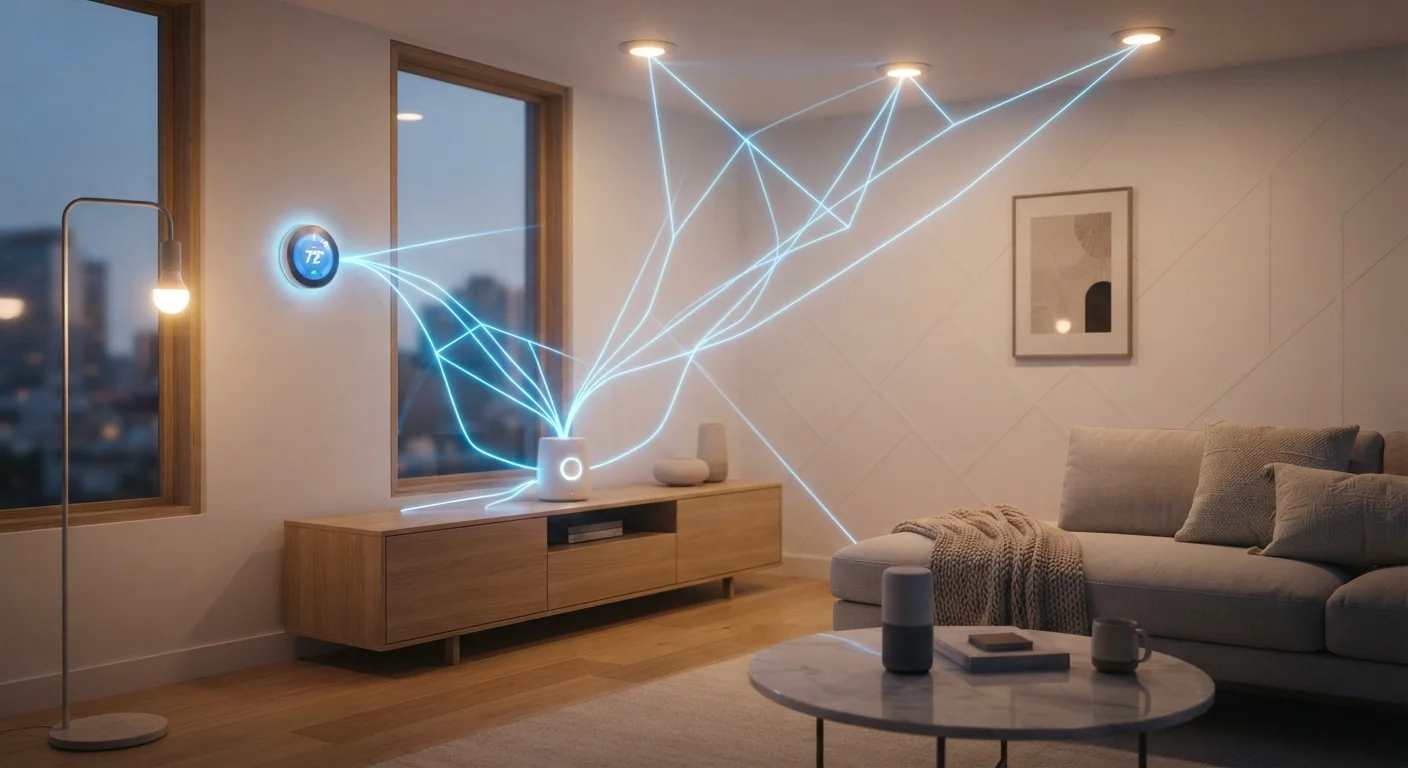
Why Matter Exists: The Fragmentation Problem
Before Matter, the smart home market was a patchwork of competing ecosystems. A bulb optimized for one platform often wouldn't cooperate with a hub from another brand. Shoppers had to research compatibility before every purchase, and switching platforms meant starting over. The result was a frustrating experience that slowed mainstream adoption.
Matter emerged from an industry-wide effort to solve exactly that. The Connectivity Standards Alliance - whose members include major tech and device companies - released Matter 1.0 in late 2022 after several years of development. The standard establishes a shared application layer so certified devices can communicate without proprietary middleware getting in the way.
For consumers, the practical payoff is simpler shopping and fewer dead ends. If a product carries the Matter certification mark, it's designed to work with any Matter-compatible controller, whether that's a dedicated hub, a smart speaker, or a smartphone app. See our smart home ecosystems explainer for broader context on how platforms interconnect.
1.0
Initial Matter specification version released
Matter 1.0 was published by the Connectivity Standards Alliance in October 2022 after multi-year development.
280+
CSA member companies backing Matter
The Connectivity Standards Alliance, which governs Matter, includes hundreds of technology and device companies as members.
4
Core transport protocols Matter supports
Matter runs over Wi-Fi (2.4 GHz and 5 GHz), Thread, and Ethernet - covering most home network configurations.
How Matter Actually Works
Matter is an application-layer protocol - it defines how devices describe themselves and communicate commands, not how the signal physically travels through your home. The actual transmission happens over Wi-Fi, Thread (a low-power mesh protocol), or wired Ethernet. Matter works on top of whichever transport is available.
Every Matter device is assigned a cryptographic certificate at the point of manufacture. When you add the device to your network, your controller verifies that certificate before pairing is allowed. This device-attestation process is one reason Matter is considered more secure than older pairing approaches that relied on simple passcodes.
A standout feature is multi-admin: a single Matter device can be registered with more than one platform simultaneously. You could control a lock through one app and have it accessible through a different voice assistant - without buying two separate devices. For households that use mixed ecosystems, this matters considerably.
For a deeper look at the mesh networking technology that often underpins Matter, see our Thread vs. Zigbee comparison.
Check for the Matter Certification Mark
When shopping for smart home devices, look for the Matter logo on packaging or product listings. The Connectivity Standards Alliance maintains a publicly searchable registry of certified devices at csa-iot.org, which lets you verify compliance independently of marketing claims.
What Matter Doesn't Cover - Yet
Matter's scope at launch was deliberately focused. The 1.0 specification covered lights, plugs, locks, thermostats, window coverings, and a handful of other categories. Security cameras, video doorbells, robot vacuums, and most major appliances were not included in the first release, though subsequent specification versions have begun to expand that list.
Matter also doesn't automatically make your existing devices compatible. Legacy products running Zigbee, Z-Wave, or proprietary Wi-Fi protocols remain on their original systems. Some hub manufacturers have introduced Matter bridges that translate between protocols, allowing older devices to appear on a Matter network - but bridge support is inconsistent and not every device category is covered.
It's also worth noting that Matter governs local communication - the exchange of commands between devices on your home network. Cloud services, subscription features, and remote access are still handled separately by each manufacturer, so platform-specific experiences haven't disappeared entirely.
Matter Bridges: A Partial Solution
Some smart home hubs can act as Matter bridges, translating commands from legacy Zigbee or Z-Wave devices into Matter-compatible signals. This can extend the life of existing devices, but bridge implementations vary in stability and supported device types. Treat bridging as a transitional tool rather than a permanent long-term solution.
Where Adoption Stands and What to Expect
Matter adoption has grown steadily since the 1.0 release, with a meaningful and expanding catalogue of certified devices across lighting, sensors, and access control. Major hub and controller platforms have released software support, and device manufacturers - from large consumer electronics names to smaller specialty makers - have brought certified products to market.
Subsequent Matter specification versions have added device categories and refined existing ones, a sign the standard is maturing rather than stagnating. The CSA publishes a public registry of certified devices, which gives consumers a way to verify compliance before purchasing.
If you're planning a smart home from the ground up, Matter-compatible devices are worth prioritizing where available - they offer more flexibility as your setup evolves. For a structured approach to building that foundation, our first smart home guide walks through sequencing decisions in practical terms.
“The goal of Matter is straightforward: a device should just work, regardless of which ecosystem a consumer has chosen. Interoperability shouldn't be a premium feature - it should be the baseline.”
— Tobin Richardson, President and CEO, Connectivity Standards Alliance
For definitions of terms like Thread, Zigbee, and hub that come up when researching Matter, the Smart Home Glossary is a useful companion resource.
Frequently Asked Questions
No. Matter-certified devices work alongside older ones, though legacy devices won't gain Matter capabilities automatically. Some smart home hubs offer bridging features that allow older devices to appear on a Matter network, but support varies by manufacturer.
Yes. Matter was built with cross-platform compatibility as a core goal, and all three major platforms have announced or released Matter support. A single Matter device can be added to multiple platforms simultaneously through the multi-admin feature.
No. Thread is a low-power mesh networking protocol that Matter can run on, but Matter also supports Wi-Fi and Ethernet. Think of Thread as a transport layer and Matter as the application language running on top of it.
Matter's initial scope includes smart lights, plugs, locks, thermostats, blinds, sensors, and TVs, among others. Cameras, robot vacuums, and certain appliances are on the roadmap but were not fully supported at launch.
Some manufacturers have issued firmware updates to add Matter support to existing devices, but this is not universal. Check with the device maker to see whether a specific model is eligible for a Matter update.
The content on this site is for informational purposes only and is not a substitute for professional advice. Always consult a qualified professional for guidance specific to your situation.