

Exercise That Doesn't Feel Like Work
Here's a secret most fitness articles won't tell you: if you're having fun, you're probably moving more than you think. Research consistently supports the idea that enjoyment is one of the strongest predictors of long-term physical activity adherence. In other words, the workout you actually want to do beats the one you dread every single time.
That's where outdoor recreation earns its stripes. Whether you're a weekend warrior or someone who hasn't set foot in a gym since high school, there's a nature-based activity that can genuinely move the needle on your fitness - without the fluorescent lights or monthly membership fees. For a broader look at matching activities to different ability levels, check out our guide on outdoor activities across every fitness level.
Below are seven accessible options that double as real, meaningful exercise - no performance anxiety required.
Cycling
Riding a bike - whether on roads, trails, or a dedicated path - is one of the most efficient low-impact cardio options available. Cycling engages the quadriceps, hamstrings, calves, and glutes while being gentler on joints than running. Even a moderate-paced 45-minute ride can burn several hundred calories and meaningfully elevate your heart rate.
It's also genuinely scalable. A flat neighborhood loop is a legitimate starting point; over time, hills and longer distances naturally increase the challenge. Many cities have expanded bike infrastructure in recent years, making casual rides more accessible than ever.
Cycling delivers serious cardio benefits with far less joint stress than running.
Kayaking and Canoeing
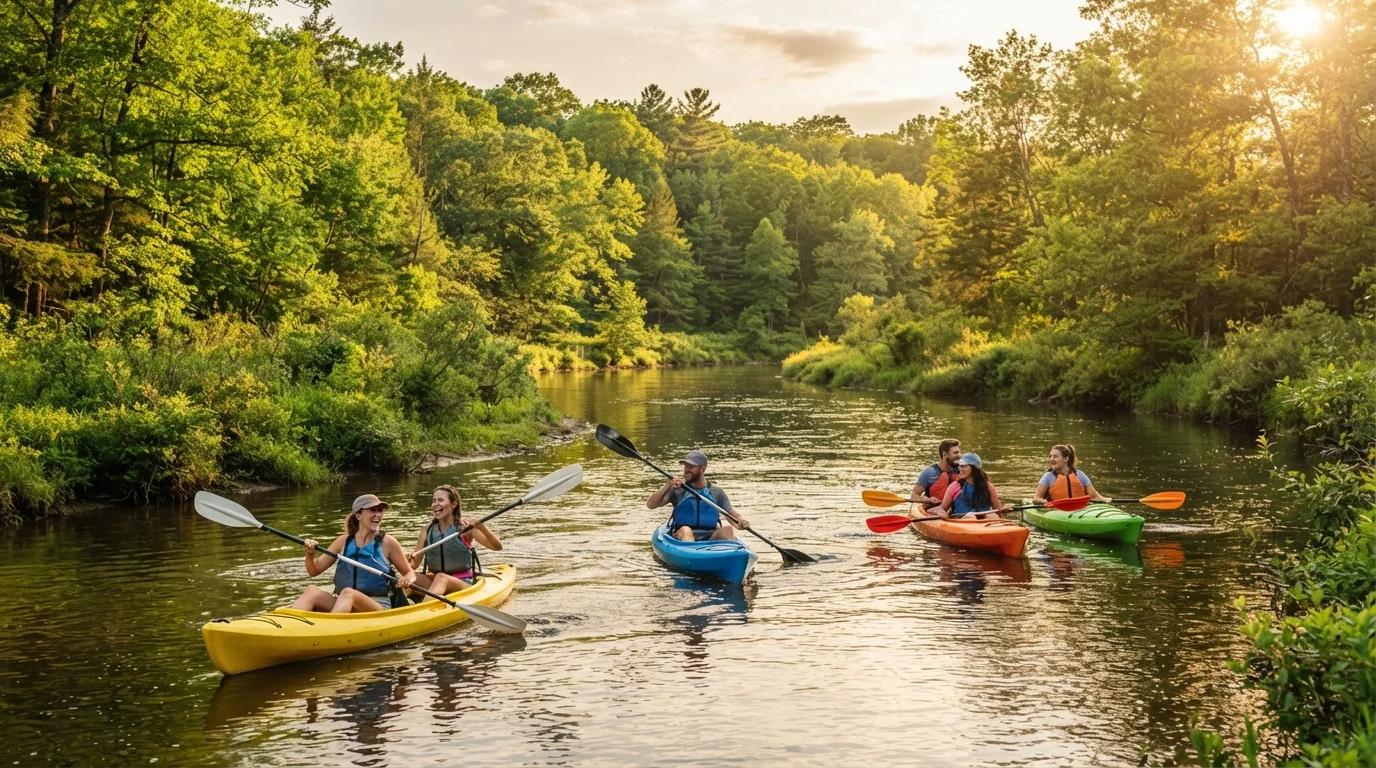
Paddling a kayak or canoe looks relaxed from the shore, but it's a genuine upper-body and core workout. Every stroke engages the shoulders, back, and abdominal muscles - and maintaining stability on the water quietly activates stabilizing muscles throughout the torso.
Calmer lakes and slow-moving rivers make this approachable for beginners. Many state parks and recreation areas offer rentals, so there's no need to invest in equipment before you know you enjoy it. The connection to water and natural scenery adds a stress-reducing bonus that few gym machines can replicate.
Every paddle stroke quietly builds shoulder, back, and core strength.
Pickleball
Pickleball has grown rapidly across the US for good reason: it's fast enough to be exciting, accessible enough for beginners, and social enough to keep you coming back. Played on a smaller court than tennis, it involves constant lateral movement, quick reaction time, and sustained cardiovascular effort - particularly in doubles play.
Studies have noted it as a moderately vigorous activity for older adults, but players of all ages find it legitimately challenging. Public courts are increasingly available at community centers, parks, and recreation facilities nationwide.
Pickleball's small court and quick rallies make for surprisingly intense cardio.
Swimming in Open Water
Pool swimming is excellent exercise, but open-water swimming - in lakes, bays, or calm coastal areas - takes that foundation and adds an element of full-body engagement that pool lanes simply can't match. Currents, temperature variation, and the need to sight your direction all increase the physical and mental demand.
Swimming is widely regarded as one of the most complete full-body workouts available, engaging the arms, legs, back, and core simultaneously with minimal joint impact. It's particularly well-suited to people managing joint discomfort or recovering from certain injuries - though anyone with health concerns should consult a professional before diving in.
Open-water swimming adds natural resistance and mental challenge to an already complete workout.
Hiking
Hiking is essentially walking with the difficulty dialed up - uneven terrain, elevation changes, and variable footing recruit muscles that flat sidewalks never touch. The glutes, hip stabilizers, and ankles all work significantly harder on a trail than on a paved surface.
The range of available trails means hiking genuinely scales with fitness level, from a gentle 2-mile nature loop to a challenging mountain ascent. Even moderate hikes of an hour or two provide meaningful aerobic and muscular conditioning, especially with a light pack. For a deeper look at how outdoor activities can be matched to different ability levels, the outdoor recreation fitness guide has you covered.
Trail terrain activates hip, glute, and stabilizer muscles that flat-surface walks miss entirely.
Stand-Up Paddleboarding
Stand-up paddleboarding (SUP) has a deceptively leisurely appearance. In practice, simply standing upright on a board on moving water demands continuous core activation and balance work. Add paddling strokes and you've engaged the shoulders, back, and arms as well.
Calmer bodies of water like lakes or bays are ideal for beginners, and the learning curve - while real - isn't prohibitive. Many recreation areas offer introductory lessons and rentals. It's also an exceptionally pleasant way to spend time on the water, which tends to make the workout feel secondary.
Just staying upright on a paddleboard keeps your core working the entire time.
Ultimate Frisbee and Disc Golf
Frisbee-based sports occupy an interesting space: socially driven, entry-level friendly, and more physically demanding than they first appear. Ultimate Frisbee in particular involves sustained running, cutting movements, jumping, and full-field sprints - making it genuinely aerobic in a competitive pickup context.
Disc golf, while less intense, still requires walking across varied terrain for several miles per round and engages the core through rotational throws. Both activities are typically free or very low cost to participate in, with disc golf courses available in parks throughout much of the US. The social element of both sports is a significant plus for those who thrive in group fitness settings.
Ultimate Frisbee's cutting and sprinting can rival traditional cardio for intensity.
Getting Started and Staying Consistent
The best outdoor activity is the one you'll return to. Start with whatever sounds most appealing from this list, try it a few times before deciding whether it fits, and don't be afraid to mix things up - variety keeps both your body and your motivation engaged. If you're curious about the science behind outdoor time and mental health, our piece on the mental health case for spending time outdoors is worth a read.
Mix Activities for Better Results
Rotating between two or three outdoor activities - say, cycling mid-week and hiking on weekends - engages different muscle groups and reduces the risk of overuse strain. It also keeps your routine from going stale. If you want to understand the terminology behind concepts like aerobic conditioning or muscular endurance, our plain-language fitness glossary is a handy reference.
And if weather or access keeps you indoors some days, that's fine too. Outdoor recreation complements rather than competes with other forms of movement, whether that's a daily walk or a simple home workout routine. The goal is consistent, enjoyable movement - and the outdoors gives you an exceptional toolkit to build exactly that.
This article is for general informational purposes only and is not medical or health advice. Consult a qualified healthcare professional before beginning any new physical activity, particularly if you have an existing health condition.
The content on this site is for informational purposes only and is not a substitute for professional advice. Always consult a qualified professional for guidance specific to your situation.