

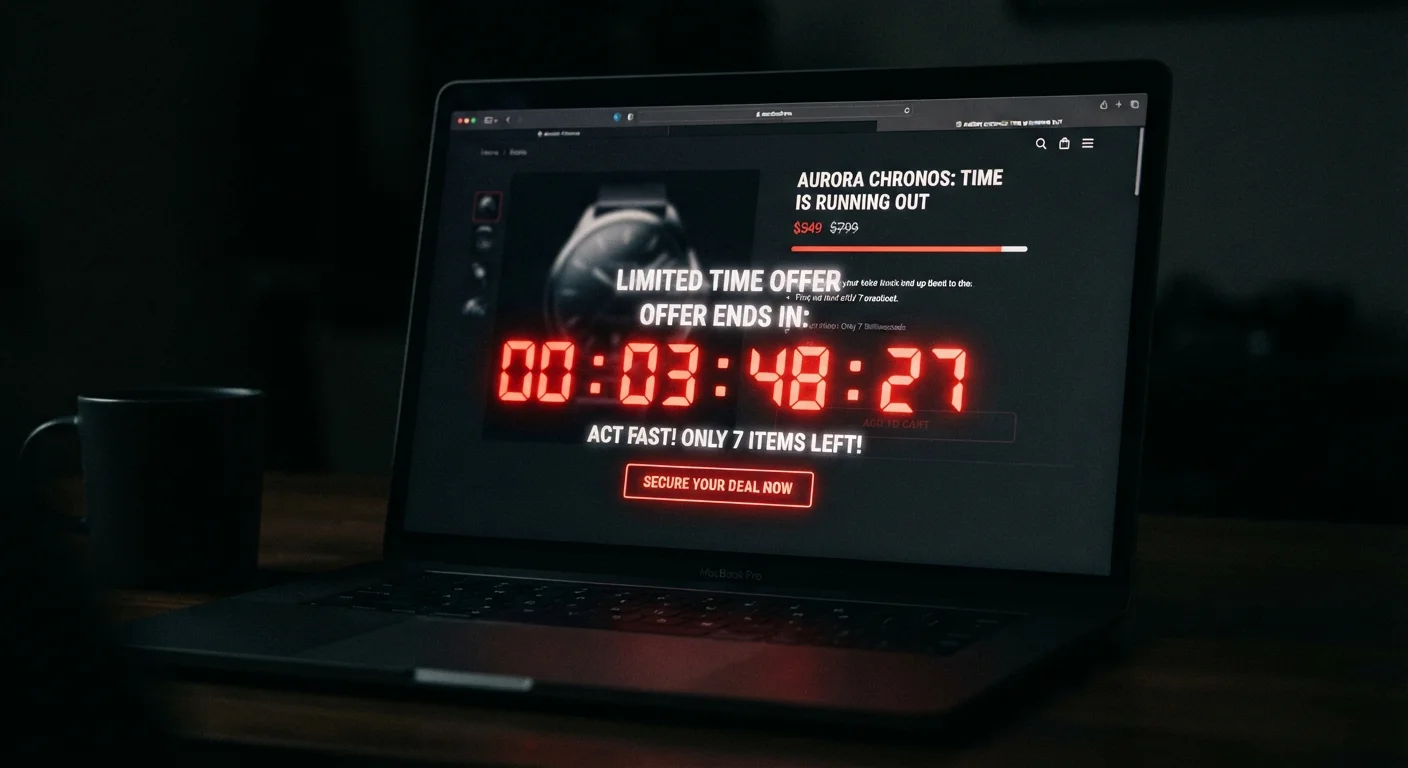
Why Your Brain Responds to 'Hurry Up'
When a retailer displays a ticking clock or a banner reading 'Only 2 left in stock,' something specific happens neurologically: your brain shifts from its deliberative system - the one that weighs pros, cons, and long-term value - toward its reactive system, which prioritizes immediate threat response. This isn't a personal weakness. It's how human cognition is wired.
The mechanism driving this is loss aversion, a principle from behavioral economics describing how people feel the sting of a potential loss more acutely than the pleasure of an equivalent gain. Urgency messaging is engineered to frame inaction as a loss. 'Missing' a deal feels worse than never having seen it in the first place, even when the underlying need for the product hasn't changed at all.
Retailers have refined these triggers for decades. Countdown timers, real-time viewer counts, and phrases like 'selling fast' all serve the same function: compress the window between exposure and decision. The shorter that window, the less time your rational evaluation has to operate. For more on the cognitive architecture behind pricing tactics, see the psychology behind why discounts feel irresistible.
2x
Weight of losses vs. equivalent gains in decision-making
Research in behavioral economics consistently shows losses feel roughly twice as impactful as equivalent gains, a pattern underlying urgency marketing's effectiveness.
~60%
Online purchases influenced by urgency cues
Multiple e-commerce UX studies have found that urgency signals such as countdown timers and low-stock notices measurably increase conversion rates, often substantially.
48 hrs
Waiting period that reduces impulse purchases
Consumer behavior researchers and personal finance practitioners widely cite a 24-48 hour pause as one of the most effective behavioral interventions against unplanned spending.
The Toolkit: Common Urgency Signals and What They Actually Mean
Understanding the individual tactics makes them easier to identify - and discount - in the moment.
- Countdown timers: Often the most dramatic visual element on a product page. Many reset on page reload or are tied to no meaningful inventory constraint. They signal 'decide now,' not necessarily 'this offer ends soon.'
- Low-stock warnings: 'Only 3 left!' is sometimes accurate for niche products with limited runs, but in large retail environments these figures can reflect warehouse segmentation rather than total availability. The same item may be available elsewhere immediately.
- Social proof pressure: '47 people are viewing this right now' adds competitive anxiety to the equation. This type of live-activity data is difficult for shoppers to verify and easy for platforms to generate artificially or misleadingly.
- Flash sale framing: The implied threat here is that the price will rise as soon as the sale ends. Price tracking tools frequently show that 'sale' prices are the effective regular prices, with 'original' prices rarely charged.
None of this means every urgency signal is fabricated. Event tickets, limited-edition products, and airline inventory do operate under real constraints. The distinction - genuine vs. manufactured scarcity - is worth developing a habit of assessing. See how anchoring and decoy pricing work alongside urgency for a broader map of related techniques.
“The best way to protect yourself from manipulation is to understand what the manipulator wants you to feel - and then notice when you're feeling it.”
— Dan Ariely, Behavioral economist and author of 'Predictably Irrational'
A Practical Framework for Responding
The most reliable counter to urgency pressure is a simple procedural habit: evaluate need before evaluating the deal. If you wouldn't have sought out this product today without the sale signal, that's worth noting before checkout.
A useful decision sequence:
- Name the need: Does this item solve a specific, existing problem? Or did the ad surface a problem you weren't aware of having? Sorting needs from wants before you shop is a reliable first filter.
- Test the timer: Reload the page. Return tomorrow. If the countdown resets or the 'deal' persists unchanged, the urgency was artificial.
- Verify the price history: Browser extensions that display historical price data can show whether today's 'sale price' is genuinely discounted or is simply the product's normal selling price dressed up with a strikethrough.
- Apply the 48-hour rule: For any non-emergency purchase, wait 48 hours. If the item remains available and you still want it, proceed with confidence. If it's gone and you feel relieved, you've saved money with no effort.
For a structured pre-purchase checklist that walks through these steps, use this checklist before clicking buy to verify whether any offer is genuinely worth acting on.
Use Price History Tools Before You Buy
Free browser extensions can display a product's price history directly on retailer pages, showing whether today's 'sale price' reflects a genuine reduction or is simply the standard price with a fabricated comparison. Checking this takes under 30 seconds and immediately clarifies whether urgency framing is backed by real pricing movement.
Urgency Awareness as a Long-Term Shopping Habit
Knowing how urgency tactics work doesn't eliminate their psychological pull entirely - these mechanisms operate partly below conscious awareness. But repeated exposure to the knowledge does build resistance over time. Shoppers who understand that a countdown timer is a design choice, not an objective fact, are measurably more likely to pause before purchasing.
The broader goal isn't to become skeptical of every retail interaction - it's to reserve your fastest decisions for situations where speed genuinely matters, and your most deliberate thinking for everything else. Urgency language is most effective when it catches buyers who haven't yet developed a framework for evaluating it. Building that framework, even a simple one, changes the dynamic substantially.
Frequently Asked Questions
Not always. Many countdown timers reset automatically when the page reloads or when a session expires. Some are purely aesthetic and bear no relation to actual stock levels or sale end times. Refreshing the page or revisiting a product listing the next day will often reveal whether the countdown is genuine.
FOMO - fear of missing out - is the anxiety that others are gaining something you won't have access to. Retailers use social proof cues like 'X people are viewing this right now' to trigger FOMO, pushing shoppers toward faster, less scrutinized decisions. Recognizing this as a deliberate design choice helps neutralize its effect.
Yes, though it's less common than the frequency of urgency signals would suggest. Airline seats, event tickets, and hotel rooms do have hard inventory limits. The difference is context: genuine scarcity is specific and verifiable, while manufactured urgency tends to be vague and repeatable.
Check whether the same item has been 'on sale' for an extended period using price-tracking browser extensions or retailer history tools. If the 'original' price rarely appears at full value, the discount framing is likely a permanent marketing tactic rather than a genuine temporary reduction.
Add the item to your cart or wishlist and return to it 24 hours later. If the deal is gone and you don't miss the product, you didn't need it. If a comparable offer doesn't reappear within a week or two, the urgency may have been legitimate.
The content on this site is for informational purposes only and is not a substitute for professional advice. Always consult a qualified professional for guidance specific to your situation.