

Why Retail Pricing Is a Designed Experience
Retail prices are rarely set by cost alone. They're engineered to feel right - to trigger a sense of value, urgency, or relief that nudges a purchase before you've had time to think it through. These aren't accidental outcomes. Pricing psychology is a studied discipline, and the techniques below have been documented in academic research and retail practice alike.
Understanding them won't make you a perfectly rational shopper - nobody is - but it will give you a clearer sense of when your perception of a deal is being constructed for you. For a broader foundation, see Understanding Deals and Pricing, which covers the core concepts every shopper should know.
Price Anchoring
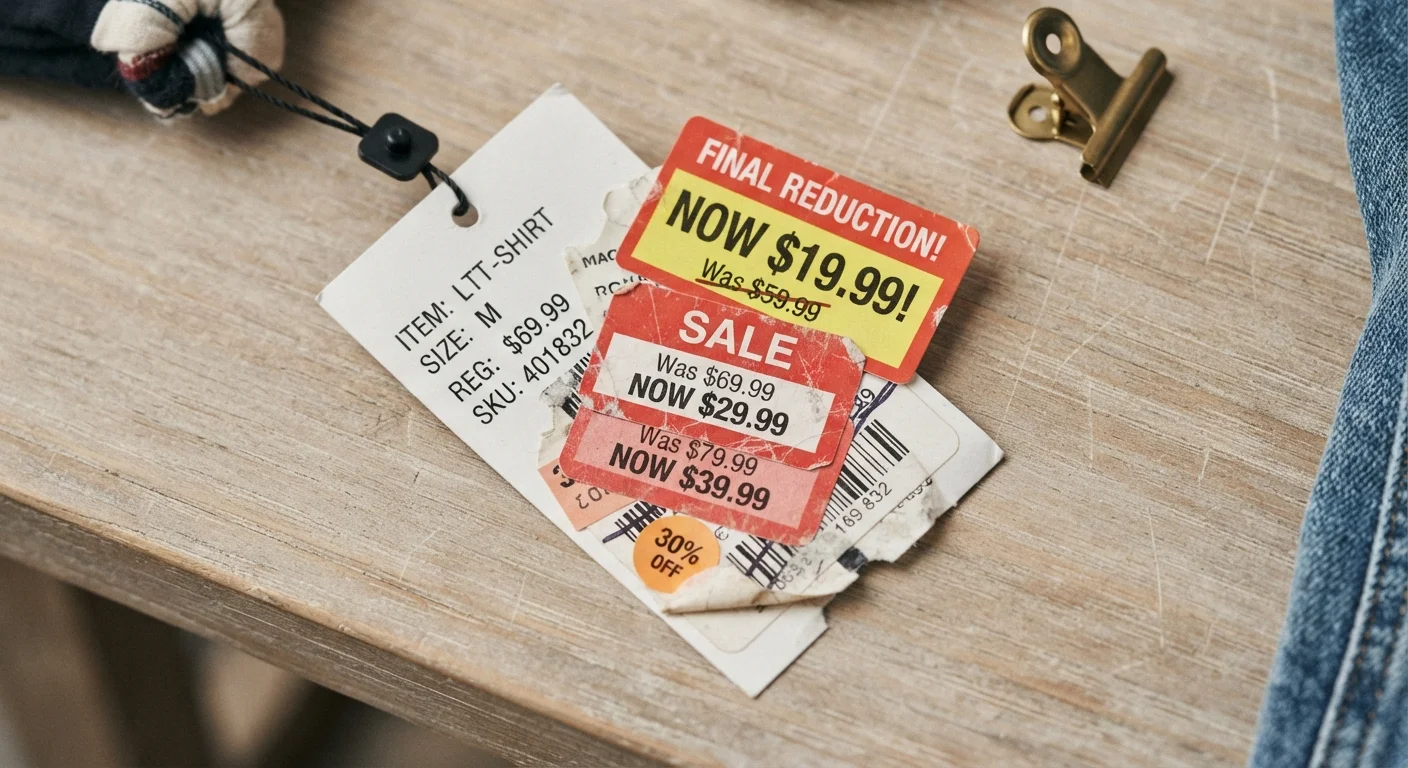
Anchoring is the practice of presenting a high reference price - often labeled "original," "MSRP," or "was" - before showing the selling price. Once that anchor is in your head, every lower number feels like a discount, regardless of whether the anchor reflects what anyone ever actually paid.
Research in behavioral economics consistently shows that people evaluate numbers relative to the first figure they see, not in absolute terms. A $60 item marked down from $120 feels like a bargain. That same $60 item with no reference price feels ordinary. The item hasn't changed - only the frame around it has.
Inflated reference prices are a documented problem. The assumptions that cost shoppers the most often start here: trusting the "original" price without questioning its legitimacy.
Anchor prices shape perception of value before you've evaluated a single real data point.
Charm Pricing ($9.99, $19.95)
Prices ending in .99 or .95 are so ubiquitous they barely register - which is exactly why they work. The effect, sometimes called "left-digit anchoring," exploits the way people read numbers from left to right. The brain logs the leftmost digit first, making $9.99 feel closer to $9 than to $10, even though the difference is a single cent.
Studies have found that charm pricing can meaningfully increase sales volumes compared to round-number pricing in certain categories, particularly for commodity goods where consumers aren't tracking exact prices. At higher price points - $299 vs $300 - the psychological effect persists and can represent a more significant perceived gap.
The awareness fix is simple in principle: round up mentally before comparing prices. If something is $79.99, treat it as $80 when weighing it against alternatives.
Your brain logs $9.99 as nine-something - not ten - before you've finished reading the price.
Decoy Pricing
Decoy pricing introduces a third option specifically designed to make one of the other options look more attractive. The classic example: a small popcorn for $3, a large for $7, and a medium for $6.50. The medium exists not to sell but to make the large look like obvious value by comparison.
This technique, sometimes called the "asymmetric dominance effect," is well-documented in consumer research. It's widely used in subscription tiers, bundle packaging, and service plans - anywhere a retailer wants to steer you toward a specific option without making it feel prescribed.
When you see three pricing tiers and one of them seems oddly close to the most expensive, pause. Ask whether you actually need the higher tier, or whether the decoy simply made it feel like the sensible choice.
Decoy options aren't meant to be chosen - they're meant to change how you evaluate the option next to them.
Artificial Scarcity and Urgency
"Only 3 left in stock." "Offer ends tonight." These cues trigger loss aversion - the well-established tendency for people to weigh potential losses more heavily than equivalent gains. If you believe you might miss out, the decision frame shifts from "should I buy this?" to "can I afford not to buy this now?"
Some scarcity signals are genuine. Many are not, or are reset regularly. Countdown timers on e-commerce sites frequently restart. "Limited" inventory claims are often impossible to verify. The urgency is real only if missing this specific window actually matters to your circumstances - not because the display says so.
A practical response: if you weren't planning to buy something before you saw the scarcity cue, treat the cue itself as a reason to slow down, not speed up.
Urgency cues shift your question from 'do I want this?' to 'can I afford to miss it?' - that shift is the tactic.
Bundle Pricing and Obscured Unit Costs
Bundles create value perception by grouping items together at a price that feels lower than buying each separately - even if you only wanted one of the items. The savings calculation depends entirely on whether you'd actually purchase the bundled extras at their listed individual prices, which most shoppers wouldn't.
A related variant: multi-unit pricing ("3 for $10") implies you should buy three to get the deal, even when the per-unit price is the same whether you buy one or three. Research suggests many shoppers over-purchase under these formats, buying more than they need because the framing implies volume is the right move.
Before accepting bundle value at face value, price the specific items you actually want individually - including from other sources. Price-match policies can also affect whether a bundled price is genuinely competitive.
A bundle is only a deal if you'd have bought every item in it anyway, at or near the listed individual prices.
Sale Price Framing Without a Real Baseline
Closely related to anchoring, this tactic involves presenting a price as "on sale" without establishing what the pre-sale price actually was - or by using a reference price that was only nominally charged for a brief period. Some retailers have faced regulatory scrutiny for advertising discounts against prices that were never meaningfully in effect.
The result: a "40% off" label can describe a genuine reduction from a real selling price, or it can describe a comparison to a price that existed only on paper. Without knowing the item's actual price history, you can't tell which you're looking at.
Price-tracking tools for common retail categories can help establish whether a "sale" price represents a real departure from the norm, or simply the item's typical going rate dressed up with a strikethrough.
A sale is only meaningful against a price that was real - not one that existed to be discounted.
Shopping More Deliberately
Each of these tactics works precisely because it's hard to notice in the moment. The antidote isn't cynicism - it's slowing down. Before acting on a price that feels compelling, ask: what is this item actually worth to me, and what would I think of this price if I'd never seen a higher one?
Check Price History Before Committing
For frequently purchased categories - electronics, appliances, household goods - price-tracking tools and browser extensions can show whether a current "sale" price is genuinely lower than the item's historical norm. A price that's been "on sale" for months isn't a sale in any meaningful sense. This kind of check takes under a minute and removes the anchor's influence entirely.
Pricing tricks also compound over time. The more you understand how seasonal markdowns actually work, the harder it becomes to mistake a manufactured sale for a genuine one. Our guide to seasonal price patterns breaks down when retailers genuinely reduce prices across major categories. And if you're curious about the deeper cognitive biases behind why discounts feel so compelling, the psychology behind why discounts feel irresistible is worth reading alongside this guide.
This article is for general informational and educational purposes only. It does not constitute financial or purchasing advice tailored to your individual circumstances.
The content on this site is for informational purposes only and is not a substitute for professional advice. Always consult a qualified professional for guidance specific to your situation.