

Start here
Why Most Buyer's Remorse Starts Before Checkout
Learn the basics
Defining the Three Categories
Apply it
How to Sort Your Own Priorities Before You Shop
Stay sharp
When the Lines Blur: Edge Cases to Watch For
Take action
Putting the Framework Into Practice
Why Most Buyer's Remorse Starts Before Checkout
Buyer's remorse rarely shows up at the moment you swipe a card. It shows up three weeks later, when you're looking at a gadget you never use or a piece of clothing still wearing its tags. The decision that caused the regret happened long before checkout - usually at the point when you didn't clearly define why you wanted the item in the first place.
Without a simple framework to sort your motivations, it's easy to let marketing, social comparison, or in-the-moment excitement make the call for you. This guide gives you a practical tool to take that decision back. For a broader look at the psychology behind purchase regret, see why shoppers regret big purchases.
Defining the Three Categories
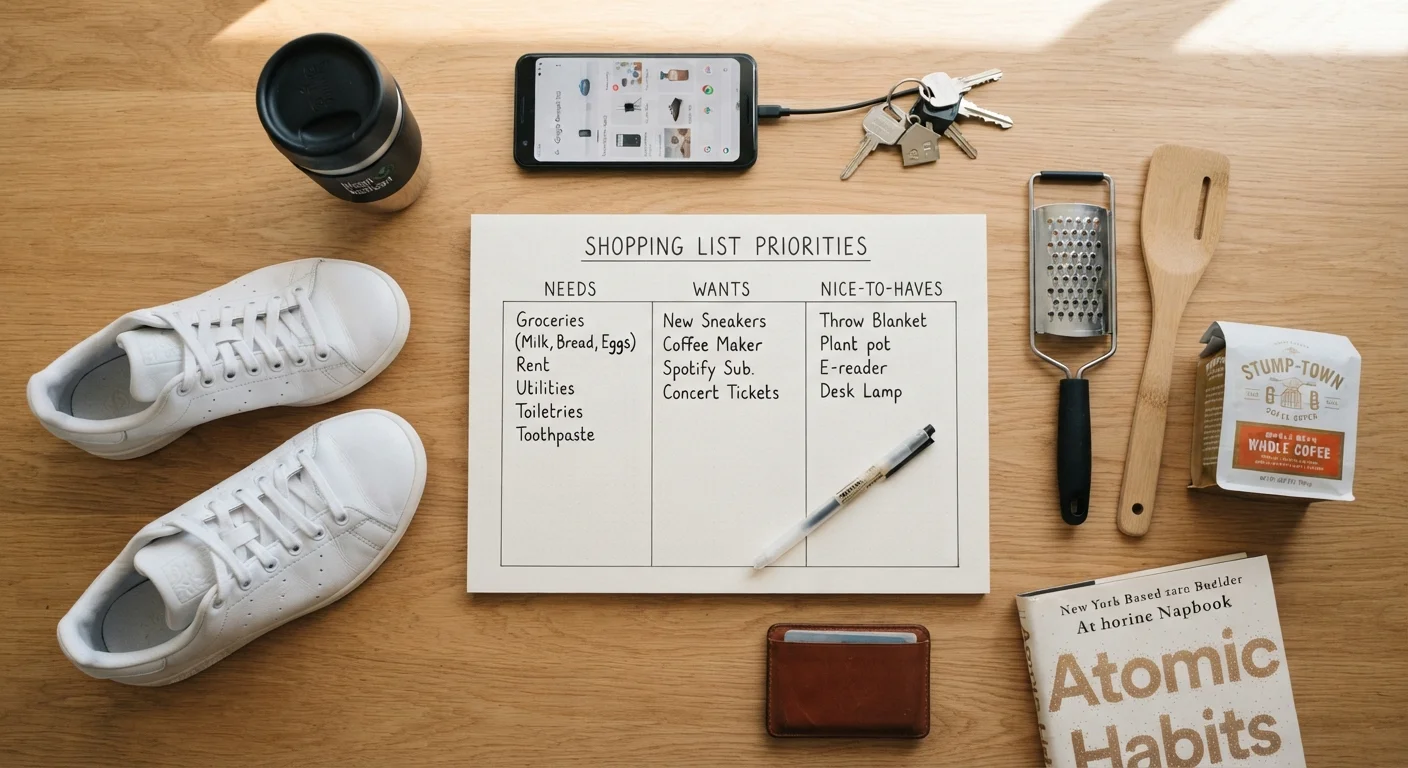
The framework breaks every potential purchase into three buckets:
Need
A purchase that addresses a genuine, current problem where not buying creates real harm or significant disruption to daily life or work.
Want
A purchase that meaningfully improves your situation but isn't required - life functions adequately without it, though the upgrade would add real value.
Nice-to-Have
A purchase that is appealing but delivers limited impact; you'd likely notice its absence only briefly, and it often goes unused within weeks.
Buyer's Remorse
The feeling of regret after a purchase, typically triggered when a Want or Nice-to-Have was treated as a Need at the moment of buying.
Manufactured Urgency
A sales tactic that creates artificial time pressure - such as countdown timers or 'only 2 left' notices - to make a purchase feel more urgent than it actually is.
- Needs solve a real, present problem. Your laptop screen is cracked and you work remotely. Your only coat has a broken zipper heading into winter. Without the purchase, something genuinely important goes wrong.
- Wants improve your situation meaningfully, but don't address an urgent gap. An upgraded monitor would make your workday more comfortable. A nicer coffee maker would improve your mornings. Life works without them, but they add real value.
- Nice-to-Haves appeal to you without delivering substantial impact. A fifth color option for something you already own. A kitchen gadget that handles a task you accomplish fine with existing tools. The appeal is real, but so is the chance you'll stop using it quickly.
None of these labels means don't buy - they mean buy with eyes open.
How to Sort Your Own Priorities Before You Shop
The exercise only takes a few minutes and is most useful for purchases over $50 or anything you're unsure about.
- Write down the specific problem you're solving. Not 'I need a new phone' - instead, 'My current phone battery dies by noon and I rely on it for navigation and work calls.' The more precise the problem statement, the clearer the category becomes.
- Ask what happens if you don't buy it. If the answer involves real inconvenience, lost income, or safety risk, you're likely in Need territory. If life continues roughly as normal, it's a Want or Nice-to-Have.
- Check your existing resources. Can you repair, borrow, or adapt something you already own? A Need only qualifies as a Need when no reasonable alternative exists.
- Separate urgency from desire. Wanting something quickly is not the same as needing it quickly. Manufactured urgency - sales countdowns, limited-stock notices - can make Wants feel like Needs in real time.
Try the 48-Hour Pause for Wants
When you identify something as a Want rather than a Need, add it to a list and revisit it 48 hours later. Most impulse-driven Wants lose their urgency within a day or two. If the item still feels worthwhile after the pause, you're making a more deliberate decision.
This framework connects directly to how you allocate your budget. The budgeting basics hub covers practical strategies for prioritizing spending categories once you've sorted your priorities.
When the Lines Blur: Edge Cases to Watch For
Categories shift with context, and it's worth being honest about a few common traps:
Watch Out for Rationalization
The most common trap is mentally promoting a Want to a Need to justify the purchase. If your reasoning only appeared after you'd already decided you wanted the item, that's a signal to slow down. Honest categorization happens before you start building a case for buying.
- Lifestyle creep as justification. As income rises, Wants can start to feel like Needs simply because you're used to a higher standard. That's worth acknowledging, not automatically accepting.
- Work-related purchases. A tool that directly enables your income stream is genuinely closer to a Need. A tool that might marginally improve productivity someday is closer to a Want.
- Health and safety items. These can appear to be Nice-to-Haves but cross into Needs when they address a real risk. An ergonomic chair matters more to someone with chronic back pain than to someone without it.
- Bundled purchases. Sometimes a single transaction covers multiple categories - a new phone might be a Need (yours is broken) with upgrades that are Wants (camera, storage tier above minimum).
The goal isn't perfect categorization. It's building the habit of pausing to ask the question before you buy. For decisions where the price point itself is a factor, when paying more upfront makes sense walks through how to evaluate value over time.
Putting the Framework Into Practice
Before your next significant purchase, take two minutes to write down which category it falls into and your honest reasoning. This small friction does something useful: it separates the decision from the shopping environment, where everything is designed to trigger immediate action.
Needs get funded first. Wants get funded when your financial situation allows. Nice-to-Haves are deliberate treats - not defaults. The framework doesn't tell you what to buy. It tells you where a purchase sits so you can decide with full awareness.
This is one step in a broader consumer decision process. The end-to-end consumer guide covers the full arc from identifying a need to evaluating what you bought. And before you commit to any specific online offer, the pre-purchase checklist helps you verify whether the deal is actually what it appears to be.
Budgeting Basics Hub
Once you've sorted your priorities, this hub helps you build a spending plan that funds Needs first and leaves room for deliberate Wants.
Product Categories Buying Hub
Applies the consumer decision framework to specific product categories so you know what factors actually matter before you shop in any aisle.
Frequently Asked Questions
A need addresses a genuine, current problem - like replacing a broken appliance. A want improves your situation without solving an urgent issue. The distinction matters because confusing the two is one of the most common triggers of buyer's remorse.
Ask yourself what problem, specifically, goes unsolved if you don't buy the item. If the honest answer is 'nothing critical,' it's likely a want. Delaying the purchase for 48 hours and revisiting the question often clarifies things.
Absolutely. A car is a need for someone commuting 40 miles to work with no transit options. For someone in a walkable city with transit access, it may be a want. Context - including your income, location, and life stage - defines the category.
Treat them as a separate discretionary bucket after needs and financial goals are covered. Funding nice-to-haves ahead of either is the pattern most likely to cause financial stress later.
Yes, though the formal exercise pays off most for purchases over $50-$100 where the stakes are higher. For smaller items, a quick mental check - 'Do I actually need this, or does it just look appealing right now?' - is usually enough.
Don't abandon the purchase automatically - wants and nice-to-haves are valid spending choices when funded deliberately. The goal is to buy them intentionally, not eliminate them entirely. Check that your needs and savings are covered first, then decide.
The content on this site is for informational purposes only and is not a substitute for professional advice. Always consult a qualified professional for guidance specific to your situation.