

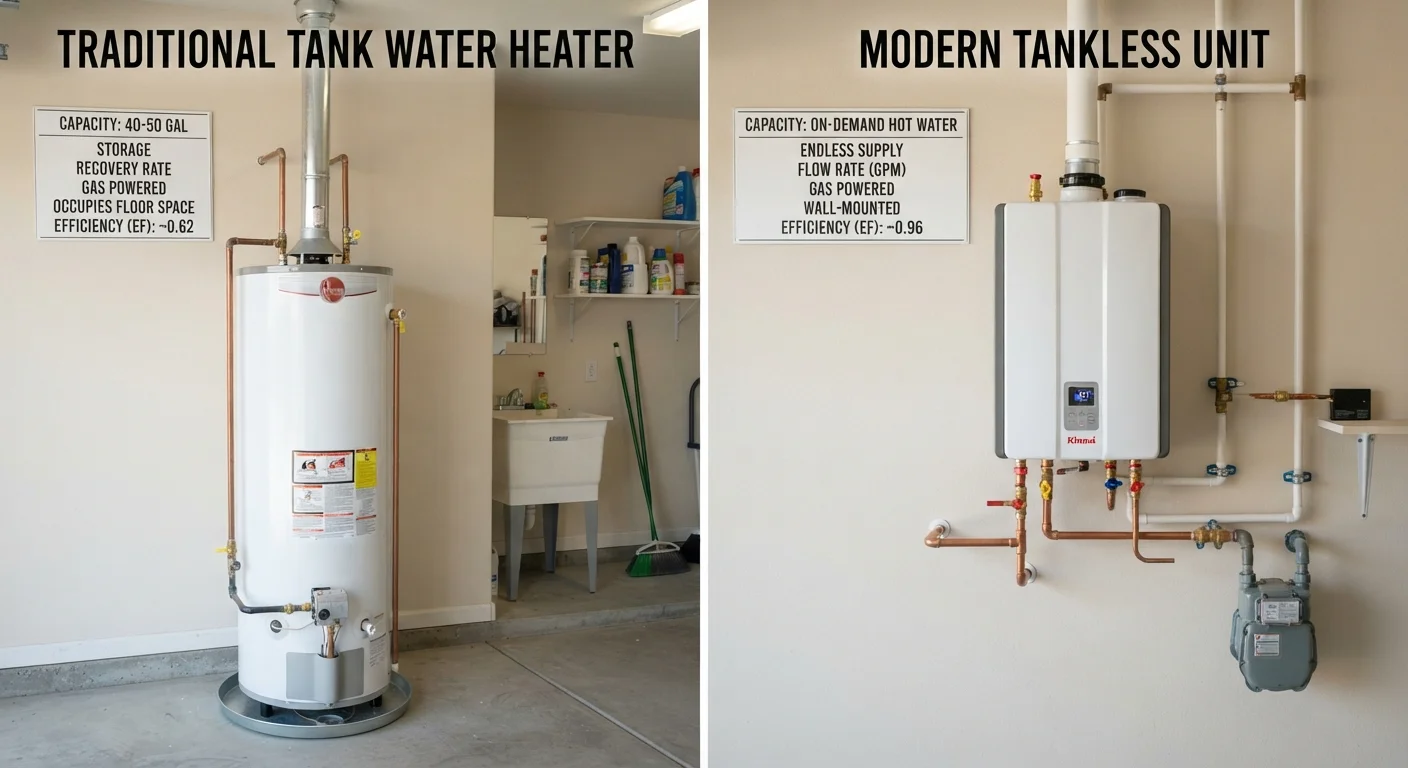
Option A
Tankless Water Heater
The on-demand, space-saving option with precision upkeep needs.
Best for: Homeowners willing to commit to annual servicing in exchange for longer equipment lifespan and energy efficiency.
Option B
Traditional Tank Water Heater
The familiar, straightforward storage unit with simpler DIY maintenance.
Best for: Homeowners or renters who prefer low-complexity upkeep and are comfortable replacing equipment every 10-15 years.
How Each System Accumulates Wear
Understanding where each water heater type is vulnerable helps you target maintenance before small issues become costly failures. See our guide on deferred home maintenance costs for a broader look at how neglect compounds across household systems.
Tankless units heat water on demand by passing it through a heat exchanger - a compact component with narrow internal passages. Those passages are highly susceptible to scale (mineral deposits from hard water). As calcium and magnesium accumulate, the unit works harder to transfer heat, efficiency drops, and eventually the exchanger can crack or fail.
Traditional tank heaters store 30-80 gallons of hot water continuously. The primary wear mechanisms are sediment settling at the tank bottom and internal corrosion. Most tanks include a sacrificial anode rod - typically magnesium or aluminum - that corrodes in place of the tank lining. Once that rod is depleted, the tank walls begin to rust from the inside out.
| Criterion | Tankless Water Heater | Traditional Tank Water Heater |
|---|---|---|
| Primary failure point | Heat exchanger scale buildup | Internal corrosion / depleted anode rod |
| Flushing frequency | Annually (every 6 mo. in hard water) | Every 6-12 months |
| Flushing complexity | Moderate (pump and hose setup required) | Low (garden hose and drain valve) |
| Secondary maintenance item | Inlet filter screen (clean annually) | Anode rod (inspect every 2-3 years) |
| Typical lifespan (maintained) | 18-25 years | 10-15 years |
| Hard water sensitivity | High - requires more frequent descaling | Moderate - sediment accumulates faster |
| DIY maintenance difficulty | Moderate | Low to moderate |
Flushing Schedules and What's Actually Involved
Both heater types require periodic flushing, but the procedures differ considerably in complexity and frequency.
Tankless Flushing (Descaling)
Annual descaling is the cornerstone of tankless maintenance. The process involves circulating a food-grade descaling or white vinegar solution through the heat exchanger using a submersible pump and hoses connected to the unit's service ports. Most manufacturers recommend this annually; households with hard water (above 7 grains per gallon) may need it every six months. This is a task many mechanically inclined homeowners can handle, though a licensed plumber can confirm the setup is correct the first time.
Tank Flushing (Sediment Removal)
Tank heaters should be partially flushed every 6-12 months to clear sediment from the bottom. You connect a garden hose to the drain valve and let water run until it flows clear. A full drain-and-flush is recommended annually. This is one of the more forgiving DIY maintenance tasks - though older tanks with corroded drain valves can be tricky to operate safely. If the valve won't fully close afterward, a plumber should replace it promptly.
Water Hardness Affects Both Units
Hard water - generally defined as containing more than 7 grains per gallon of dissolved minerals - accelerates wear on both heater types, but hits tankless units harder. If you're unsure about your local water quality, your municipal water utility is required to publish an annual water quality report. A basic water hardness test kit can also give you a quick reading at home. Consider a whole-house water softener if readings are consistently high.
For a broader view of how these tasks fit into a year-round routine, see what a home maintenance schedule actually looks like.
Anode Rods, Filters, and Secondary Failure Points
Beyond flushing, each system has additional components that need periodic attention.
Tank Heater: Anode Rod
The anode rod is the single most important maintenance item on a tank heater and the most commonly overlooked. Inspect it every 2-3 years; replace it when it's depleted to less than half an inch of core wire or is heavily coated in calcium. A functioning rod can add years to a tank's life. Without it, corrosion can shorten the unit's lifespan significantly.
Tankless Heater: Inlet Filter Screen
Tankless units have a small inlet filter screen that catches debris before it enters the heat exchanger. Cleaning this screen every 6-12 months is a simple but often skipped task. A clogged screen reduces flow rate and can trigger error codes or premature shutdowns.
Both Types: Pressure Relief Valve
The temperature-pressure relief (TPR) valve is a critical safety device on both unit types. It should be manually tested annually to confirm it opens and reseats properly. A valve that won't open or won't reseal after testing should be replaced by a licensed plumber - this is not a task to defer. New homeowners often miss this entirely; it's covered in our list of maintenance tasks new homeowners most commonly overlook.
Lifespan Expectations and When to Plan for Replacement
Maintenance consistency is the single biggest factor separating a water heater that lasts its full expected lifespan from one that fails early.
10-15 yrs
Average lifespan of a maintained tank water heater
The U.S. Department of Energy notes that storage tank water heaters typically last 10-15 years with routine upkeep.
20+ yrs
Expected lifespan of a well-maintained tankless unit
Industry estimates commonly cite 20 years or more for tankless water heaters that receive consistent annual descaling and servicing.
~85%
Of water heater failures linked to corrosion or sediment
Plumbing industry data consistently identifies mineral buildup and internal corrosion as the leading causes of premature water heater failure.
Traditional tank heaters typically last 10-15 years with regular maintenance. Units that never receive anode rod replacement or flushing often fail closer to 8-10 years. Signs you're approaching end-of-life include rusty water, rumbling or popping sounds during heating cycles (caused by hardened sediment), and visible corrosion around fittings.
Tankless units are built for longevity - 20 years is a realistic expectation with consistent annual servicing. However, a unit that never gets descaled in a hard-water area may experience heat exchanger failure in as few as 7-10 years, erasing one of the technology's primary advantages.
For plumbing upkeep habits that support both systems, monitoring household water pressure and checking for slow-drip leaks around connections can help catch problems early.
The content on this site is for informational purposes only and is not a substitute for professional advice. Always consult a qualified professional for guidance specific to your situation.