

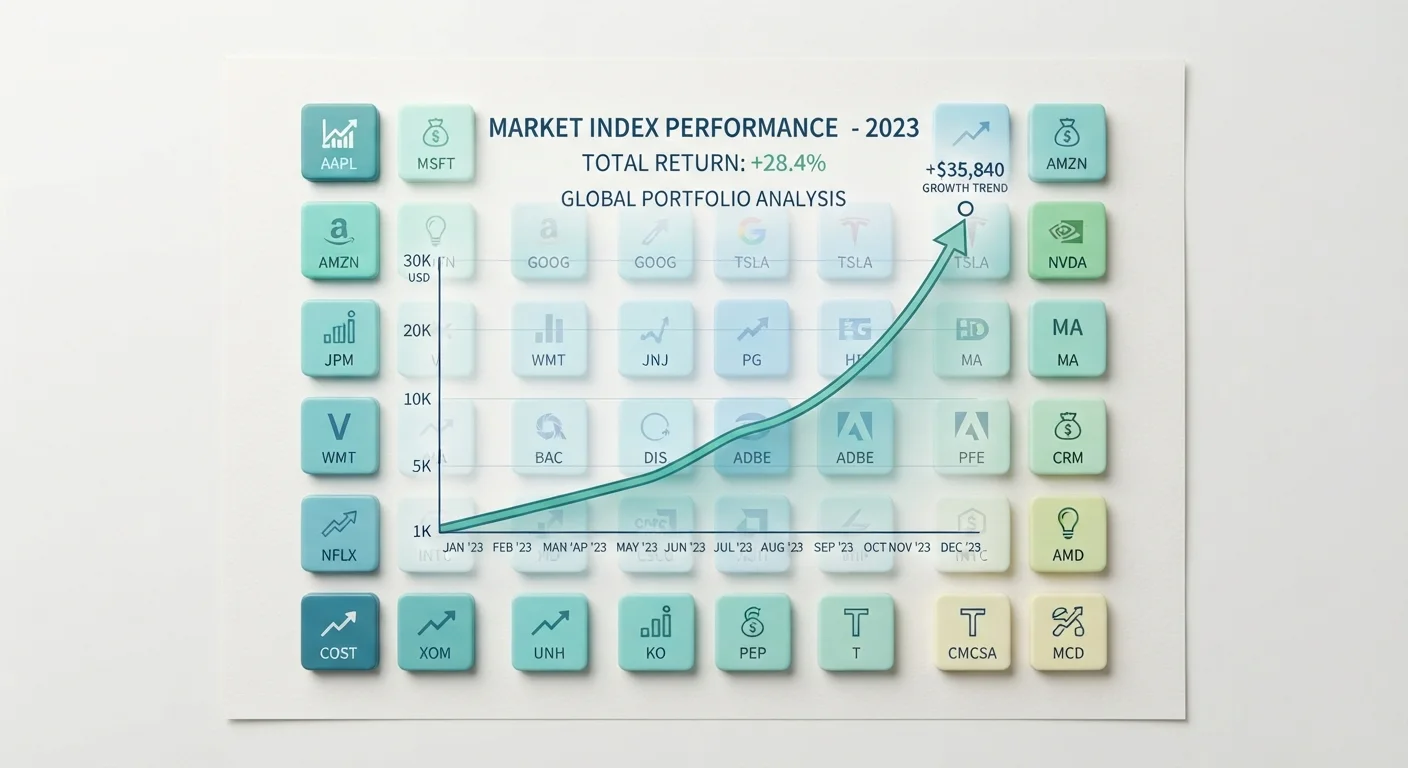
How Index Funds Work
When you invest in an index fund, your money is pooled with other investors' money to purchase a collection of securities that replicate a chosen market index. A fund tracking the S&P 500, for example, holds shares in all 500 companies included in that index, weighted roughly by their market size.
This approach is called passive investing - the fund isn't trying to outperform the market; it's trying to match it. No analyst team is deciding which stocks to buy or sell. The portfolio changes only when the underlying index changes its composition.
Understanding where index funds fit relative to other asset classes is helpful before investing. See our plain-language guide to asset classes for a grounding in the building blocks that make up these funds.
Passive Doesn't Mean Hands-Off Forever
Index funds require minimal day-to-day management, but that doesn't mean you should never review your portfolio. Over time, your allocation across different fund types may drift away from your original target as some funds grow faster than others. Periodically rebalancing - adjusting holdings back toward your intended mix - is a standard practice many investors follow annually.
Why Low Costs Matter More Than You Might Think
One of the most cited advantages of index funds is their low cost. Because no active management team is researching and trading securities, the fund's operating expenses - captured in a metric called the expense ratio - tend to be much lower than those of actively managed funds.
~0.05%
Typical expense ratio for broad index funds
Many broad market index funds carry expense ratios well under 0.10%, compared to averages above 0.60% for actively managed equity funds, according to Morningstar's annual fund fee study.
~$10T+
Assets held in U.S. index funds
As of recent years, index funds have surpassed actively managed funds in total U.S. assets under management, reflecting a long-term shift in how American investors choose to invest.
Less than 25%
Active funds beating their index over 20 years
S&P Global's SPIVA research has consistently shown that the large majority of actively managed funds underperform their benchmark index over long time horizons, net of fees.
Compounding works in both directions: just as returns grow over time, so do fees. An expense ratio that seems trivially small in year one can quietly erode a meaningful portion of your portfolio over 20 or 30 years. For long-term goals like retirement, keeping costs low is one of the few investment outcomes truly within an investor's control.
The Case for Diversification
Owning a single company's stock ties your investment entirely to that company's fortunes. Index funds spread that risk across dozens, hundreds, or even thousands of securities. If one company in the index performs poorly, its drag on the overall fund is limited by the weight of all the others.
This built-in diversification is particularly valuable for investors who don't have the time or expertise to research individual companies. Rather than betting on winners, you're participating in the broad performance of an entire market segment.
That said, diversification within an index fund doesn't eliminate risk. A fund tracking a single sector - technology, for instance - carries more concentrated risk than one tracking the total stock market. And when markets broadly decline, most index funds decline with them. This is a normal feature of market participation, not a flaw unique to index funds.
Match the Index to Your Goal
Not all index funds cover the same ground. Some track large U.S. companies, others track international markets, bonds, or specific sectors. Before investing, consider whether the index a fund tracks aligns with your time horizon and risk tolerance. A total market fund offers broader diversification than a single-sector fund.
Where Index Funds Fit in a Broader Financial Plan
Index funds are a tool - a flexible and efficient one - but they work best in the context of a broader financial strategy. Before committing money to any investment, it's worth understanding the distinction between saving and investing: our explainer on saving vs. investing walks through that foundation clearly.
Index funds are commonly held inside tax-advantaged retirement accounts such as 401(k)s, traditional IRAs, and Roth IRAs. Holding them in these accounts can defer or reduce the taxes owed on investment gains, depending on the account type. See Retirement Accounts 101 for a concise breakdown of how these accounts differ.
New investors sometimes hold back due to misconceptions about minimum requirements or complexity. If that resonates, common myths about investing addresses many of those concerns directly. And once you're ready to start, it's worth reading about mistakes that derail new investors so you can sidestep the most common early errors.
This article is for general informational and educational purposes only. It does not constitute personalized financial, investment, tax, or legal advice. Please consult a qualified financial professional before making decisions about your own investments or financial situation.
Frequently Asked Questions
An index fund grows in value as the companies within its tracked index grow. If the overall market rises, the fund's value rises proportionally. Investors may also receive dividends when the underlying companies distribute profits.
Index funds are often considered beginner-friendly because they are simple, diversified, and low-cost. However, they still carry market risk - your investment can lose value if the market falls. They are not savings accounts and should be considered long-term investments.
An expense ratio is the annual fee a fund charges, expressed as a percentage of your investment. Even a small difference - say 0.05% versus 1% - compounds significantly over decades, directly reducing your net returns.
Yes. Index funds are widely available inside 401(k), IRA, and Roth IRA accounts. Many financial professionals consider them a foundational holding for long-term retirement savers because of their low costs and broad diversification.
Many ETFs are index funds - they track an index passively. The main structural difference is that ETFs trade on a stock exchange throughout the day, while traditional index mutual funds are priced once at end of day. Both can offer similar index-tracking exposure.
The content on this site is for informational purposes only and is not a substitute for professional advice. Always consult a qualified professional for guidance specific to your situation.