

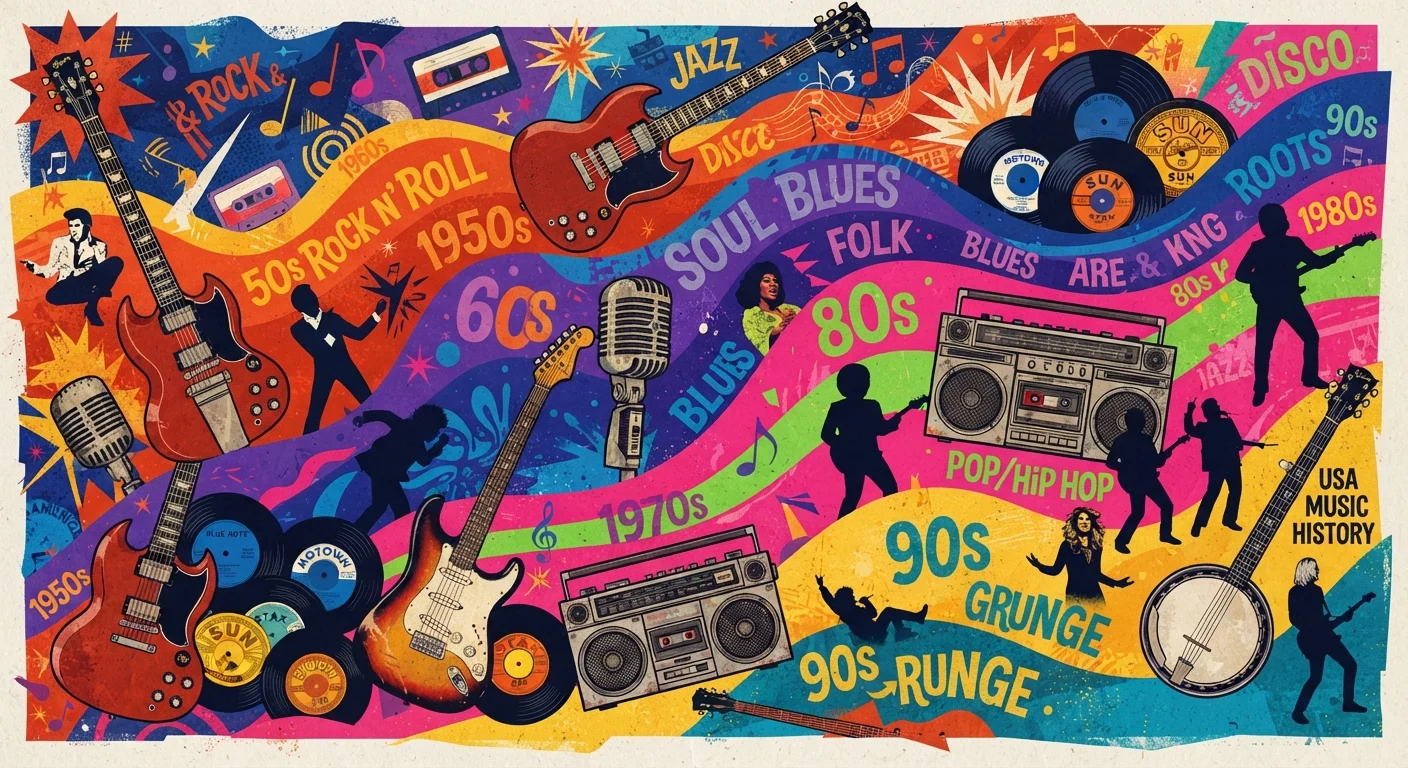
When Music Becomes a Movement
There's a difference between a hit song and a cultural earthquake. American music history is full of both - but it's the earthquakes that permanently shift the landscape. Certain movements didn't just dominate radio waves; they rewired how people dressed, talked, protested, fell in love, and understood themselves. The sounds were the surface. Underneath ran something far more powerful: a shared identity, a defiant energy, a sense of belonging that crossed lines of race, class, and geography.
Understanding these movements means looking past the Billboard charts and into the communities that created them - and the wider culture that absorbed, often commodified, and sometimes transformed them. Whether you're curious about why grunge T-shirts still hang in thrift stores or why Motown's chord progressions keep appearing in contemporary pop, the answer lives in the cultural fingerprints these eras left behind. For a deeper look at how individual artists navigate identity shifts within and across these eras, see our exploration of how musicians reinvent themselves between albums.
Motown and the Sound of Black Excellence
Founded in Detroit in 1959, Motown Records didn't just produce polished pop - it delivered a counter-narrative to the racial segregation defining American life. Artists like Marvin Gaye, Stevie Wonder, Diana Ross, and The Temptations brought Black artistry into white living rooms at a moment when integration was bitterly contested. The label's meticulous production style - lush strings, call-and-response vocals, irresistible hooks - became a blueprint for popular music worldwide.
But the fingerprint went deeper than music. Motown's choreography, wardrobe, and presentation modeled Black elegance in an era when mainstream media rarely did. The movement seeded a visual and cultural language of aspiration that echoed forward into soul, R&B, and contemporary pop.
Motown delivered Black artistry into mainstream America at a moment of fierce cultural resistance.
Punk and the Politics of Refusal
American punk - galvanized by New York acts like the Ramones and Television in the mid-1970s and later amplified by hardcore scenes in cities like Washington D.C. and Los Angeles - was an explicit rejection of rock's bloated excesses. Three chords, two minutes, a snarl. But punk's real legacy wasn't musical minimalism; it was the DIY ethic it installed in American youth culture.
Fanzines, self-released records, all-ages venues, and community-run spaces all trace their DNA to punk's insistence that you didn't need permission to create. That philosophy migrated into indie rock, zine culture, skateboarding, and eventually the early internet. The safety pin and the torn T-shirt became shorthand for an entire philosophy of self-determination.
Punk's true gift wasn't three-chord songs - it was the radical permission to create without gatekeepers.
Hip-Hop and the Remaking of American Language
Emerging from the South Bronx in the late 1970s, hip-hop began as a block-party phenomenon and became the defining cultural force of the late 20th and early 21st centuries. Its four elements - DJing, MCing, breakdancing, and graffiti writing - represented a complete cultural ecosystem born from communities with limited resources and unlimited creativity.
Hip-hop's fingerprint on American language is perhaps its most pervasive legacy. Slang coined in specific neighborhoods became mainstream American English within years. Fashion - from Adidas tracksuits to luxury streetwear - followed. And lyrically, hip-hop pushed narrative complexity, wordplay, and social commentary into the center of popular music. Today's genre hybrids - emo-rap, country-trap - all run through hip-hop's influence.
Hip-hop rewrote American slang, fashion, and narrative ambition from a single South Bronx block party outward.
Grunge and the Permission to Be Unpolished
Seattle's grunge explosion of the late 1980s and early 1990s arrived as a visceral rebuke to the glossy excess of arena rock and hair metal. Flannel shirts, uncombed hair, distorted guitars, and lyrics soaked in alienation - it was a sound that made imperfection feel honest. Bands like Nirvana, Soundgarden, and Pearl Jam weren't just successful; they repositioned authenticity as the highest value in American rock.
Grunge's cultural fingerprint shows up in fashion cycles that keep returning to oversized, worn-in aesthetics. More importantly, it normalized emotional rawness in rock music - the idea that vulnerability and anger could coexist in a single song - paving the way for the confessional strain running through alternative music ever since.
Grunge made emotional rawness and deliberate imperfection the most credible stance in American rock.
Trap and the Sound of the New American South
Trap music - rooted in Atlanta's hip-hop scene of the early 2000s and accelerating through the 2010s - transformed both the sonic palette of popular music and the cultural geography of American cool. Producers like Lex Luger and artists associated with labels and collectives based in the South built an aesthetic around 808 bass, hi-hat rolls, and unflinching accounts of economic hardship and street life.
But trap's fingerprint stretched far beyond its origins. Its production techniques migrated into pop, EDM, Latin music, and K-pop. Its fashion sensibility - designer labels worn as armor, heavy jewelry as achievement - influenced luxury brands and streetwear globally. Trap didn't just document a particular American experience; it exported that experience as an international aesthetic. Music documentaries can help unpack how movements like trap gain this kind of reach.
Trap turned Atlanta's sonic innovations into a global aesthetic that reshaped pop, fashion, and luxury culture.
Why These Fingerprints Never Fully Fade
What makes a music movement culturally durable isn't chart longevity - it's the degree to which it changed the conversation. The movements explored above each introduced new vocabularies: sonic, visual, political, and personal. They gave listeners frameworks for understanding the world around them, and that kind of meaning-making doesn't evaporate when the era ends.
Look Beyond the Music Itself
When tracing a movement's cultural impact, pay attention to what happened around the music: the magazines, the fashion, the slang, the political alignments. These peripheral elements often outlast the music trends themselves and tell the richer story of why a movement mattered. Documentaries, oral histories, and regional journalism are especially valuable windows into that fuller picture.
It's also worth noting that the internet and streaming have complicated how new movements form and spread. Without the gatekeeping of traditional radio or major label infrastructure, micro-movements emerge faster and fragment more quickly - though whether that produces the same deep cultural imprint is still an open question. Streaming reshaped music in ways artists didn't always anticipate, and that shift is still being felt. Nostalgia, too, plays a role in keeping older movements alive - revisiting why audiences keep returning to earlier decades reveals just how emotionally loaded these sounds remain. The cultural fingerprints endure precisely because the feelings that sparked them - rebellion, joy, grief, pride - are endlessly renewable.
The content on this site is for informational purposes only and is not a substitute for professional advice. Always consult a qualified professional for guidance specific to your situation.