

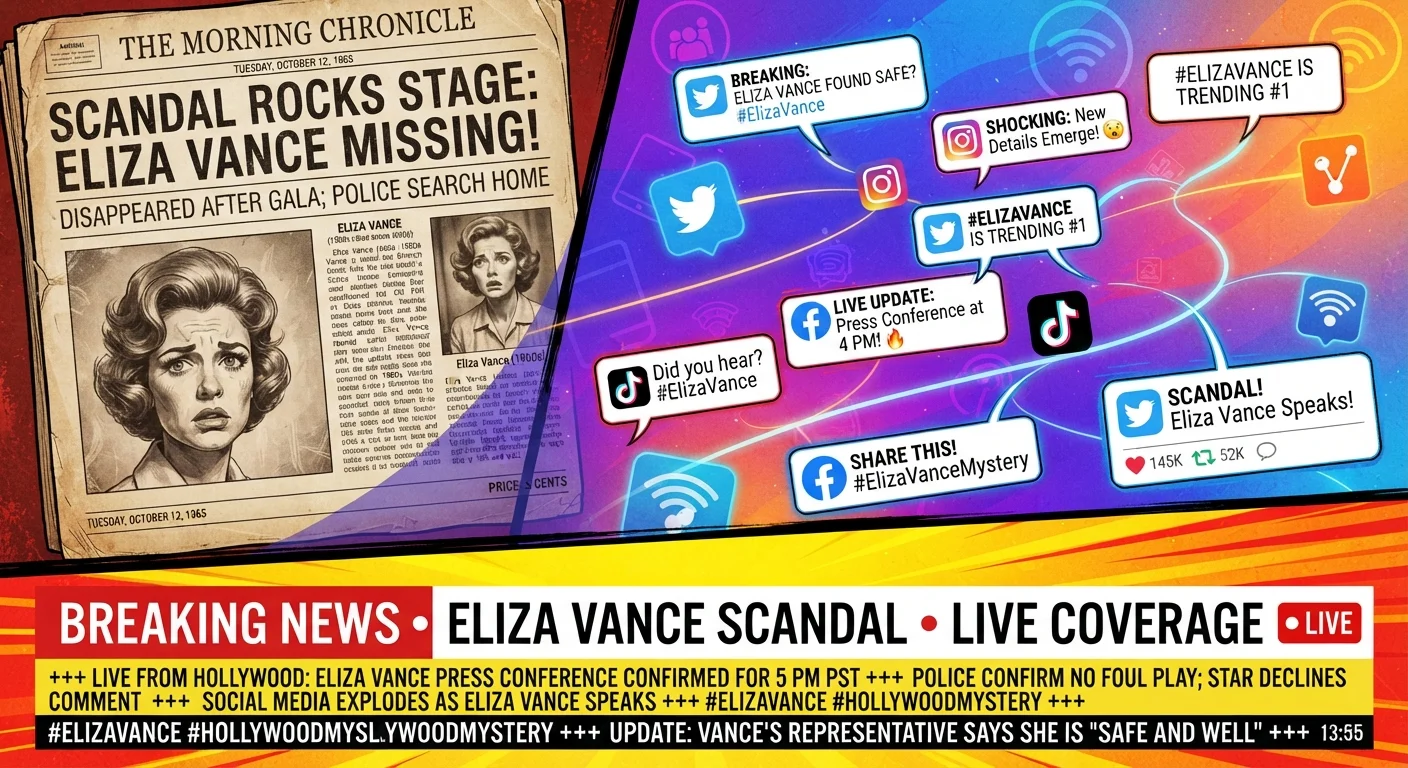
The Breaking News Moment
Every celebrity story starts with a spark - a paparazzi photo, a leaked statement, a candid post that gets screenshotted before deletion. This is the ignition phase, and it moves fast. Entertainment outlets race to verify and publish first, while wire services and aggregators syndicate details within minutes. The initial report is often incomplete; sourcing may hinge on a single unnamed insider or a single image.
At this stage, the line between tabloid speculation and legitimate entertainment journalism matters enormously. Outlets with higher sourcing standards will hedge with language like "sources say," while others publish assertions as fact. Readers who understand this distinction can gauge how much weight to give a fresh headline.
First Impressions Shape Lasting Perception
The framing established in the first wave of coverage tends to anchor public memory even when subsequent reporting corrects the record. Studies in media framing consistently show that corrections receive far less attention than original reports. Reading beyond the headline - and checking whether a story has been updated - is a meaningful act of information hygiene.
What gets reported in the first 24 hours frequently anchors public perception - even if later reporting significantly revises the facts. The first frame is hard to dislodge.
The Social Media Amplification Stage
Once a story is live, social platforms take over as the primary distribution engine. Twitter (now X), TikTok, Instagram, and Reddit each process the story through their own cultural filters. A clip gets remixed; a quote gets turned into a meme; a reaction video accumulates millions of views. The story is no longer just reported - it's performed and debated in real time.
This phase is where fan communities exert enormous influence. Devoted fanbases can flood trending topics, suppress negative hashtags, or organize coordinated responses that shift the dominant narrative. Casual audiences, meanwhile, often absorb the social consensus rather than the original reporting.
~48 hrs
Typical peak social engagement window for celebrity stories
Research on social media attention patterns consistently finds most viral celebrity stories peak in engagement within two days of breaking.
~10%
Stories that generate sustained long-form analysis
Industry observers estimate that only a small fraction of celebrity news items ever progress beyond the initial breaking-news and social-reaction phases into deeper editorial coverage.
Virality here doesn't guarantee longevity. A story that dominates for 48 hours on social media may vanish entirely by the following week, replaced by the next cycle's event.
The Analysis and Narrative-Building Phase
If a story survives the initial churn, it enters a more deliberate phase: think pieces, podcast episodes, YouTube video essays, and long-form features begin pulling at the threads. This is where context accumulates. Journalists revisit the original reporting, commentators place the event within the celebrity's broader arc, and cultural critics connect it to larger social patterns.
It's also when publicists begin their most active work, placing strategic interviews, coordinating "candid" sightings, or issuing carefully worded statements designed to guide interpretation. The celebrity's own social media posts - timed and calibrated - become part of the counter-narrative toolkit.
When a celebrity story breaks, give it 48-72 hours before forming strong opinions. The initial framing almost always shifts as more sourcing surfaces.
First-day reporting is frequently based on a single source or incomplete information; waiting allows the fuller picture to emerge before the narrative hardens.
Pay attention to the timing of a celebrity's response - a statement released on a Friday afternoon is a classic signal that the team expects the story to diminish over the weekend.
News cycles slow over weekends, so strategic communicators often use that window to release unfavorable information with minimal amplification.
For stories involving music artists or actors, their next professional project often becomes the vehicle for reframing the narrative. An album release or a high-profile role can redirect public attention with remarkable efficiency. See how this plays out in the music space and across film and television.
The Backlash, Reconsideration, or Forgetting Cycle
Most stories hit one of three fates after the analysis phase winds down: backlash, reconsideration, or quiet disappearance. Backlash can reverse a sympathetic early narrative - new information emerges, contradictions surface, or public mood shifts. Reconsideration moves in the opposite direction: a figure who was initially condemned may be reassessed as fuller context arrives or cultural attitudes evolve.
Forgetting is, statistically, the most common outcome. The vast majority of celebrity stories that once felt urgent simply stop generating engagement and drift out of the news cycle without resolution. Understanding how fame differs from notoriety and genuine influence helps predict which stories fade and which ones stick.
Feuds Have Long Half-Lives
Celebrity feuds rarely resolve cleanly. Even years-old conflicts can be re-ignited by a single public appearance, song lyric, or interview comment. Audiences and media outlets both have incentives to keep these narratives alive, which means a story you assume is closed may resurface with little warning.
Stories about celebrity feuds are particularly susceptible to cyclical resurfacing - a single new interview or award-show moment can reignite a conflict the public assumed was settled.
When a Story Becomes Cultural Memory
A rare subset of celebrity stories transcends the news cycle entirely and embeds itself in the broader cultural record. These stories get referenced in documentaries, cited in academic media studies, parodied in sketch comedy years later, and taught in journalism courses. They become shorthand - a single name or phrase that immediately evokes an entire era's anxieties or fascinations.
What separates these stories from the forgettable majority? Usually a combination of timing, symbolic weight, and repetition. They tend to arrive at cultural inflection points, involve figures who already carry outsized public investment, and get retold enough times - across enough formats - that they calcify into shared reference points. Think of them as the stories that didn't just happen to the culture; they happened with it.
“The media doesn't just report on celebrities - it constructs them. Every editorial choice about what to cover, how long to cover it, and what angle to lead with is a form of authorship.”
— Neil Postman, Media theorist and author of 'Amusing Ourselves to Death'
For audiences, recognizing this lifecycle in real time is its own form of media literacy - a way to ask not just "what happened?" but "where is this story in its arc, and who is shaping it right now?" That question, more than any single headline, is the most useful lens for navigating the relentless churn of celebrity news.
The content on this site is for informational purposes only and is not a substitute for professional advice. Always consult a qualified professional for guidance specific to your situation.