

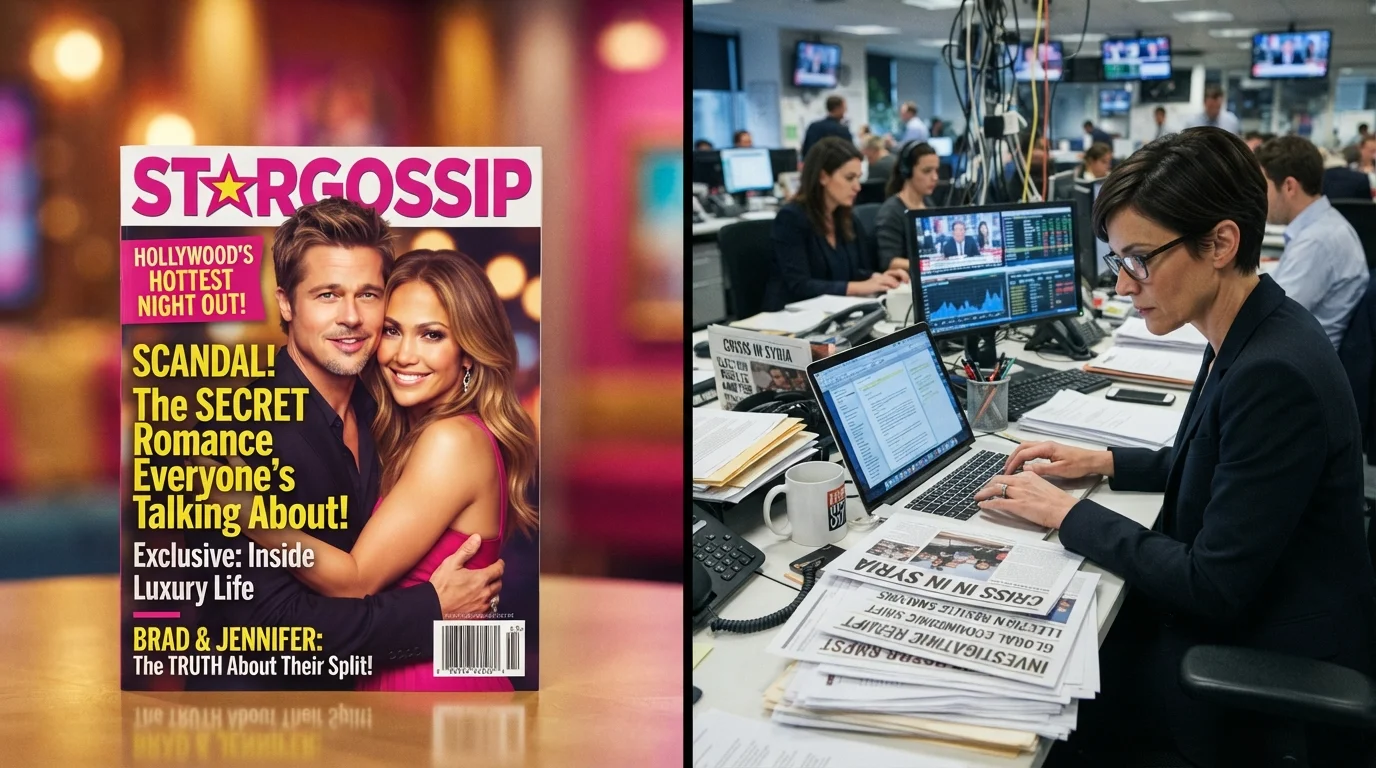
Option A
Tabloid Media
The fast-moving, sensation-first wing of celebrity coverage.
Best for: Readers who want immediate, emotionally engaging celebrity stories with maximum cultural buzz.
Option B
Entertainment Journalism
The standards-driven, context-rich approach to covering pop culture.
Best for: Readers who want verified, sourced coverage of the entertainment industry with editorial accountability.
What Actually Separates Them
At their core, tabloid media and entertainment journalism are after the same thing: the stories about public figures that audiences can't stop talking about. But the methods - and accountability - diverge sharply.
Tabloid media operates on a speed-first model. Stories go live based on tips, anonymous sourcing, paparazzi imagery, or social media inference. Attribution is vague by design; phrases like "insiders say" or "those close to the situation" allow publication without naming - or fully verifying - a source. The business model rewards clicks and emotional response, which means headlines lean dramatic and details can be thin.
Entertainment journalism, at its disciplined best, applies the same sourcing and verification standards used in political or financial reporting. Reporters seek on-record comment from publicists or talent representatives, cross-reference claims across multiple sources, and run corrections when facts prove wrong. The language entertainment outlets use actually signals a lot about their process - and knowing how to read it matters.
| Criterion | Tabloid Media | Entertainment Journalism |
|---|---|---|
| Primary goal | Maximum engagement, speed | Accurate, contextualized reporting |
| Source transparency | Vague ('insiders say') | Named or verified where possible |
| Correction culture | Rarely issues corrections | Editorial corrections expected |
| Story origin | Tips, paparazzi, social media | On-record interviews, press access |
| Speed vs. accuracy trade-off | Prioritizes speed | Prioritizes accuracy |
| Influence on mainstream media | Often sets early agenda | Confirms or debunks tabloid claims |
How the Lines Blur in the Social Media Era
The distinction that once felt clear - supermarket tabloid vs. reputable entertainment magazine - has grown considerably murkier. Several forces are responsible.
First, the 24-hour news cycle pressures even legacy entertainment outlets to publish before full verification, narrowing the gap with tabloid practice. Second, social platforms have made every user a potential tipster, so stories that once circulated only in tabloid ecosystems now reach mainstream audiences within hours. Third, and perhaps most significantly, tabloid exclusives are often confirmed by traditional outlets days or weeks later - meaning tabloids effectively set the news agenda even when they aren't considered authoritative.
Understanding how celebrity stories move from rumor to headline reveals just how porous the barrier between tabloid tip and confirmed news actually is. A story might begin as a grainy photo on a celebrity gossip site, get picked up by mid-tier entertainment blogs, and land in a verified feature piece at a major outlet - each step adding credibility but rarely acknowledging the tabloid origin.
~50%
Americans who get news from social media
Pew Research Center studies have consistently found roughly half of U.S. adults encounter news - including celebrity and entertainment stories - via social platforms, accelerating tabloid-style content's reach.
4-72 hrs
Typical lag before mainstream confirmation
Media analysts have observed that tabloid celebrity exclusives, when ultimately confirmed, are typically verified by mainstream entertainment outlets within hours to a few days.
Sourcing, Standards, and Accountability
The most practical way to evaluate any celebrity story is to ask: Who is the source, and what's their relationship to the subject? Tabloid outlets rarely answer that question transparently. Entertainment journalism outlets, when operating correctly, build their credibility on doing exactly that.
Consider how celebrity stories evolve through the media lifecycle - early tabloid claims often get either confirmed or quietly dropped as more reporting emerges. Outlets that practice genuine entertainment journalism issue corrections; tabloids typically let inaccurate stories slide off the front page without acknowledgment.
This also affects public figures themselves. A tabloid story, even a false one, can shape public perception before a correction reaches the same audience. That's why the distinction between fame, notoriety, and influence is partly a product of which outlets cover a figure and how.
A Note on 'Sources Close To'
The phrase 'sources close to [subject]' is one of the most common signals in celebrity coverage - and one of the most ambiguous. In entertainment journalism with editorial standards, it typically means a source with direct knowledge who has asked for anonymity. In tabloid contexts, it can mean almost anyone with a tenuous connection. Understanding this distinction is a useful first step in evaluating any celebrity story you encounter. For a deeper breakdown, see how entertainment media language works in practice.
Why It Matters for Readers
Media literacy around celebrity coverage isn't a trivial skill - it shapes how we process information across every topic. If you've absorbed the tabloid habit of treating unverified claims as likely true, that pattern can carry into how you engage with news on health, politics, or finance.
Approaching entertainment coverage critically means asking whether a story names sources, whether the outlet has a correction policy, and whether competing outlets have confirmed the same facts. It also means appreciating that tabloids and entertainment journalism serve genuinely different cultural functions: one is a first-alert system for cultural conversation; the other is a record of verified fact. Both have value when you know which one you're reading.
The entertainment landscape - from streaming drama to celebrity culture - is more documented than ever. That documentation is only as reliable as the sourcing behind it.
The content on this site is for informational purposes only and is not a substitute for professional advice. Always consult a qualified professional for guidance specific to your situation.