

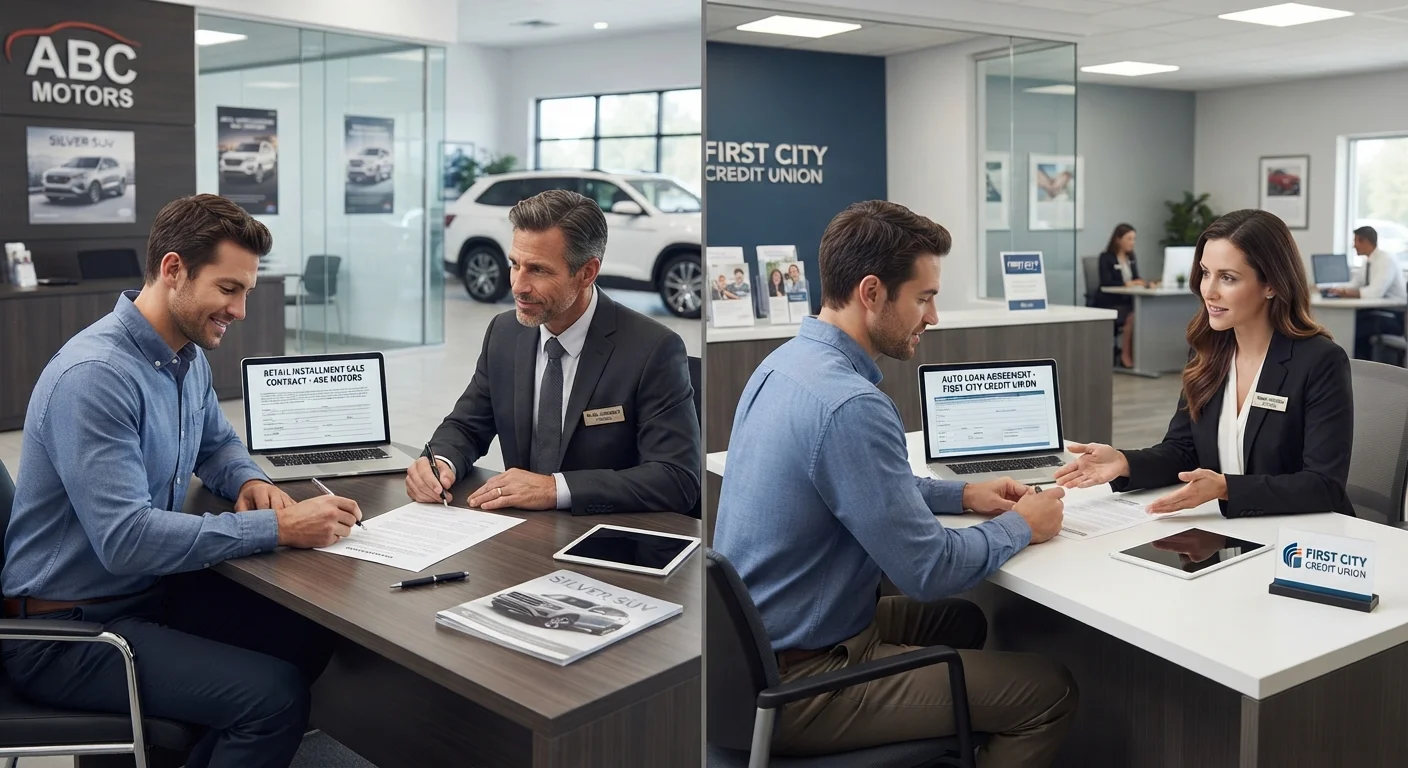
Option A
Dealer Financing
The convenient, one-stop lending arrangement.
Best for: Buyers who want a streamlined purchase process and may qualify for manufacturer-backed promotional rates.
Option B
Bank or Credit Union Financing
The independent, pre-arranged lending alternative.
Best for: Buyers who want rate transparency and negotiating leverage before stepping into a dealership.
How Each Financing Path Works
When you finance through a dealership, the dealer acts as an intermediary. You apply for credit at the dealership, which then submits your application to one or more lenders - banks, credit unions, or the manufacturer's own finance company. The lender sets a base rate; the dealer may add a markup (sometimes called a "dealer reserve") and keep the difference as compensation. The result is a single loan you sign at the dealership.
Direct lending works differently. You apply with a bank or credit union before visiting the dealership, receive a conditional pre-approval, and bring that offer with you. The lender funds the purchase directly, and the dealer is paid as though you were a cash buyer. Your credit score plays a central role in the rate both types of lenders offer you.
Understanding how each channel is structured - and who profits from each step - helps you evaluate offers on an equal footing. Auto loans are secured debt, meaning the vehicle serves as collateral; for a broader look at what that means for your obligations, see our overview of secured vs. unsecured debt.
| Criterion | Dealer Financing | Bank or Credit Union Financing |
|---|---|---|
| Application location | At the dealership | Online, by phone, or in-branch |
| Rate transparency | Rate may include dealer markup | Rate quoted directly by lender |
| Promotional APR offers | Available (manufacturer programs) | Not available |
| Negotiating position | Rate set after vehicle is selected | Pre-approval known before visit |
| Speed of funding | Same-day in most cases | May take 1-3 business days |
| Number of lenders considered | Multiple, via dealer network | One lender per application |
| Credit inquiry type | Multiple hard pulls possible | One hard pull per lender |
The Real Trade-Offs to Weigh
Dealer financing's main advantage is convenience - one location, one set of paperwork, often same-day funding. Dealers also have access to manufacturer promotional rates, such as low or zero-percent APR incentives, that outside lenders simply cannot offer. These programs are typically limited to specific models, trim levels, and credit tiers, so not every buyer qualifies.
The downside is opacity. Because the dealer can adjust the rate within lender guidelines, buyers who don't comparison-shop may pay more than necessary without realizing it. Monthly payment framing - "Can you afford $X per month?" - can also obscure the total loan cost, including the interest rate and term length.
Bank and credit union financing trades convenience for transparency and leverage. With a pre-approval in hand, you know your ceiling rate before the conversation starts. Credit unions in particular often provide rates competitive with or below commercial banks, given their nonprofit structure. The practical friction is real: you must apply separately, and the funds may not arrive instantly.
~80%
New car buyers who finance at the dealership
Consumer Financial Protection Bureau research has indicated that the large majority of new vehicle purchases involve dealership-arranged financing rather than direct lending.
0.5-2.5%
Typical dealer interest rate markup range
Industry observers have reported that dealer reserve markups on indirect auto loans commonly fall within this range above the lender's buy rate, though caps vary by lender and regulation.
Whichever path you choose, read the full agreement carefully before signing. APR, loan term, prepayment penalties, and bundled add-ons all affect total cost. Our guide to reading a car loan agreement walks through the fine print in detail.
If circumstances change after you sign, refinancing a car loan may be an option worth evaluating - particularly if rates have dropped or your credit profile has improved since origination.
Rate Shopping and Your Credit Score
Applying to multiple lenders within a short window - generally 14 to 45 days depending on the scoring model - typically counts as a single hard inquiry for scoring purposes. This means comparing offers from a bank, a credit union, and a dealer's lender simultaneously is less damaging to your credit than it might seem. Check the specific guidelines of the scoring model your lenders use, as practices can differ.
The content on this site is for informational purposes only and is not a substitute for professional advice. Always consult a qualified professional for guidance specific to your situation.