

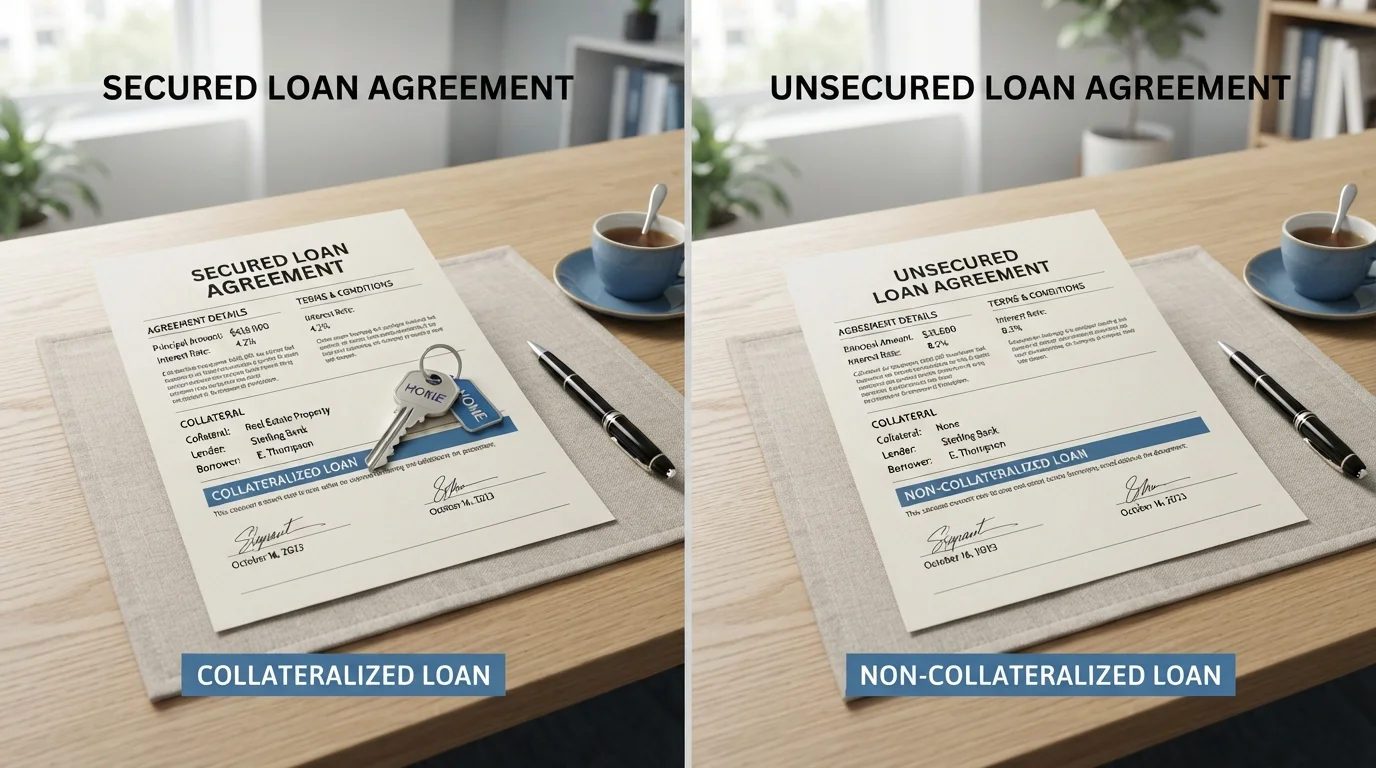
Option A
Secured Debt
Collateral-backed borrowing with lower rates and higher stakes.
Best for: Consumers financing large purchases - such as a home or vehicle - who can accept the risk of asset loss in exchange for more favourable terms.
Option B
Unsecured Debt
Signature-based credit that relies on your creditworthiness alone.
Best for: Borrowers who need flexible financing without pledging an asset, and who understand they may pay higher interest as a result.
What Makes Debt 'Secured' or 'Unsecured'?
The single defining difference between secured and unsecured debt is collateral - an asset you pledge to the lender as a guarantee of repayment. With secured debt, the lender has a legal claim on that asset. With unsecured debt, no such claim exists; the lender extends credit based solely on your creditworthiness.
Common examples of secured debt include mortgages, where the home is the collateral, and auto loans, where the vehicle serves that role. Unsecured debt includes most credit cards, personal loans, medical bills, and student loans (though federal student loans carry their own unique rules).
Before exploring either category, it helps to be familiar with foundational terminology. Our glossary of key credit and debt terms covers concepts like APR and charge-off that appear frequently in borrowing conversations.
| Criterion | Secured Debt | Unsecured Debt |
|---|---|---|
| Collateral required | Yes - asset pledged to lender | No - creditworthiness only |
| Typical interest rate | Generally lower | Generally higher |
| Common examples | Mortgage, auto loan, home equity loan | Credit card, personal loan, medical debt |
| Borrowing limits | Can be large (tied to asset value) | Often smaller or credit-score-capped |
| Default consequence | Repossession or foreclosure | Collections, credit damage, possible judgment |
| Credit score impact | Affects mix and payment history | Also affects utilisation ratio |
How Each Type Affects Interest Rates and Borrowing Power
Because secured lenders can recoup losses by seizing and selling collateral, they assume less risk - and that reduced risk usually translates into lower interest rates for the borrower. A mortgage, for example, will almost always carry a lower rate than an unsecured personal loan of a comparable amount.
Unsecured lenders have no fallback asset, so they compensate by charging higher rates and often imposing stricter credit score requirements. Your credit profile - payment history, utilisation ratio, and length of credit history - carries far more weight when no collateral is involved.
~$17.5T
Total US household debt (secured + unsecured)
According to the Federal Reserve Bank of New York's Household Debt and Credit Report, total US household debt has reached multi-trillion-dollar levels, with mortgage debt comprising the largest share.
3-5×
Rate premium on unsecured vs. secured credit
Interest rates on unsecured personal loans and credit cards can be several times higher than comparable secured debt, reflecting the absence of collateral and increased lender risk.
~70%
Share of household debt that is mortgage-related
Federal Reserve data consistently shows that mortgage debt - the most common form of secured debt - accounts for the majority of total US household liabilities.
Borrowing limits also differ. Secured debt can scale to the value of the underlying asset (a home loan can reach hundreds of thousands of dollars). Unsecured personal loans and credit lines are typically capped at amounts lenders judge recoverable through the collections process alone.
Consequences of Default: What Each Lender Can Do
Understanding the consequences of non-payment is arguably the most practical reason to know which type of debt you carry.
With secured debt, the lender's primary remedy is to take the collateral. Miss enough mortgage payments and the lender initiates foreclosure. Fall behind on an auto loan and the vehicle may be repossessed - often with little notice. These outcomes can happen relatively quickly and have lasting effects on housing and transportation stability.
With unsecured debt, lenders cannot seize an asset directly. Instead, they typically pursue collections contact, report the delinquency to credit bureaus, and may eventually sue to obtain a court judgment. A judgment can lead to wage garnishment in many states, so unsecured default is not consequence-free - it simply plays out differently.
If you are already feeling overwhelmed, our article on signs that debt has become unmanageable outlines warning indicators and general options worth exploring.
Debt Type and Your Credit Score
Both secured and unsecured debts appear on your credit report and influence your score, but they interact with scoring models in distinct ways. Secured installment loans (mortgages, auto loans) contribute to your credit mix - one factor scoring models consider - and demonstrate long-term repayment behaviour when managed well.
Unsecured revolving credit, such as credit cards, has an outsized impact on your credit utilisation ratio (the share of available revolving credit you are using). Keeping that ratio low is one of the more actionable steps borrowers can take to protect their scores. For a deeper look at how installment and revolving accounts compare, see revolving credit vs. installment loans.
If you are managing a mix of both debt types and considering simplification, it is worth reading about when debt consolidation helps and when it doesn't before making any changes.
This article is for general informational purposes only and does not constitute personalised financial, legal, or investment advice. Consult a licensed financial adviser or credit counsellor for guidance specific to your circumstances.
The content on this site is for informational purposes only and is not a substitute for professional advice. Always consult a qualified professional for guidance specific to your situation.