

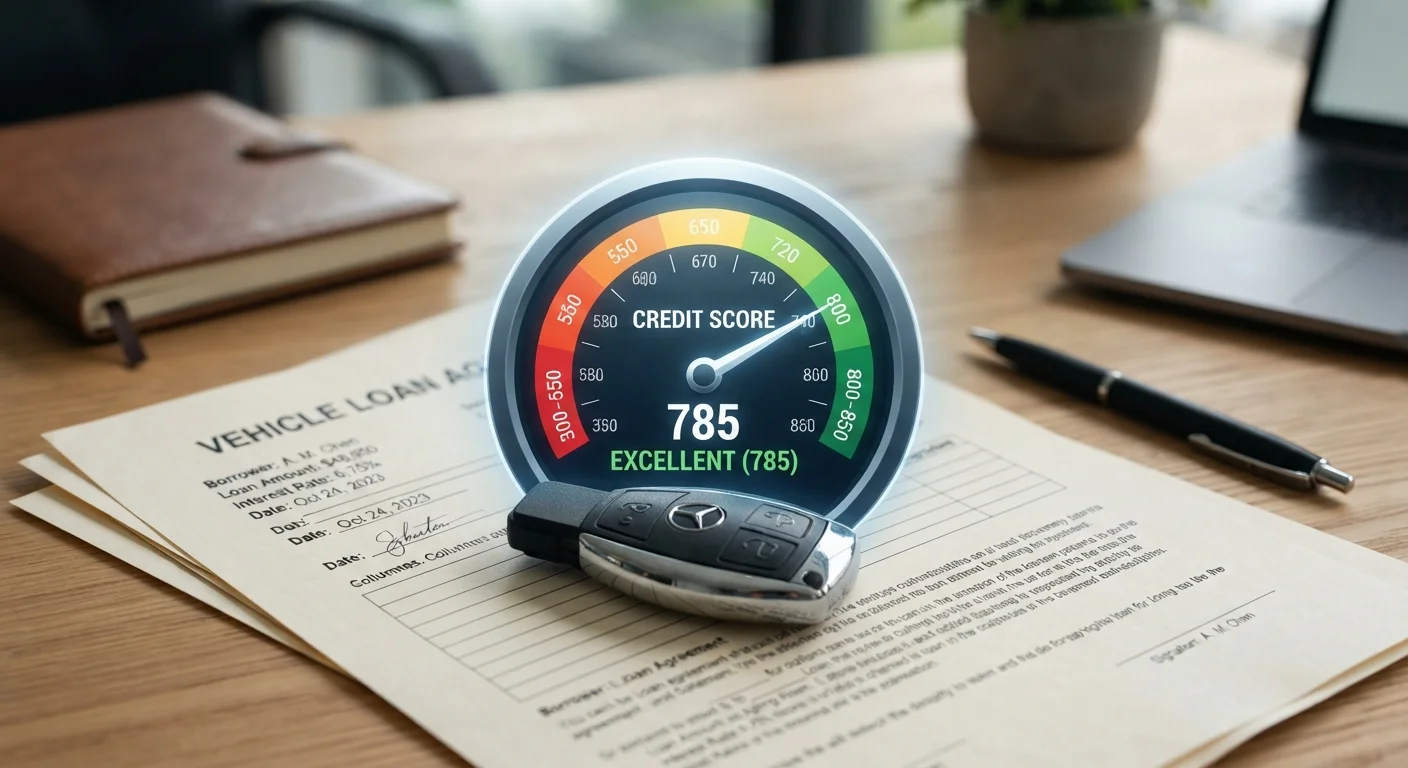
How Lenders Translate Your Score Into a Rate
When you apply for auto financing, lenders don't just look at a single number in isolation. Your credit score functions as a sorting mechanism that places you into a risk tier. Each tier carries a corresponding interest rate range. Borrowers in the highest tier - often called prime or super-prime - receive the lowest rates, while those in lower tiers pay progressively more for the same loan amount.
Lenders set these tiers based on statistical risk models: historically, borrowers with lower scores have defaulted at higher rates, so lenders price that risk into the APR. This isn't a judgment about your character - it's an actuarial calculation. Understanding that helps you approach the process strategically rather than emotionally.
~100+ pts
Typical score spread between prime and subprime tiers
Credit bureaus and industry analysts generally define prime borrowers as those with FICO scores of 660 and above, while subprime typically begins below 580.
$6,000+
Potential extra interest paid by subprime borrowers
Illustrative calculation based on a $28,000, 60-month loan comparing a 6% APR against a 14% APR - rates representative of different risk tiers.
3
Major credit bureaus reporting your history
Equifax, Experian, and TransUnion each maintain independent credit files; lenders may pull from one or more when evaluating an auto loan application.
The Real Dollar Cost of a Lower Score
Abstract percentages become concrete when you run the numbers. Consider a $28,000 vehicle loan with a 60-month term. At a 6% APR, the total interest paid over the life of the loan is roughly $4,400. At 14% APR - a rate more typical for a borrower in a subprime tier - the total interest climbs to approximately $11,100. That's a difference of nearly $6,700 for the exact same vehicle.
This is why financial educators consistently emphasize reviewing and, where possible, improving your credit profile before applying for a loan. Even moving one tier - for example, from a fair score into a good score range - can meaningfully reduce your APR.
For broader context on how different types of credit accounts interact with your score, see our guide to revolving credit vs. installment loans.
Rate-Shop Within a Short Window
When comparing auto loan offers from multiple lenders, try to submit all applications within a 14- to 45-day period. Most scoring models consolidate those inquiries into a single hard pull, limiting the temporary score impact. Getting pre-approved by a bank or credit union before visiting a dealership also gives you a baseline rate to negotiate against.
What You Can Do Before You Apply
You are entitled to a free copy of your credit report from each of the three major bureaus - Equifax, Experian, and TransUnion - through AnnualCreditReport.com. Reviewing these reports before shopping for a loan lets you identify any errors or outdated negative items that may be dragging your score down. Disputing inaccuracies is a legitimate and federally protected process under the Fair Credit Reporting Act (FCRA).
Beyond error correction, paying down revolving balances and avoiding new credit applications in the months leading up to a car purchase can provide a modest score lift. These steps don't guarantee a specific outcome, but they put you in the strongest possible position before a lender evaluates your file.
Your Score May Look Different to Lenders
The credit score displayed on consumer apps or bank dashboards is often a generic FICO or VantageScore version. Auto lenders may instead pull an industry-specific FICO Auto Score, which weights certain factors - like previous auto loan repayment history - differently. The gap between the two versions is usually modest, but it's worth knowing the score you see may not be the exact score a lender uses.
For a broader foundation on managing the credit side of car ownership and personal finance, the Credit & Debt hub covers key concepts in plain language.
This article is for general informational purposes only and does not constitute financial or legal advice. Consult a qualified financial professional for guidance specific to your circumstances.
Frequently Asked Questions
Most lenders will consider applicants across a wide range of scores, but borrowers with scores above 660 generally qualify for more competitive rates. Those with scores below 580 may still get approved but typically face significantly higher interest rates or stricter loan terms.
The difference can be substantial. On a $30,000 loan over 60 months, the spread between a top-tier and subprime interest rate can translate to hundreds of dollars more per month and thousands more over the life of the loan. Running loan scenarios with different APRs using an online loan calculator can illustrate the impact clearly.
Each hard inquiry from a lender can temporarily lower your score by a few points. However, most credit scoring models treat multiple auto loan inquiries made within a short window - typically 14 to 45 days - as a single inquiry, so rate-shopping multiple lenders in that period has a limited impact.
Refinancing is an option if your credit score improves significantly after the original loan is issued. You would apply for a new loan with a different lender to pay off the original, ideally at a lower rate. Consult a licensed financial professional to evaluate whether refinancing makes sense for your situation.
Not always. Auto lenders often use FICO Auto Scores, which are industry-specific versions of the standard FICO model and may differ from the score shown on consumer credit monitoring services. The score you see is still a useful directional indicator of your creditworthiness.
The content on this site is for informational purposes only and is not a substitute for professional advice. Always consult a qualified professional for guidance specific to your situation.