

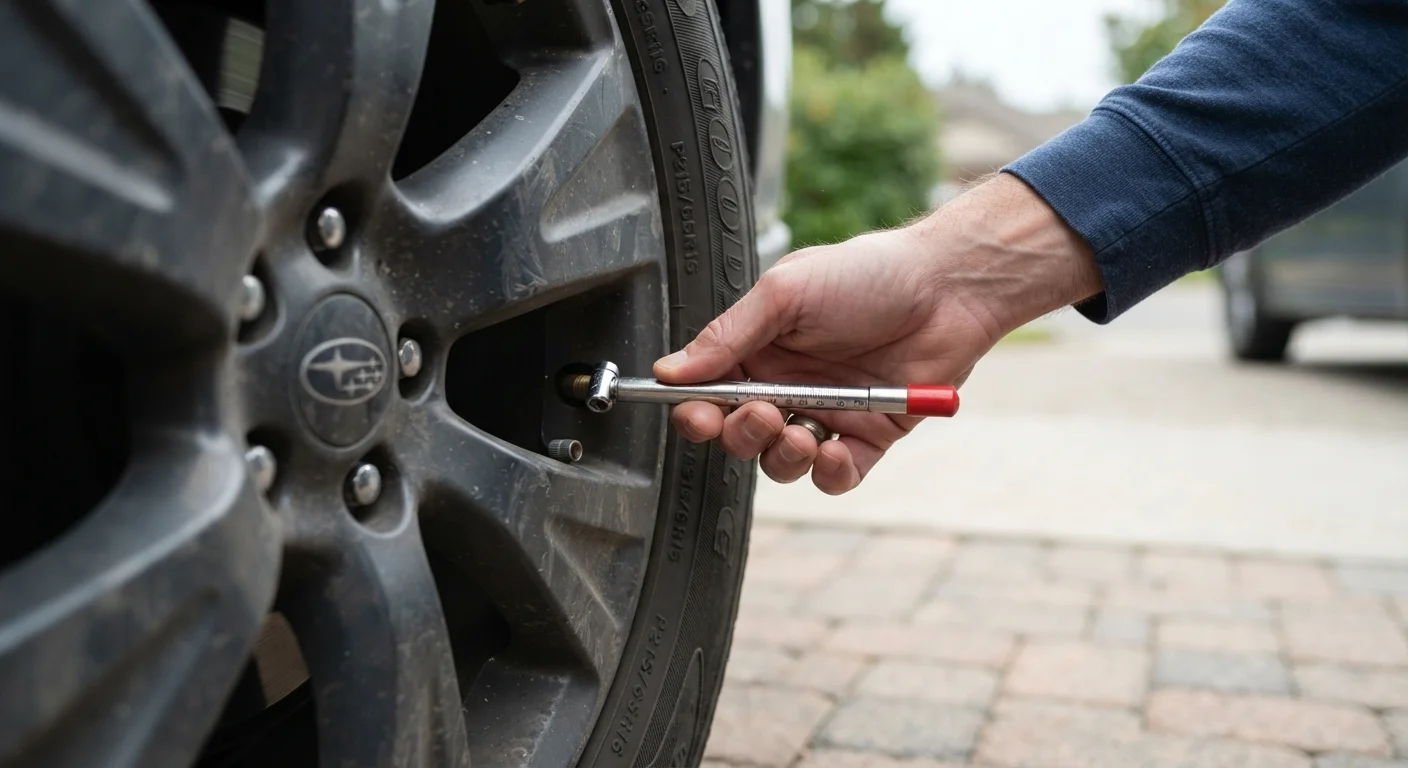
What PSI Means and Where to Find Your Number
PSI stands for pounds per square inch - the unit used to measure the air pressure inside your tires. When people talk about tire pressure, PSI is the number they're referring to. Most passenger vehicles call for somewhere between 30 and 35 PSI, though the exact figure depends on your specific vehicle and tire combination.
The single most important thing to understand: the correct PSI for your car is not written on the tire. The number stamped on the tire sidewall is the maximum pressure that tire can safely hold - a structural limit, not a driving recommendation. Your vehicle's recommended pressure is on a sticker inside the driver's door jamb, or in your owner's manual. Front and rear tires sometimes require different pressures, so check both.
Front and Rear Tires May Differ
Some vehicles specify different PSI for front and rear tires, particularly trucks, SUVs, and rear-wheel-drive vehicles carrying varying loads. Always check the door jamb sticker rather than assuming all four tires take the same pressure - using the wrong number for an axle can affect handling balance.
Why Under-Inflation Is the More Common - and Costly - Problem
Tires lose air naturally over time, even without punctures. A typical tire loses about 1 PSI per month under normal conditions. Seasonal temperature swings accelerate this: tire pressure drops roughly 1 PSI for every 10°F drop in outside temperature. That means a tire properly inflated in summer may be noticeably low by January without a single slow leak.
Running under-inflated tires carries real costs across several areas:
- Fuel economy: Under-inflated tires increase rolling resistance - the engine works harder to move the vehicle. The U.S. Department of Energy has noted that proper inflation can improve gas mileage meaningfully over time.
- Tire lifespan: Low pressure causes the tire's shoulders (outer edges) to wear faster than the center, shortening tread life and leading to earlier replacement.
- Handling and safety: Soft tires respond more slowly to steering inputs and can overheat at highway speeds, increasing blowout risk. This matters even more in adverse weather - see how weather affects your car's handling for more on traction and control.
~1 PSI
Pressure lost per 10°F temperature drop
A widely cited rule of thumb supported by the U.S. Department of Transportation and tire industry guidance.
1 PSI/month
Typical natural air loss per tire
Even undamaged tires lose pressure gradually through the valve stem and tire material, making regular checks necessary.
25% below
TPMS trigger threshold
Federal TPMS regulations require the warning light to activate when pressure falls to 25% below the vehicle's recommended level.
How to Check Tire Pressure Correctly
Checking tire pressure is a straightforward task that takes under two minutes per tire. It's a core part of what everyday drivers can safely handle at home. Here's how to do it right:
- Check when tires are cold. Drive less than a mile at low speed, or check before driving. Heat from driving temporarily increases pressure, which skews the reading.
- Remove the valve cap from the tire's valve stem - the small rubber or metal post on the inner wheel edge.
- Press a tire gauge firmly onto the valve stem. A digital gauge is easier to read than a stick gauge, but both work. Gas station gauges are often inaccurate; a dedicated gauge you own is more reliable.
- Read the PSI and compare it to your door jamb sticker. Add air if low; release air if over by pressing the small pin inside the valve stem.
- Replace the valve cap after checking.
Repeat monthly, before road trips, and whenever the temperature drops significantly. Don't forget the spare - a flat spare is useless in an emergency.
Keep a Gauge in Your Glove Box
A basic digital tire pressure gauge costs only a few dollars and fits easily in your glove compartment. Gas station gauges are often worn or miscalibrated - having your own means you get an accurate reading every time, no matter where you are.
Understanding Your TPMS Light - and Its Limits
Most vehicles built after 2008 are required by federal law to include a Tire Pressure Monitoring System (TPMS) - a sensor-based system that triggers a dashboard warning light when pressure in one or more tires drops to approximately 25% below the recommended level. That's a meaningful safety threshold, but it has limitations drivers should understand.
The TPMS light is a reactive alert, not a real-time pressure gauge. By the time it illuminates, the tire is already well below its optimal range. It won't tell you which tire is low (on most vehicles without a more advanced display), and it won't catch gradual drops that haven't yet hit the trigger threshold. This is why monthly manual checks matter - you'll catch a tire drifting low well before the warning light ever appears.
If your TPMS light comes on, add air as soon as safely possible and verify the pressure manually with a gauge. If the light stays on after inflating all tires, a sensor may need service. For a broader look at what warning lights indicate and how urgently to respond, see our dashboard warning lights guide.
Tire pressure is one of the simplest things a driver can monitor, and one of the most consequential when ignored. A gauge, two minutes a month, and awareness of seasonal changes is all it takes to keep this basic system working in your favor. For broader context on how vehicle mechanics connect to road safety, the Driving & Safety hub is a useful starting point.
Frequently Asked Questions
Look for a sticker on the inside edge of the driver's door or door jamb. Your owner's manual also lists it. Do not use the maximum PSI printed on the tire sidewall - that is the tire's limit, not your vehicle's recommendation.
A monthly check is a practical standard for most drivers. You should also check before long road trips and whenever outside temperatures shift significantly, since cold weather causes pressure to drop noticeably.
Yes. Over-inflation causes the center of the tread to carry too much load, leading to uneven wear and a harsher ride. Over-inflated tires also lose some grip because less rubber contacts the road surface.
The Tire Pressure Monitoring System (TPMS) light indicates that one or more tires has dropped to a level significantly below the recommended PSI - typically 25% below. It is a warning, not a real-time gauge, so you still need to check each tire manually.
You should address it as soon as safely possible. Driving on significantly under-inflated tires increases blowout risk and degrades handling. See <a href="/autos/car-maintenance/your-cars-dashboard-warning-lights-decoded">what dashboard warning lights mean</a> for more context on how urgent different alerts are.
Yes. Both under- and over-inflation reduce the tire's ability to maintain optimal contact with the road, which can extend stopping distances - especially on wet or slippery surfaces.
The content on this site is for informational purposes only and is not a substitute for professional advice. Always consult a qualified professional for guidance specific to your situation.