

What Energy Labels Actually Tell You
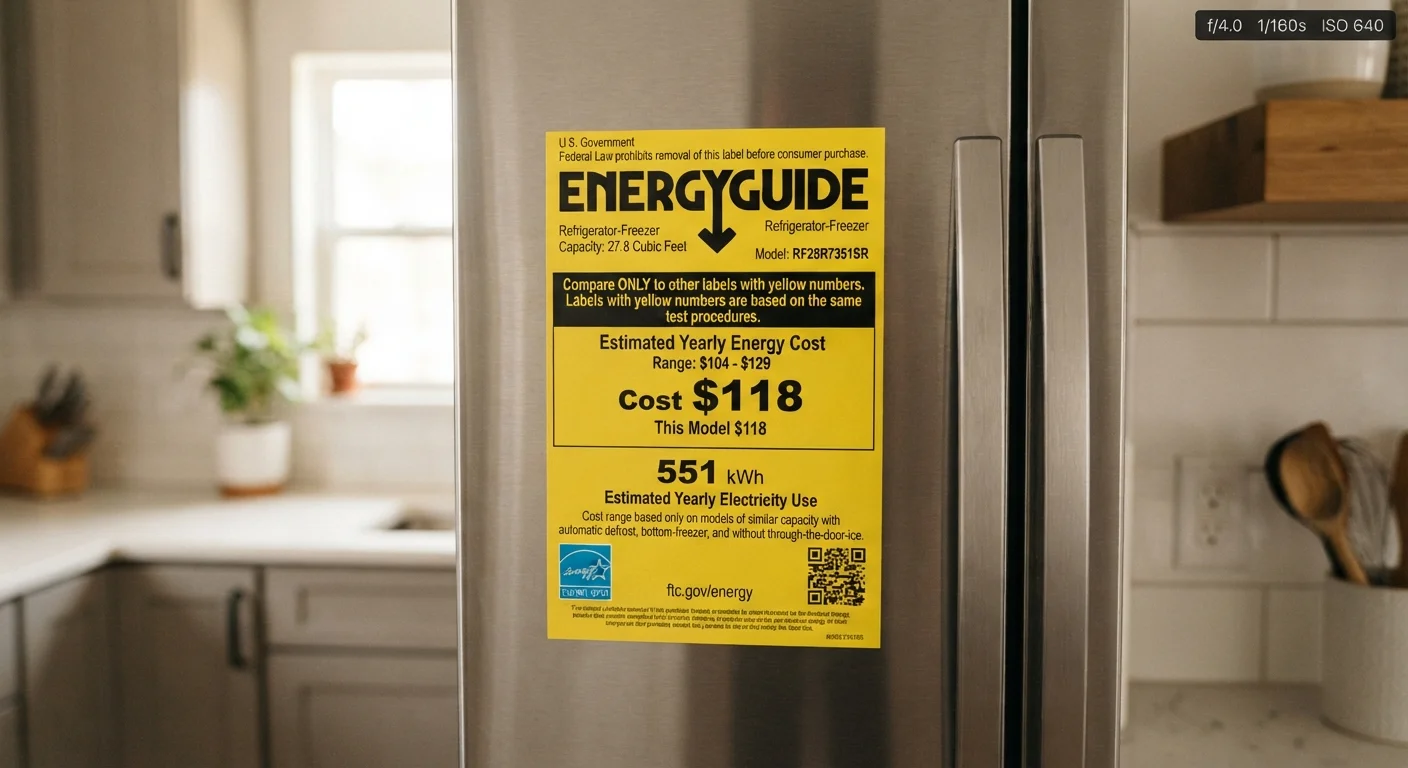
Energy labels are standardized disclosures - not marketing materials. In the U.S., the EnergyGuide label (administered by the Federal Trade Commission) is required on most major appliances and displays estimated annual energy consumption or efficiency ratings. The yellow-and-black label compares a specific model against a range of similar products, helping consumers gauge relative efficiency.
However, the label looks different depending on the appliance category. Refrigerators show estimated kilowatt-hours per year. Air conditioners show a SEER or EER rating. Washers use an Integrated Modified Energy Factor. Understanding which metric applies - and what it means - is the core skill. For a broader look at decoding specs, see our guide to reading product specifications.
| Label Administrator | Federal Trade Commission (FTC) (FTC EnergyGuide Program) |
| Appliances Requiring Labels | Refrigerators, washers, dryers, dishwashers, water heaters, furnaces, central A/C, heat pumps, and more (FTC CFR Title 16, Part 305) |
| Metric: Refrigerators | Estimated annual kWh |
| Metric: Central A/C & Heat Pumps | SEER2 (cooling), HSPF2 (heating) (Updated standard effective January 2023) |
| Metric: Furnaces & Boilers | AFUE percentage |
| Metric: Clothes Washers | IMEF (higher = more efficient) |
Kitchen Appliances: Refrigerators and Dishwashers
Refrigerators display estimated annual energy use in kWh. A lower kWh number means lower operating costs. The label also shows where that model falls within a comparison range for similar-sized units - useful context since a large French-door refrigerator will always consume more than a compact unit, even at peak efficiency.
Dishwashers report estimated annual energy cost (in dollars) and estimated annual water use (in gallons). Both figures assume a set number of cycles per year - typically 215 - so real-world costs will vary based on actual usage frequency and local utility rates.
EnergyGuide Label
A yellow label mandated by the U.S. Federal Trade Commission on most major appliances. It displays estimated annual energy consumption or an efficiency rating, along with a comparison range for similar models.
kWh (Kilowatt-Hour)
The standard unit for measuring electrical energy consumption. One kilowatt-hour equals one kilowatt of power used continuously for one hour. Utility bills are priced in kWh.
SEER2
Seasonal Energy Efficiency Ratio 2. Measures the cooling output of an air conditioner or heat pump relative to the electrical energy it consumes over an entire cooling season, under updated 2023 test conditions.
AFUE
Annual Fuel Utilization Efficiency. A percentage representing how much of the fuel consumed by a furnace or boiler is converted into usable heat. Higher percentages mean less waste.
IMEF
Integrated Modified Energy Factor. An efficiency metric for clothes washers that accounts for both washing energy and the energy needed to remove moisture from laundry. A higher number indicates better efficiency.
CEER
Combined Energy Efficiency Ratio. Used for room air conditioners, it factors in both active cooling efficiency and standby power consumption, giving a more complete picture of real-world energy use.
Laundry Room: Washers and Dryers
Clothes washers use the Integrated Modified Energy Factor (IMEF) - a higher number indicates greater efficiency. The label also shows estimated annual energy and water costs. Front-load washers generally score higher on IMEF than top-loaders, largely because they use less water per cycle.
Dryers historically lacked efficiency standards, but heat-pump dryers now carry EnergyGuide labels showing kWh per cycle. Heat-pump models use roughly half the energy of conventional resistance dryers, though they typically take longer per cycle - a trade-off worth weighing.
~50%
Energy saved by heat-pump vs. resistance dryers
According to the U.S. Department of Energy, heat-pump dryers use roughly half the energy of conventional electric resistance models.
215
Assumed annual dishwasher cycles on EnergyGuide labels
The FTC uses 215 cycles per year as the standard assumption when calculating estimated annual energy and water costs on dishwasher labels.
95%
Maximum AFUE for high-efficiency gas furnaces
High-efficiency condensing furnaces can achieve AFUE ratings up to 98%, compared to 80% for standard mid-efficiency models.
HVAC: Heating and Cooling Efficiency Metrics
Heating and cooling systems use the most complex set of efficiency ratings:
- SEER2 (Seasonal Energy Efficiency Ratio 2): Measures cooling efficiency for central air conditioners and heat pumps over a full season. Higher is more efficient. SEER2 replaced the original SEER standard in 2023 with updated testing conditions.
- HSPF2 (Heating Seasonal Performance Factor 2): Measures heat pump heating efficiency. Again, higher numbers indicate better performance.
- AFUE (Annual Fuel Utilization Efficiency): Used for furnaces and boilers; expressed as a percentage. An AFUE of 95% means 95 cents of every fuel dollar becomes heat.
Window and portable air conditioners use CEER (Combined Energy Efficiency Ratio), which accounts for standby power draw in addition to active cooling.
For context on how your home's insulation interacts with HVAC efficiency, see our explainer on insulation types and R-values. Keeping up with HVAC maintenance also matters - our seasonal home maintenance reference outlines when to inspect key systems.
ENERGY STAR vs. EnergyGuide: Not the Same Thing
EnergyGuide labels appear on virtually all covered appliances and show estimated energy use - they do not signal exceptional efficiency. ENERGY STAR certification, managed by the U.S. EPA and Department of Energy, is a separate voluntary program awarded only to products that meet efficiency thresholds significantly above the minimum federal standard. An appliance can carry an EnergyGuide label without earning ENERGY STAR certification.
The content on this site is for informational purposes only and is not a substitute for professional advice. Always consult a qualified professional for guidance specific to your situation.