

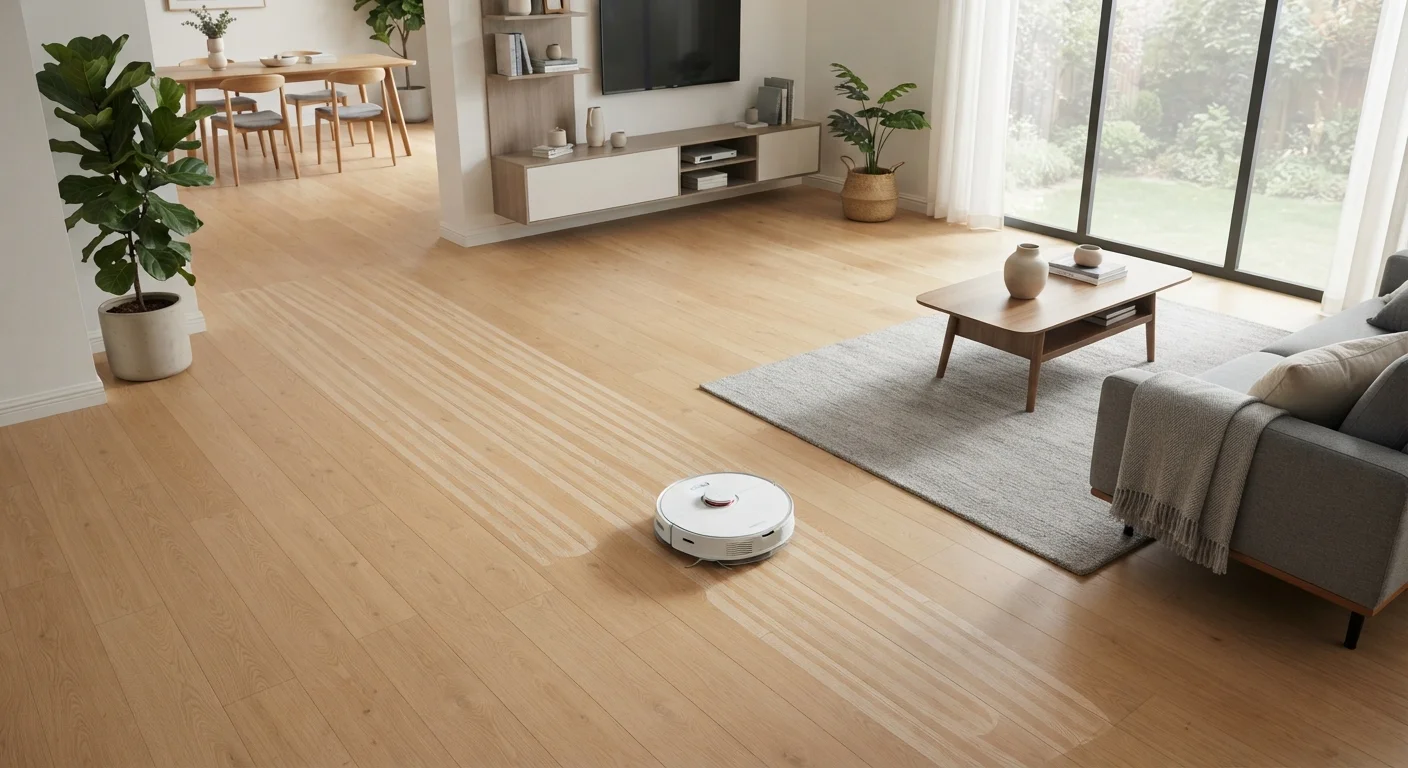
The Core Problem: How Does a Robot Know Where It Is?
A robot vacuum faces a surprisingly hard problem every time it starts a cleaning cycle: it needs to move through a space it can't fully see, avoid objects it didn't expect, and eventually cover the entire floor without getting stuck or doubling back constantly. How a given robot solves that problem is what navigation technology is all about.
At the most basic level, all robot vacuums use some combination of physical sensors (cliff sensors to detect stairs, bump sensors to detect walls) and positioning logic (the decision-making layer that determines where to go next). The difference between a $150 model and a $600 model often comes down almost entirely to how sophisticated that positioning logic is - and what data it draws on. For a broader look at evaluating connected home devices, see Home Tech & Smart Devices.
~30%
Less cleaning time with mapped vs. random navigation
Industry testing across multiple review organizations consistently finds systematic mapping reduces total cleaning time compared to random-bounce models in equivalent spaces.
3-5 years
Typical useful lifespan of a consumer robot vacuum
Consumer electronics lifecycle research suggests most robot vacuums remain functional for three to five years, making navigation capability a meaningful long-term consideration at purchase.
LiDAR vs. camera
Two dominant mapping technologies in premium models
Most mapping-capable robot vacuums use either laser-based LiDAR or camera-based vSLAM; a smaller number combine both sensors for redundancy.
Random Navigation: Simple, Cheap, and Surprisingly Functional
The original robot vacuum approach - still used in many entry-level models - is called random or reactive navigation. The robot moves in a straight line until it hits something, then turns at a semi-random angle and tries again. Over enough time, this covers most of a room through sheer repetition.
The practical trade-offs are real. Random-navigation robots take significantly longer to clean the same space as a mapped robot. They tend to revisit some areas many times while missing others entirely. They also can't tell you where they cleaned or generate a map you can interact with via an app.
That said, for very small spaces - a single bedroom, a studio apartment - random navigation can be entirely adequate. The lower price point reflects the simpler hardware, not necessarily inferior suction or build quality.
Test Before You Commit to a Mapping System
If possible, run any robot vacuum for at least two full cleaning cycles before deciding whether its navigation meets your needs. Most mapping robots improve their floor plan accuracy after the first pass. Evaluating after just one run may understate how the system actually performs day-to-day.
Gyroscope and Camera Systems: The Middle Ground
A step up from pure random movement involves adding a gyroscope, which gives the robot a sense of direction and lets it navigate in straighter, more systematic rows - similar to how a person would mow a lawn. This reduces redundant passes and speeds up coverage without the cost of full laser mapping.
Some robots use visual simultaneous localization and mapping (vSLAM) - essentially a downward- or upward-facing camera that tracks visual features on floors or ceilings to build a rough map. These systems are meaningfully smarter than gyroscope-only models and can generate usable floor plans, but they depend on adequate lighting. Move the robot to a dark hallway and accuracy can degrade noticeably.
Understanding the vocabulary used to describe these systems helps when reading product listings - the Smart Home Glossary covers many of the terms you'll encounter across connected device categories.
LiDAR Mapping: The Most Precise Approach Available
LiDAR (Light Detection and Ranging) is currently the most accurate consumer-grade navigation technology available in robot vacuums. A spinning laser emitter - visible as the small turret on top of many higher-end models - fires thousands of pulses per second and measures how long each takes to return. The result is a precise, real-time point-cloud map of the room.
LiDAR-equipped robots typically complete a mapping pass on the first run, then clean systematically on subsequent cycles. They can divide a home into named rooms, accept virtual no-go zones set via app, and return to their dock reliably. They also work in complete darkness, since the laser provides its own light source.
The honest caveat: LiDAR maps are only as useful as the environment they're built in. Homes with lots of clutter, frequently moved furniture, or reflective surfaces (glass table legs, mirrors at floor level) can confuse even high-end systems.
LiDAR Turrets and Low Furniture
The spinning LiDAR turret on top of many mapping robots adds height - typically around 3.5 to 4 inches total. This can prevent the robot from fitting under certain sofas or bed frames that a flatter camera-based or random-navigation model would clear. Measuring clearance before purchasing a LiDAR model is a practical step worth taking.
App Connectivity Is Separate from Navigation Quality
A robot vacuum may advertise app control without having true floor mapping. App connectivity can include scheduling and status alerts on models with basic random navigation. The presence of an app alone does not confirm that a robot builds or stores a usable map of your home.
What Navigation Tier Makes Sense for Your Home?
The right navigation level depends on three practical factors: home size, floor plan complexity, and how you want to interact with the robot.
- Small, open layouts: Random or gyroscope navigation is often sufficient. The efficiency gap shrinks when total floor area is limited.
- Multi-room homes with varied flooring: A mapping system pays off by navigating transitions reliably and ensuring full coverage without supervision.
- Households with pets or young children: Frequent obstacle changes (toys, food bowls) stress any navigation system - look for models with good real-time obstacle avoidance alongside their mapping capability, as these are separate features.
Navigation technology is one dimension of robot vacuum performance, but not the only one. Suction power, brush design, dustbin capacity, and filter quality all affect cleaning results independently. For a framework to evaluate purchases like this from start to finish, this end-to-end consumer guide walks through how to weigh competing features against actual needs. And for honest perspective on where smart home devices deliver versus where they disappoint, see this overview of smart home device value.
Frequently Asked Questions
Random navigation uses sensors to bounce off walls and obstacles without a plan, eventually covering a room by chance. Mapped navigation builds a layout of your home and follows a systematic path, resulting in faster and more complete coverage with fewer missed spots.
LiDAR is generally more reliable because it works in complete darkness and isn't affected by lighting changes. Camera-based systems can be comparably accurate in well-lit rooms but may lose positioning in low light. Both outperform random navigation in efficiency.
Many mid-range and higher-tier robots with mapping capability can store multiple floor maps, allowing them to recognize which level of a home they're on. This is a feature worth checking in product specifications before purchasing.
Repeated misses usually come down to navigation limits - random-bounce models miss spots by probability, while mapped models can struggle near furniture legs, tight corners, or areas with complex shadows. Repositioning a virtual boundary or physical obstacle can sometimes help.
Not necessarily - navigation technology and suction power are separate hardware components. A robot can have excellent mapping but modest suction, or vice versa. Evaluating both independently is worthwhile when comparing options.
Gyroscope-based models occupy a middle ground: they navigate in straighter lines than pure random models but don't build a true floor map. They can be a reasonable choice for smaller, less complex spaces where full LiDAR mapping may not justify the added cost.
The content on this site is for informational purposes only and is not a substitute for professional advice. Always consult a qualified professional for guidance specific to your situation.