

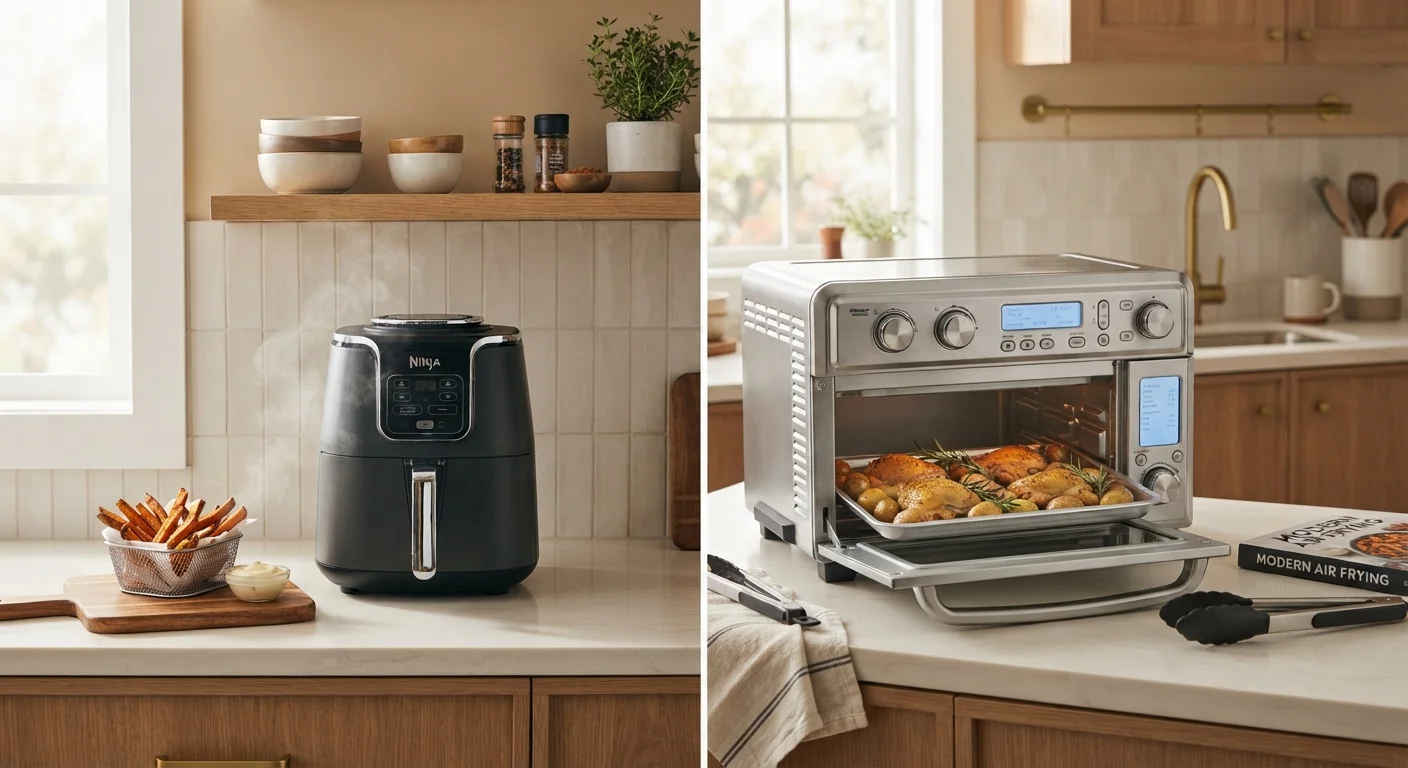
Option A
Air Fryer
The compact, fast-heating countertop option.
Best for: Small households wanting quick, crispy results with minimal preheating and counter footprint.
Option B
Convection Oven
The full-capacity, versatile kitchen workhorse.
Best for: Households that regularly cook large batches or need oven-level capacity alongside circulated-air cooking.
How Each Appliance Actually Works
Strip away the marketing and both appliances operate on the same principle: a heating element warms the air inside a chamber, and a fan circulates that hot air continuously around the food. This forced convection is what separates both from a traditional static oven, where heat rises unevenly and food cooks more slowly.
The meaningful difference is scale and geometry. An air fryer's cooking chamber is small - typically 2 to 6 quarts - and the heating element sits very close to the food, usually just above a perforated basket. That tight proximity means the circulating air moves at higher velocity relative to the food surface, accelerating moisture evaporation and producing the crispy exterior air fryers are known for.
A convection oven's chamber is much larger. The fan still circulates hot air, but the greater distance between the heating element and the food means the airflow is less intense at the food surface. The result is excellent, even cooking - but not quite the same rapid crisping effect for small portions.
| Criterion | Air Fryer | Convection Oven |
|---|---|---|
| Core technology | Fan-circulated hot air | Fan-circulated hot air |
| Typical capacity | 2-6 quarts | 3-5 cubic feet (full oven) |
| Preheat time | 2-4 minutes | 10-15 minutes |
| Crisping performance (small portions) | Excellent | Good |
| Batch cooking | Limited | Strong |
| Baking versatility | Moderate | High |
| Counter space required | Low to moderate | None (built-in) or high (countertop) |
| Energy use (small tasks) | Lower | Higher |
Where Air Fryers Have a Clear Edge
Speed and convenience are the air fryer's strongest arguments. Preheating takes two to four minutes versus ten to fifteen for a full oven. For weeknight reheating, frozen snacks, or small batches of vegetables, that time difference is genuinely meaningful.
Energy consumption also favors the air fryer for small tasks. Running a compact appliance rather than heating a full-size oven for a handful of chicken wings is more efficient in terms of both electricity and time - though the actual savings depend on frequency of use and local utility rates.
~1,500W
Typical air fryer wattage
Most air fryers draw between 1,200 and 1,800 watts, compared to 2,000-5,000 watts for a standard electric oven element.
3-5 min
Average air fryer preheat time
Consumer testing across multiple models consistently shows air fryers reaching target temperature in under five minutes, versus ten or more for full-size ovens.
Texture on small, high-surface-area foods - fries, wings, breaded items - is typically better in an air fryer than in a convection oven at comparable temperatures. The high-velocity airflow in a confined space does a more aggressive job of driving off surface moisture.
Where Convection Ovens Pull Ahead
Capacity is the convection oven's decisive advantage. A standard 30-inch range with a convection setting can hold a full sheet pan of roasted vegetables alongside a whole chicken. No countertop air fryer comes close to that volume. For families, meal-preppers, or anyone cooking in batches, this matters considerably.
Convection ovens also handle delicate baking - cookies, pastries, bread - more predictably. The gentler airflow allows for better oven-spring in baked goods and more consistent browning across a large tray. Air fryers can bake, but the intense airflow and small chamber introduce variables that experienced bakers often find limiting.
Versatility rounds out the case. A convection oven can broil, proof dough, dehydrate, and roast simultaneously on multiple racks. It integrates into how most people already cook rather than requiring a separate workflow. If you're evaluating your overall kitchen setup, see our guide to cookware materials for additional context on how appliances and cookware interact.
Combo Units: A Middle Path
Some countertop ovens are marketed as both convection ovens and air fryers, using the same chamber for both functions. These combo units offer more capacity than a standalone air fryer and more convenience than a built-in oven. Trade-offs typically include slower airflow than a dedicated air fryer and less capacity than a full-size oven - but they can be a practical compromise for kitchens with limited space and diverse cooking needs.
Which One Should You Actually Choose?
The honest answer for most people: if you already own a convection oven, you may not need an air fryer at all. The fan setting on a convection oven replicates the core mechanism. Where an air fryer wins is in convenience and speed for small portions - not in fundamentally different cooking chemistry.
If you're choosing between the two as a primary appliance, household size and cooking habits are the deciding variables. A two-person household that mostly cooks quick meals will likely find an air fryer sufficient and more practical. A household cooking regularly for four or more should lean toward convection oven capacity.
The decision parallels other format-versus-function trade-offs - similar to how online versus in-store shopping comes down to what you're buying and how you use it, not which format is objectively superior. Match the tool to the task, and you'll rarely go wrong.
The content on this site is for informational purposes only and is not a substitute for professional advice. Always consult a qualified professional for guidance specific to your situation.