

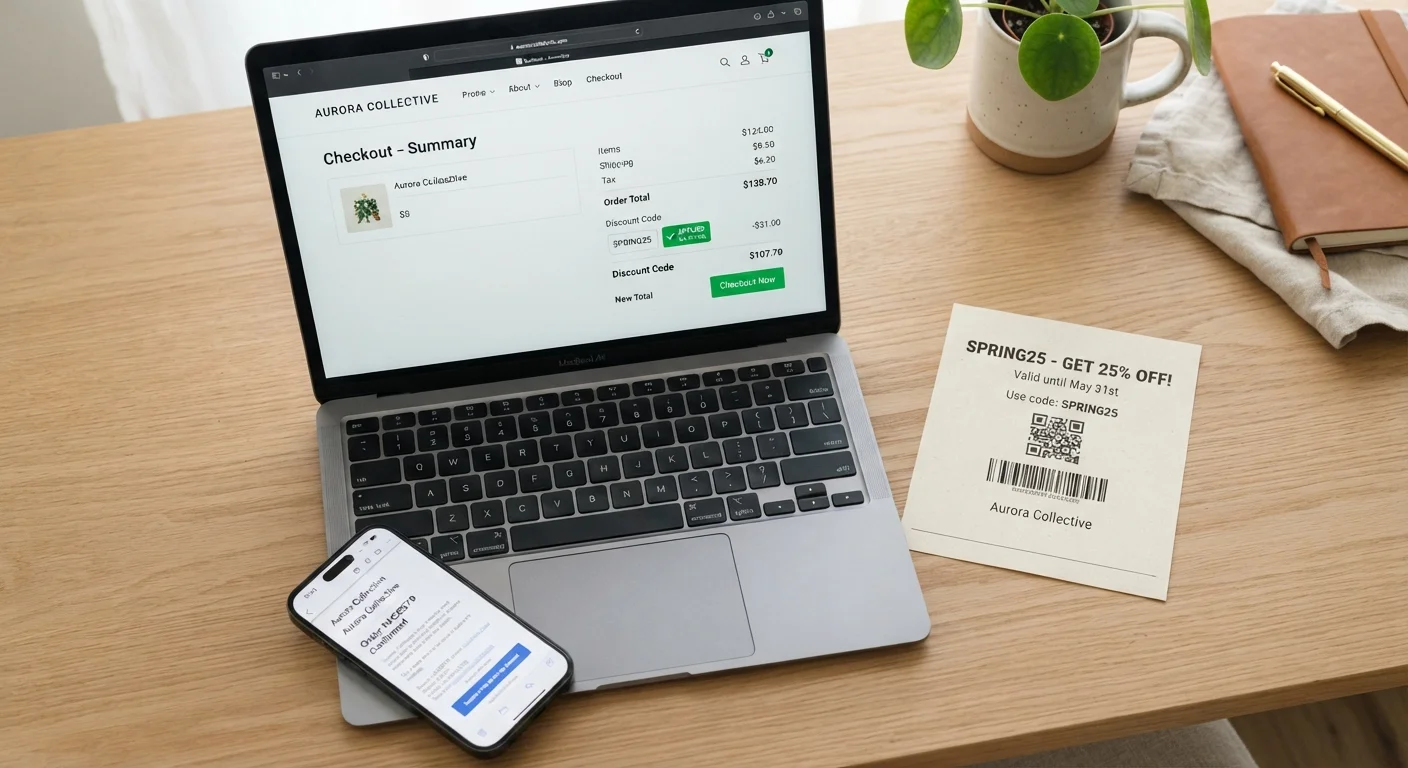
Option A
Coupon Codes
The manual, hunt-and-enter discount method.
Best for: Shoppers willing to spend time searching for codes in exchange for potentially deeper, targeted savings.
Option B
Automatic Discounts
The frictionless, retailer-controlled promotion.
Best for: Shoppers who want discounts applied without extra steps, accepting whatever the retailer has pre-set.
How Each Discount Type Actually Works
Understanding how retailers structure discounts helps you recognize when you're getting a genuine deal versus a marketing tactic dressed up as one. For broader context on pricing mechanics, the consumer's guide to deals and pricing is a solid foundation.
Coupon codes are alphanumeric strings - sometimes called promo codes or discount codes - that shoppers enter manually at checkout. Retailers issue them through email campaigns, affiliate partnerships, browser extensions, or loyalty programs. Because they require deliberate action, they can be scoped narrowly: to a specific product category, a minimum cart value, a first-time customer, or a limited time window.
Automatic discounts, by contrast, are applied by the retailer's system without any input from the shopper. When a product is marked 20% off during a sale, that reduction appears in the cart automatically. These are commonly used for sitewide events, clearance sections, or bundled pricing. The shopper doesn't need to find anything - but they also can't negotiate or unlock a deeper tier.
| Criterion | Coupon Codes | Automatic Discounts |
|---|---|---|
| Effort required | High - must be found and entered | None - applied automatically |
| Discount depth potential | Can be higher for targeted offers | Uniform across eligible shoppers |
| Availability | Varies by channel and eligibility | Open to all shoppers on site |
| Expiration risk | High - codes expire or become invalid | Lower - sale window is clearly stated |
| Stackability | Sometimes stackable with promotions | Often exclusive; stacking usually blocked |
| Common use case | Email campaigns, loyalty tiers, affiliates | Sitewide sales, clearance, seasonal events |
| Retailer control | Granular - scoped to segment or product | Broad - applied at category or site level |
The Pricing Psychology Behind Each Approach
Retailers design these mechanisms with different behavioral goals in mind, and recognizing those goals gives shoppers an informational edge.
Coupon codes create a sense of exclusivity and reward. When you enter a code and see the price drop, there's a psychological payoff that reinforces the feeling of being a savvy shopper. Retailers use this deliberately - distributing codes through channels that attract price-sensitive customers, or offering them to cart-abandoners via follow-up emails. The effort required acts as a filter: only motivated buyers complete the extra step.
Automatic discounts, on the other hand, reduce friction at checkout. Retailers deploy them to move inventory quickly, clear seasonal stock, or compete during broad shopping events. Because everyone sees the same price, there's less of a "I found a deal" feeling - but conversion rates tend to rise. Dynamic pricing algorithms often interact with automatic discounts, adjusting the baseline price before the promotion even applies.
60%+
Shoppers who search for a code before buying
Research from the Coupon Bureau has consistently found a majority of US shoppers look for a discount code before completing an online purchase.
~30%
Of issued coupon codes that are never redeemed
Retailer data across e-commerce platforms suggests a substantial share of distributed codes go unused, reflecting the friction involved in the redemption process.
One practical implication: automatic discounts are more likely to be the floor price. A retailer running a 15% sitewide sale may also be willing to honor a 20% coupon code on top - or may explicitly block stacking. Always check the promotion terms.
Which Tends to Offer Deeper Savings - and When
Neither type consistently beats the other across all situations. The depth of a discount depends on the retailer's margin goals, the product category, and the timing of your purchase.
Coupon codes have a higher ceiling in targeted scenarios. A retailer trying to re-engage lapsed customers might issue a 30% code that far exceeds the 10-15% automatic discount available to everyone. Email subscribers and loyalty members often access these tiered offers. However, codes can also be superficial - some circulate widely and apply only to already-discounted items, providing no real additional reduction.
Automatic discounts tend to be more reliable during peak shopping seasons. During events like end-of-season clearances or broad promotional windows, sitewide markdowns are pre-applied and don't require any validation. The tradeoff is uniformity - you get the same deal as every other shopper, with no ability to unlock more.
For large purchases, it's worth attempting both: check whether a coupon code exists, and verify if it stacks with any running automatic promotion. This intersects with the broader question of when paying more upfront - or negotiating harder - actually saves money long-term. The guide on paying more upfront versus choosing the cheaper option explores that trade-off in detail.
Watch for 'Was / Now' Pricing
Automatic discounts sometimes use inflated reference prices - showing a high 'original' price against a 'sale' price. The Federal Trade Commission has issued guidance on deceptive pricing practices, and several states have specific regulations around advertised reference prices. If a discount looks dramatic, it's worth checking whether the 'original' price reflects what the item actually sold for over a meaningful period.
It's also worth noting that loyalty programs frequently blur the line between the two: member prices may look like automatic discounts but are actually gated behind enrollment, functioning more like a standing coupon code.
The content on this site is for informational purposes only and is not a substitute for professional advice. Always consult a qualified professional for guidance specific to your situation.