

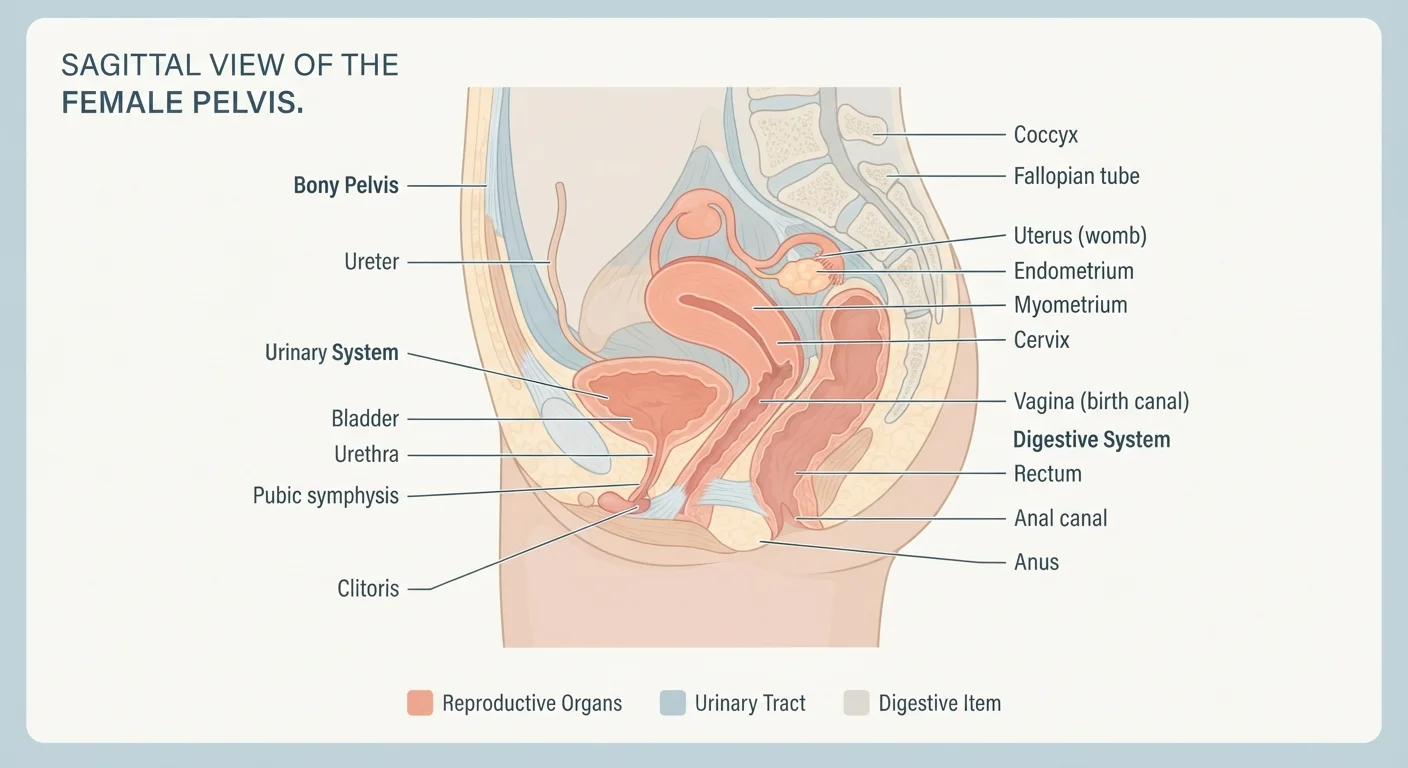
What the Pelvic Floor Actually Is
The pelvic floor is a layered group of muscles, ligaments, and connective tissue that forms the base of the pelvis. Stretching roughly like a hammock from the pubic bone at the front to the tailbone at the back, this structure sits beneath the bladder, bowel, and uterus, providing support and functional control for all three organs.
Despite being a foundational part of the body, the pelvic floor receives relatively little attention in routine health education. Many women only encounter the term during or after pregnancy - yet pelvic floor function is relevant across every decade of life.
1 in 3
Women affected by pelvic floor disorders
According to the National Institutes of Health, approximately one in three women in the US is affected by a pelvic floor disorder at some point in her life.
50%
Women with pelvic organ prolapse postpartum
Research published in peer-reviewed obstetric literature estimates that up to half of women who have given birth vaginally show some degree of pelvic organ descent, though not all experience symptoms.
~80%
Cases of stress incontinence in women
Stress urinary incontinence - leakage triggered by physical exertion - accounts for roughly 80% of incontinence cases in women, according to clinical estimates from urogynecology literature.
What the Pelvic Floor Does
The pelvic floor has several distinct roles that work together continuously:
- Sphincter control: The muscles regulate the openings of the urethra and rectum, allowing voluntary control of urination and bowel movements.
- Organ support: By holding the pelvic organs in position, the pelvic floor helps prevent prolapse - a condition in which organs descend toward or beyond the vaginal opening.
- Core stability: The pelvic floor works in coordination with the diaphragm, deep abdominal muscles, and spinal stabilizers. It engages automatically during movement and exertion.
- Sexual function: These muscles play a role in sensation, arousal, and comfort during sexual activity.
- Pregnancy and childbirth support: The pelvic floor adapts significantly during pregnancy and must withstand considerable forces during vaginal delivery.
Because these roles are interconnected, dysfunction in one area often affects others. For example, pelvic floor tension can contribute to both lower back discomfort and pain during intercourse.
Factors That Weaken or Strain the Pelvic Floor
Pelvic floor dysfunction can stem from weakness, but also from overactivity - muscles that are too tight or unable to properly relax. Common contributing factors include:
- Pregnancy and vaginal delivery, particularly with prolonged pushing, large babies, or assisted delivery instruments
- Hormonal shifts, especially the estrogen decline during perimenopause and menopause, which affects tissue elasticity and moisture
- Chronic straining from constipation or heavy lifting with improper breath management
- High-impact exercise performed without adequate pelvic floor awareness, particularly in the postpartum period
- Chronic cough from conditions like asthma or smoking-related disease
- Obesity, which increases sustained downward pressure on pelvic structures
- Pelvic surgeries, including hysterectomy
Tension Can Be as Problematic as Weakness
Pelvic floor dysfunction is not always about muscles that are too weak. An overactive or hypertonic pelvic floor can cause pelvic pain, pain during intercourse, and even urinary urgency. Performing strengthening exercises in this context may worsen symptoms. Always seek a clinical assessment before beginning a pelvic floor exercise program.
Importantly, not all pelvic floor problems reflect weakness. Hypertonic (overly tense) pelvic floor muscles are a recognized clinical presentation that can cause pelvic pain, urinary urgency, and discomfort - and are addressed differently than weakness-related dysfunction.
Pelvic Floor Health Across Life Stages
Pelvic floor considerations shift meaningfully with age and life circumstance:
Adolescence and early adulthood
Awareness of pelvic floor function matters even before pregnancy. The menstrual cycle can be associated with pelvic floor tension changes throughout the month, and some young women experience pelvic floor-related conditions such as vaginismus or interstitial cystitis without recognizing the connection.
Pregnancy and the postpartum period
This is the life stage most commonly associated with pelvic floor changes. During pregnancy, the growing uterus adds sustained load on pelvic structures. Vaginal delivery, particularly with prolonged labor or perineal tearing, can affect muscle integrity. Expert guidance typically recommends individualized postpartum rehabilitation rather than a one-size-fits-all timeline for returning to exercise.
Don't wait until symptoms appear to think about your pelvic floor. Establishing good bowel habits, breath coordination, and body awareness during pregnancy can reduce the severity of postpartum dysfunction.
Prehabilitation - preparing the body before a known physiological challenge - is a principle increasingly supported in obstetric physical therapy, as early intervention is associated with better postpartum pelvic floor outcomes.
If you're leaking during exercise postpartum, that's a signal to scale back intensity and seek a pelvic floor assessment before progressing - not to push through and hope it resolves.
Postpartum connective tissue and muscle are still recovering for months after delivery. Continued high loading before adequate rehabilitation can extend recovery time and worsen symptoms.
Midlife and menopause
Estrogen decline during perimenopause reduces collagen and tissue integrity throughout the body - including the pelvic floor and surrounding tissues. This is a key reason why urinary leakage and pelvic organ prolapse become more prevalent after menopause. Hormone-related changes also affect the bone density that supports overall musculoskeletal function, including the pelvis.
Older adulthood
Staying physically active as we age - as outlined in guidance on staying active after 50 - supports overall muscle function, including the pelvic floor. However, older women may also face cumulative effects from decades of pelvic loading, prior deliveries, and hormonal changes, making assessment by a specialist particularly valuable.
Recognizing When to Seek Help
Many women normalize symptoms that warrant clinical attention. Common presentations that merit evaluation include:
- Leaking urine when coughing, sneezing, laughing, or exercising (stress incontinence)
- Strong, sudden urges to urinate that are difficult to defer (urgency incontinence)
- A sensation of heaviness, fullness, or bulging in the vaginal area
- Chronic pelvic pain or pain during intercourse
- Difficulty with bowel emptying or chronic constipation
Symptoms Are Common - But Not Inevitable
Leakage, pelvic pressure, and pain during intercourse affect large numbers of women, but they are not simply the price of childbearing or aging. Effective, evidence-based treatments exist for most pelvic floor conditions. If you experience any of these symptoms, speak with your healthcare provider or ask for a referral to a pelvic floor specialist rather than assuming nothing can be done.
The appropriate specialist for pelvic floor assessment is a pelvic floor physical therapist - a licensed physical therapist with specialized postgraduate training in pelvic health. Gynecologists and urogynecologists also play a role, particularly when structural evaluation or medical management is needed. A primary care provider is a good starting point for a referral.
General Habits That Support Pelvic Floor Function
While individualized guidance from a clinician is the most reliable path for those with symptoms, certain general habits are broadly understood to support pelvic floor health:
- Bowel regularity: Straining during bowel movements places significant downward pressure on pelvic structures. Adequate dietary fiber and fluid intake help maintain soft, regular stools.
- Bladder habits: Avoid habitual "just in case" urination, which can gradually reduce bladder capacity and increase urgency signals over time.
- Posture and breath awareness: The pelvic floor coordinates with the diaphragm during breathing. Breath-holding during exertion (such as lifting) increases intra-abdominal pressure abruptly. Learning to exhale during effort is a simple but effective strategy.
- Appropriate exercise: Low-impact movement such as walking, swimming, and yoga supports pelvic floor conditioning without excessive loading. Return to high-impact exercise, particularly postpartum, is ideally guided by a specialist.
- Healthy weight management: Sustained excess abdominal weight increases chronic pelvic floor load.
Kegels Aren't Always the Answer
Pelvic floor exercises can be highly effective - but only when the goal is strengthening. For women with a hypertonic (overly tight) pelvic floor, repeated contractions may intensify symptoms. A pelvic floor physical therapist can determine whether you need strengthening, relaxation techniques, or a combination of both before recommending any exercise program.
Pelvic floor exercises - commonly called Kegel exercises - are widely recommended, but performing them incorrectly, or performing them when the pelvic floor is already overactive, can worsen symptoms. A pelvic floor physical therapist can assess whether strengthening or relaxation is the appropriate goal before exercises are prescribed.
This article is for general informational and educational purposes only. It is not a substitute for professional medical advice, diagnosis, or treatment. Always consult a qualified healthcare provider regarding any symptoms or concerns about your pelvic health or any other medical condition.
The content on this site is for informational purposes only and is not a substitute for professional advice. Always consult a qualified professional for guidance specific to your situation.