

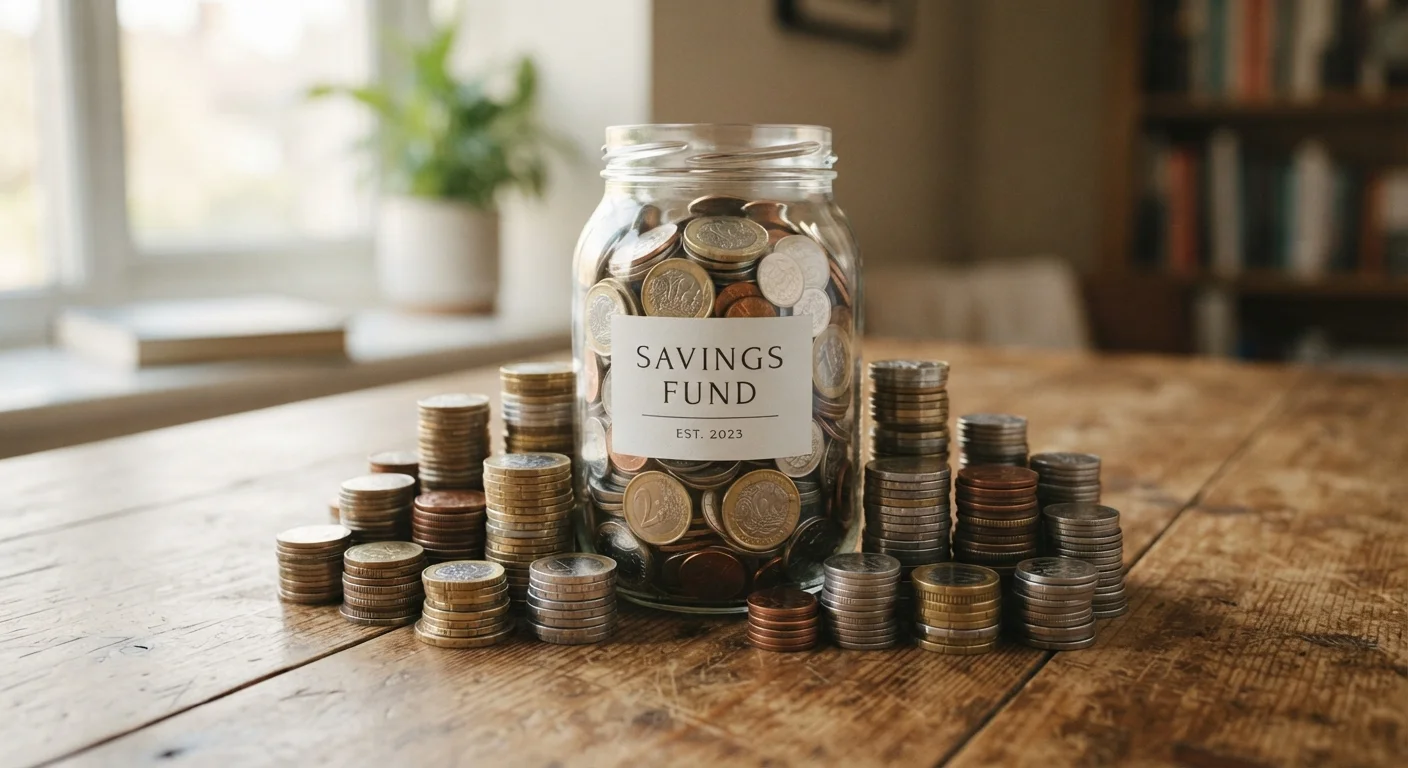
How Compound Interest Actually Works
At its core, compound interest means your money earns a return - and then that return earns a return too. Each compounding period, interest is added to your balance, and the new, larger balance becomes the foundation for the next calculation.
Consider a simple illustration: $1,000 deposited at a 5% annual interest rate. After year one, you have $1,050. In year two, 5% is applied to $1,050, not the original $1,000 - giving you $1,102.50. By year 10, that original $1,000 has grown to roughly $1,629 without any additional deposits. By year 30, it approaches $4,322. The principal never changed. Time and compounding did the work.
This is why compound interest is often described as exponential rather than linear. Growth accelerates as the base grows. Understanding the difference between saving and investing helps clarify which financial vehicles actually harness this effect and which ones leave it largely untapped.
$4,322
Growth of $1,000 at 5% over 30 years
Illustrates how compound interest at a moderate rate turns a modest sum into more than four times the original amount with no additional contributions.
72
The Rule of 72: a doubling shortcut
Divide 72 by your annual return rate to estimate how many years it takes to double your money - a widely used rule of thumb in personal finance education.
Daily
Most common compounding frequency on credit cards
Many US credit card issuers compound interest daily on unpaid balances, which means debt can grow faster than borrowers realize if only minimum payments are made.
The Role of Time - and Why Early Movers Win
Time is the single most influential factor in compound growth. A person who begins saving in their mid-twenties and stops contributing entirely a decade later will often end up with more at retirement than someone who starts in their mid-thirties and contributes every year until retirement. This counterintuitive result comes from the extra compounding years at the beginning of the first saver's timeline.
The years closest to retirement contribute the least in absolute dollar growth because compounding has had the least time to work. The years furthest away contribute the most. This makes early participation in savings and retirement accounts one of the most impactful financial decisions a person can make - not because of the amounts involved, but because of the time horizon unlocked.
Start Small, But Start Now
You don't need a large sum to benefit from compounding - you need time. Even small, regular contributions to a retirement or savings account begin accumulating interest that itself earns interest. Delaying by even a few years meaningfully reduces long-term outcomes, so starting with whatever you can afford is more valuable than waiting until you can afford more.
For those building consistent saving habits, savings habits that tend to stick over time explores the structural approaches that make regular contributions more sustainable.
When Compounding Works Against You
The same mechanics that build wealth in savings accounts can erode it in debt. Credit card balances, for example, typically compound daily or monthly at high interest rates. A balance left unpaid doesn't simply stay flat - it grows, often faster than minimum payments reduce it.
Understanding this dynamic is essential. The principles behind credit and debt management directly intersect with compound interest: carrying revolving balances long-term means paying interest on interest, not just on what you originally borrowed.
Compound interest is a neutral mechanism. It rewards those who let savings grow untouched and penalizes those who let debt balances linger. The direction it works in depends entirely on which side of the equation you're on.
Compounding Frequency Varies by Product
Savings accounts, CDs, and investment accounts each compound on different schedules - daily, monthly, or annually. When comparing financial products, the Annual Percentage Yield (APY) reflects the effective annual return including compounding, making it a more useful comparison metric than the stated interest rate alone.
Putting Compounding in Context: Accounts and Inflation
Not all savings vehicles compound equally. A standard savings account at a major bank may offer a negligible interest rate, while high-yield savings accounts often carry meaningfully higher rates - making a real difference in how quickly compounding takes effect.
There's also an important counterforce to consider: inflation. If your savings earn 2% annually but inflation runs at 3%, your purchasing power is actually declining, even as your nominal balance rises. How inflation affects your savings is a concept every saver should understand alongside compounding - because one can quietly undo the other.
For investors who want to harness compound growth within a disciplined strategy, dollar-cost averaging pairs well with long-term compounding by removing the temptation to time the market.
This article is for general informational and educational purposes only and does not constitute personalized financial, investment, or tax advice. Consult a qualified financial professional before making decisions about your own financial situation.
Frequently Asked Questions
Simple interest is calculated only on the original principal. Compound interest is calculated on the principal plus any interest already earned. Over long periods, the difference in total growth between the two can be substantial.
No. Compounding applies to savings accounts, certificates of deposit, retirement accounts, and debt products like credit cards and loans. When it applies to debt, it works against you, causing balances to grow if you only make minimum payments.
The more frequently interest compounds - daily versus annually, for example - the more total interest accrues over time. The difference is often modest on savings, but the principle matters when comparing account types.
The Rule of 72 is a common shortcut: divide 72 by the annual interest rate to estimate how many years it takes to double your money. At 6% annual growth, money roughly doubles in about 12 years.
Because compounding is exponential, not linear. The growth in the final years of a long savings horizon is far larger than in the early years. Every year you delay removes one of those high-growth years from the end of the timeline.
The content on this site is for informational purposes only and is not a substitute for professional advice. Always consult a qualified professional for guidance specific to your situation.