

Our Verdict
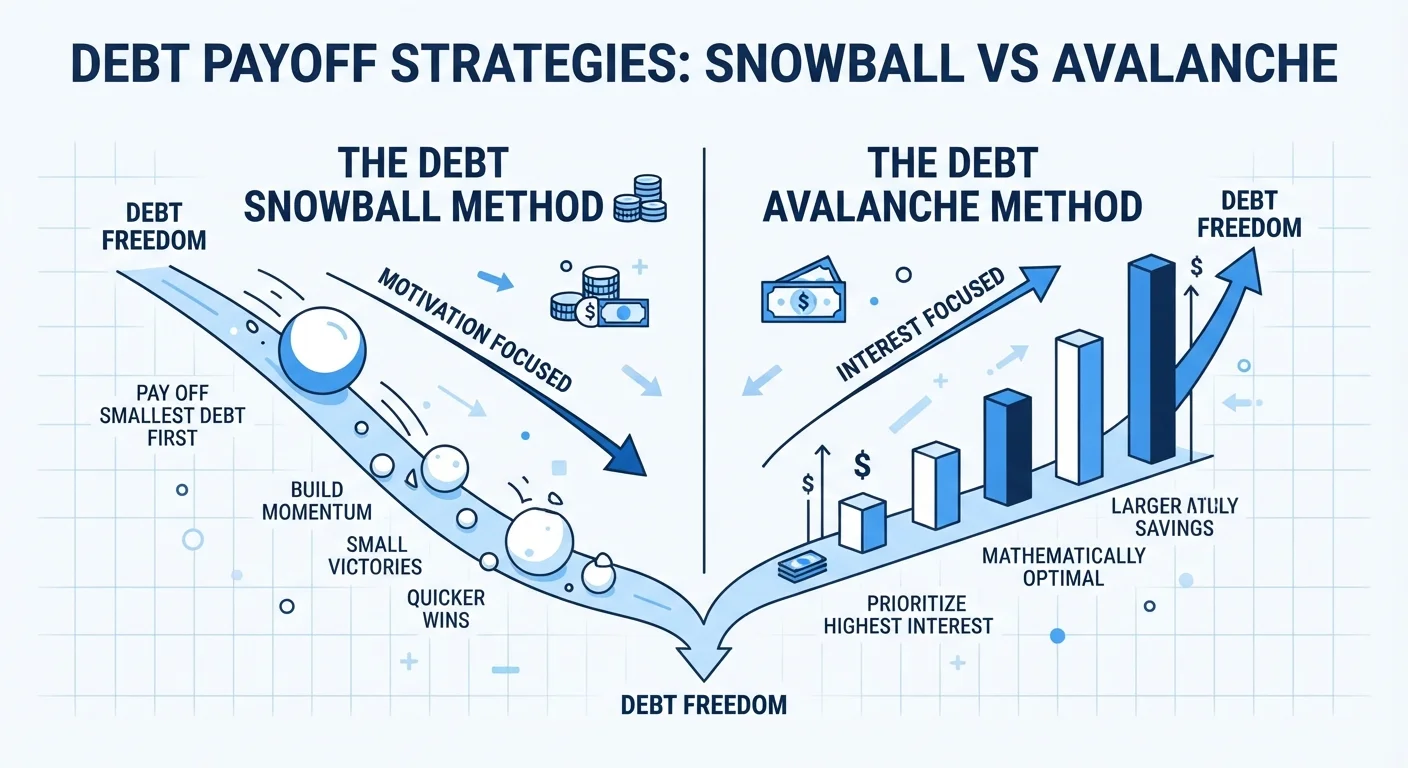
The debt avalanche is the mathematically superior choice for reducing total interest costs, while the debt snowball offers stronger psychological reinforcement through quick wins. The best strategy is ultimately the one you can commit to month after month - and both meaningfully outperform making only minimum payments.
| Best for | Recommended |
|---|---|
| Those motivated by minimizing total interest paid | Debt Avalanche |
| Those who need early wins to stay motivated | Debt Snowball |
| Those with large gaps in interest rates between accounts | Debt Avalanche |
| Those with many small balances spread across accounts | Debt Snowball |
How Each Strategy Works
Both the debt avalanche and the debt snowball are structured repayment frameworks. You continue paying the minimum on all accounts, then direct any extra money toward one targeted debt at a time. When that balance reaches zero, you roll its payment into the next target - creating a compounding payoff effect.
The difference lies entirely in how you rank your debts:
- Debt Avalanche: List all debts by interest rate, highest to lowest. Attack the costliest debt first. Once it's gone, redirect that payment to the next highest rate, and so on.
- Debt Snowball: List all debts by balance, smallest to largest. Pay off the smallest balance first. When it's eliminated, roll its payment to the next smallest, building a larger "snowball" of payment power over time.
Understanding what type of debt you're carrying - and whether it's secured or unsecured - can also shape which accounts make sense to prioritize. See how secured and unsecured debt differ for context before mapping out your list.
Cost and Speed: The Numbers Perspective
From a pure math standpoint, the debt avalanche wins. By eliminating high-interest balances first, you reduce the rate at which interest compounds across your total debt load. Over a multi-year payoff timeline, this can mean paying meaningfully less in total interest compared to the snowball approach.
~$1,000+
Potential interest savings with avalanche
Financial planning educators generally illustrate that targeting high-rate debt first can save hundreds to over a thousand dollars depending on balances and rates.
3-5 years
Typical payoff timeline for structured plans
Consumer finance resources commonly estimate that disciplined use of either strategy can eliminate moderate debt loads within three to five years.
Consider a simplified example: if you have a $5,000 balance at 22% APR and a $1,200 balance at 8% APR, the avalanche directs extra payments to the 22% account immediately. The snowball would clear the $1,200 first - faster in terms of accounts closed, but slower in terms of interest reduction.
The total time to become debt-free is often similar between the two methods, but the avalanche typically saves money. If the interest rates on your debts are close together, the difference may be modest. The wider the spread, the more the avalanche saves.
If you're also weighing whether to consolidate before choosing a payoff approach, debt consolidation trade-offs are worth reviewing - combining balances can sometimes change which strategy makes more sense.
The Psychology of Paying Off Debt
Financial behavior research consistently shows that motivation and consistency matter as much as the optimal plan on paper. The debt snowball was designed with this in mind: each eliminated account delivers a concrete, visible win that reinforces the habit of paying extra.
Automate Minimum Payments First
Before directing extra funds to your target debt, set all minimum payments to autopay. This protects your credit and prevents late fees from undermining your progress. Treat the extra payment to your target account as a separate, intentional action each month.
For people who have struggled to maintain a debt payoff plan in the past, the snowball can provide the emotional fuel needed to stay on track. Closing an account - even a small one - signals real progress in a way that a reduced interest charge on a large balance may not.
The avalanche, by contrast, can feel slow at first. If your highest-rate debt also carries the largest balance, months may pass before you see an account fully paid off. That requires patience and discipline. For someone who tracks spreadsheets and finds motivation in numbers declining, this is entirely manageable. For others, the wait can cause them to abandon the plan.
Staying on any structured payoff plan also requires that your day-to-day budgeting is stable enough to keep new debt from replacing the balances you're eliminating.
Choosing the Right Approach for Your Situation
| Debt Avalanche | Debt Snowball | |
|---|---|---|
| Payoff order | Highest interest rate first | Smallest balance first |
| Total interest paid | Lower (mathematically optimal) | Potentially higher |
| Time to first account closed | Slower if high-rate debt is large | Faster - smallest balance goes first |
| Psychological reinforcement | Delayed - results are numeric | Immediate - accounts close quickly |
| Best suited for | Disciplined, numbers-driven planners | Those needing visible motivation |
| Complexity | Simple to track by rate | Simple to track by balance |
Neither method is inherently superior for every person. A few questions can help clarify which fits better:
- Are your interest rates spread far apart? A wide gap favors the avalanche, where the interest savings are most pronounced.
- Do you have several small balances? The snowball clears those quickly, reducing the number of accounts you're managing.
- Have you tried and abandoned debt plans before? The psychological reinforcement of the snowball may make a real difference in follow-through.
- Are you comfortable with delayed gratification? If yes, the avalanche's longer wait for that first payoff may not deter you.
Some people use a hybrid approach - paying off one or two very small balances first to gain momentum, then switching to the avalanche order. This isn't a formally named strategy, but it reflects a practical middle ground that can work if applied consistently.
It's also worth knowing the warning signs that debt may have moved beyond what either strategy can address on its own. Recognizing when debt becomes unmanageable is an important reference if minimum payments are already difficult to meet.
This article is for general informational and educational purposes only and does not constitute personalized financial, tax, or legal advice. Consult a qualified financial professional for guidance specific to your situation.
The content on this site is for informational purposes only and is not a substitute for professional advice. Always consult a qualified professional for guidance specific to your situation.