

The Five Factors Inside Every Score
A credit score isn't generated by a single data point - it's the output of a weighted formula applied to information in your credit report. Under the FICO® model, five distinct factors contribute, each carrying a different share of the total:
- Payment history (≈35%): Whether you've paid bills on time. Late or missed payments have the largest negative impact of any single factor.
- Amounts owed / credit utilization (≈30%): How much of your available revolving credit you're currently using. Lower utilization is generally better. See why utilization gets watched so closely for a deeper look.
- Length of credit history (≈15%): How long your accounts have been open, including the age of your oldest account, newest account, and the average age across all accounts.
- Credit mix (≈10%): The variety of credit types you manage - such as credit cards, mortgages, and installment loans. Revolving credit and installment loans are treated differently by scoring models.
- New credit (≈10%): Recent applications for new credit, tracked through hard inquiries on your report.
These percentages are approximations for the standard FICO® model. VantageScore and other models use the same underlying data but may weight factors differently.
35%
Weight of payment history in a FICO® Score
Payment history is the single largest factor in the standard FICO® scoring model, according to FICO's published scoring criteria.
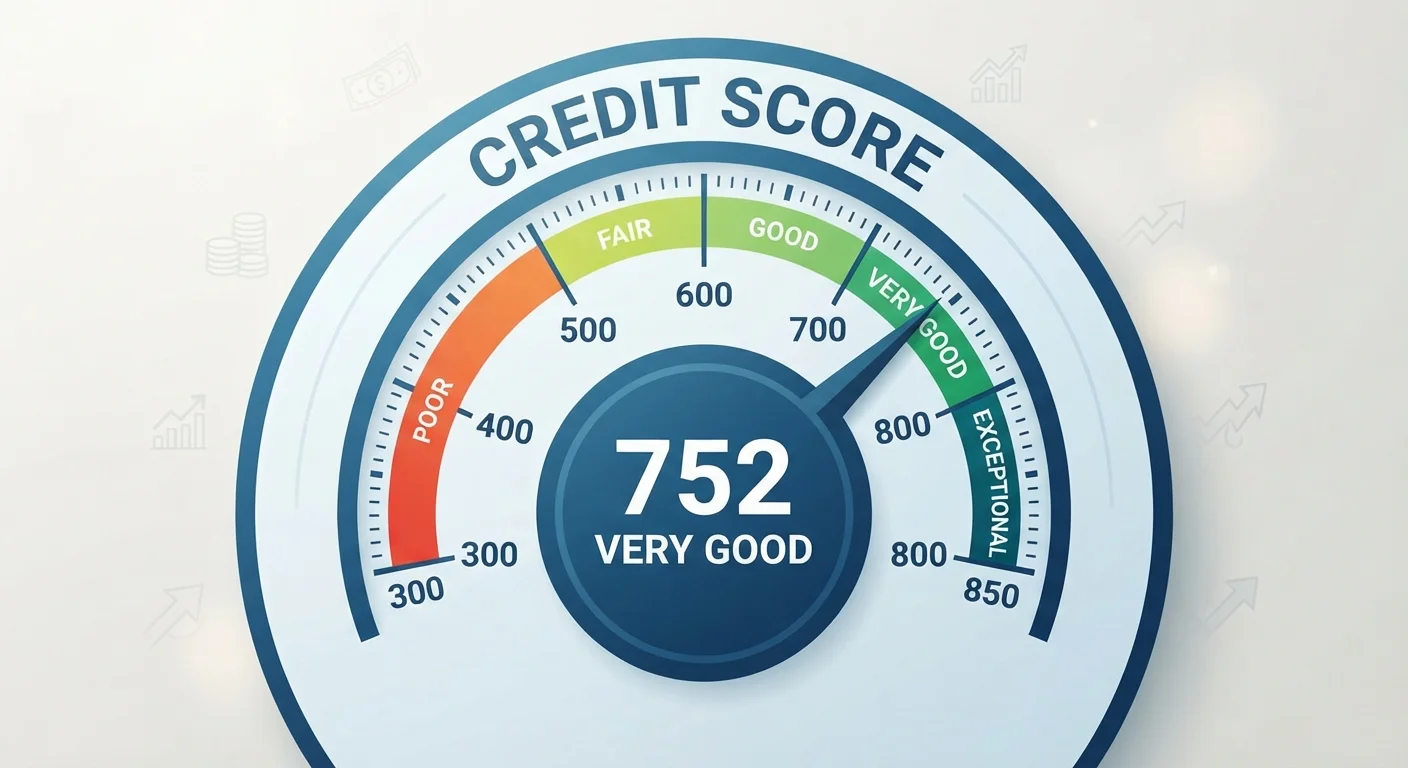
300-850
Standard FICO® Score range
The FICO® Score range used by most US lenders runs from 300 (lowest) to 850 (highest), with the majority of Americans scoring above 600.
3
Major credit bureaus reporting in the US
Equifax, Experian, and TransUnion each independently collect and report credit data, meaning your score may differ slightly across bureaus.
What a Credit Score Does Not Measure
A credit score is narrower in scope than many people assume. It measures your history with borrowed money - nothing more. Several common assumptions about what's included are simply wrong:
- Income and wealth: Your salary, savings account balance, and net worth have no direct role in standard scoring models. A high earner with a history of missed payments will score lower than a moderate earner with spotless payment history.
- Employment status: Whether you're employed, self-employed, or unemployed does not appear in your score. Lenders may verify employment separately during underwriting, but it's outside the score itself.
- Bank account balances: Checking and savings account activity generally doesn't feed into credit scores. These accounts are not typically reported to the three major credit bureaus.
- Debit card use: Using a debit card does not build or damage credit, because you're spending your own money rather than borrowing.
Understanding these boundaries matters because it clarifies exactly what you can control to influence your score. For a full picture of what lenders review beyond the number itself, see what lenders actually see when they pull your credit report.
Score Variations Are Normal
It's common to have slightly different scores when checking across different platforms or bureaus. This happens because each bureau may hold different account data, and lenders may use different scoring models depending on what type of credit you're applying for. None of these variations indicate an error on their own - they reflect the structure of the system.
Why Lenders Rely on the Score - and What It Means for You
Lenders process thousands of applications, often making decisions in minutes. A credit score condenses years of borrowing behavior into one comparable number, allowing for faster, more consistent risk assessment than manually reviewing every account.
The practical consequences of your score extend well beyond approval or denial. Lenders use score tiers to set interest rates, credit limits, and loan terms. A borrower with a higher score may receive a lower interest rate on an auto loan or mortgage - potentially saving thousands of dollars over the life of a loan. Your credit score has a direct effect on your car loan rate, which is why understanding your score before visiting a dealership is worth the effort.
Landlords, and in some cases employers in certain states, may also review credit information as part of their screening processes - though the rules on permissible use vary by state.
Check Your Report Before You Apply
Reviewing your credit report before a major application - such as for a mortgage or auto loan - gives you a chance to spot errors or outdated information that could be dragging your score down. You can request free reports from each of the three major bureaus at AnnualCreditReport.com, the officially authorized source under federal law. Disputing inaccuracies can take time, so building in a buffer before applying is a practical habit.
One persistent source of confusion is the gap between what people think the score measures and what it actually tracks. Common credit score myths can lead to decisions that quietly damage a score over time, making it worth separating fact from assumption before acting.
This article is for general informational and educational purposes only and does not constitute personalized financial or legal advice. Consult a qualified financial professional for guidance specific to your situation.
Frequently Asked Questions
Under the FICO® model, scores of 670-739 are generally considered 'good,' while 740-799 is 'very good' and 800+ is 'exceptional.' Scores below 580 are typically categorized as poor. Different lenders may apply their own thresholds, so these ranges are general benchmarks rather than universal rules.
No. Checking your own credit score is classified as a 'soft inquiry' and has no effect on your score. Only 'hard inquiries' - triggered when a lender pulls your credit as part of a formal application - can cause a small, temporary dip.
Most scoring models require at least six months of credit activity before generating a score. Building a strong score typically takes several years of consistent, on-time payments and responsible credit use.
The three major credit bureaus - Equifax, Experian, and TransUnion - each collect data independently, so some accounts may appear on one report but not another. Different scoring models also weight the same data differently, producing variations between scores.
No. Your income, savings, and net worth are not factored into standard credit scores. Scores focus exclusively on how you manage borrowed money, not how much money you earn or hold.
Yes. A payment reported 30 or more days late can cause a noticeable drop, particularly if your score was high to begin with. The impact generally lessens over time as you build a new record of on-time payments.
The content on this site is for informational purposes only and is not a substitute for professional advice. Always consult a qualified professional for guidance specific to your situation.