

Our Verdict
Envelope budgeting is a proven, low-tech method that forces intentional spending through hard limits. Its greatest strengths - visibility and simplicity - are also tied to its biggest limitation: it's difficult to maintain in a world built around cards and online payments. For those who find digital tools abstract or easy to ignore, the envelope method can be a genuine turning point.
Ideal for beginners who overspend in specific categories, people who respond well to visual and tactile cues, or anyone looking for a structured reset after struggling with looser budgeting approaches.
What Is Envelope Budgeting?
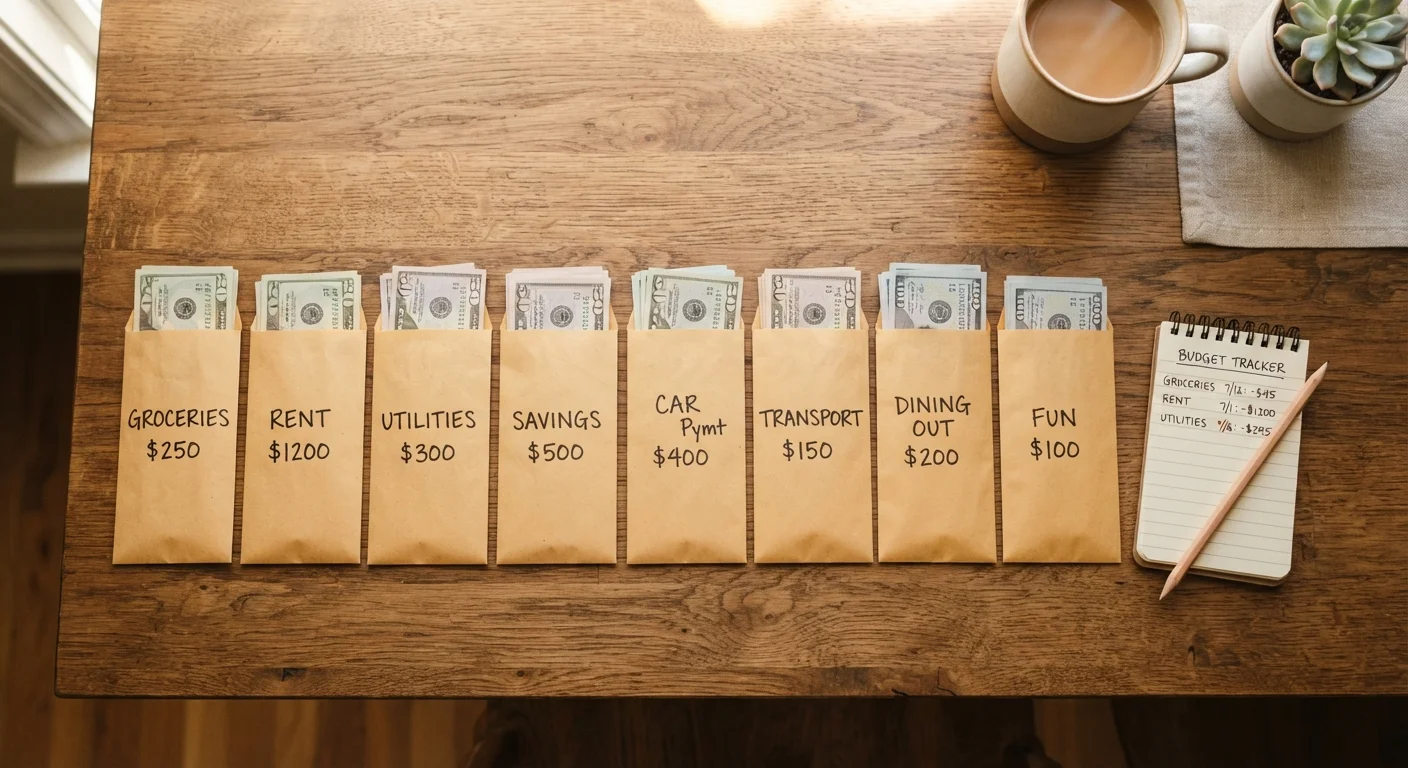
Envelope budgeting is a cash-based system where you divide your monthly income into physical envelopes, each labeled for a spending category - groceries, gas, dining out, entertainment, and so on. When an envelope is empty, spending in that category stops for the month. No exceptions, no borrowing from savings unless you consciously move money between envelopes.
The method has roots decades back but gained wide mainstream attention through personal finance educators. Its appeal is straightforward: it replaces abstract numbers on a screen with a tangible limit you can see and feel. If you're building your first real budget, our plain-English starting point covers the foundational concepts that complement this approach.
The Advantages of Envelope Budgeting
Envelope budgeting earns its reputation for a reason. Several of its core advantages are backed by behavioral research on how people relate to money differently depending on its form.
Makes overspending immediately visible
When cash runs out, the envelope is physically empty - there's no ambiguity. Research in behavioral economics suggests people spend more cautiously with physical cash than with cards, partly because the loss feels more tangible.
Forces intentional allocation before spending begins
Dividing income at the start of the month means every dollar has a job before temptation arises. This front-loaded decision-making reduces impulsive purchases because the money is already committed elsewhere.
Simple enough to start without any tools
You need cash, envelopes, and a pen. There's no app to learn, no spreadsheet to build, and no subscription required - a genuine advantage for people who find technology a barrier to getting started.
Builds awareness of spending patterns
Handling physical money for specific categories quickly reveals which areas absorb the most spending. Many first-time budgeters are surprised to find how fast their dining or entertainment envelope empties.
Creates a natural pause before discretionary purchases
Having to physically retrieve cash from an envelope introduces a small friction that can prevent automatic or habitual overspending, giving you a moment to reconsider whether the purchase aligns with your priorities.
A Note on Budgeting Myths
Many people avoid budgeting because they believe it requires deprivation or only matters for people in debt. Neither is true. Envelope budgeting, like most methods, is simply a tool for directing money deliberately. The goal isn't restriction - it's alignment between your spending and your actual priorities.
Spending limits don't have to feel punishing. Our article on budgeting myths addresses the mistaken idea that budgeting requires sacrificing everything enjoyable.
The Disadvantages of Envelope Budgeting
No budgeting method is without trade-offs, and envelope budgeting has some real friction points - especially for Americans who rarely use cash in daily life.
Impractical for online or card-based purchases
A significant portion of everyday spending - utility bills, subscriptions, online shopping - can't be paid with cash from an envelope. This forces workarounds that can undermine the system's discipline.
Carrying large amounts of cash creates security risks
Unlike debit or credit cards, cash that is lost or stolen is gone permanently. For people in high-traffic areas or those who travel frequently, this poses a practical safety concern.
Time-consuming to manage and maintain
Withdrawing cash, counting it into envelopes, and reconciling remaining amounts takes consistent effort. For people with demanding schedules, this overhead can make the system feel unsustainable.
Misses out on card rewards and purchase protections
Credit cards often offer fraud protection, extended warranties, and cash-back rewards that cash purchases don't provide. Committing fully to cash means forgoing these benefits.
Rigid structure can be frustrating to adjust mid-month
Life doesn't follow neat monthly categories - an unexpected car repair or medical cost doesn't fit cleanly into a predefined envelope. Moving money between categories requires conscious record-keeping to stay accurate.
~18%
US transactions made with cash
According to the Federal Reserve's Diary of Consumer Payment Choice, cash accounted for roughly 18% of US transactions in recent years, down from over 30% a decade earlier - highlighting the friction envelope budgeting faces in a card-dominant economy.
83%
Adults who report overspending in at least one category monthly
A widely cited survey by the National Foundation for Credit Counseling found that a significant majority of US adults acknowledge regularly exceeding their intended spending in at least one budget category.
If you want to compare envelope budgeting to other frameworks before committing, see our breakdown of zero-based budgeting vs. the 50/30/20 method or explore pen-and-paper vs. spreadsheets vs. apps to find the format that fits your life.
Making It Work in a Digital World
The core limitation of classic envelope budgeting - that it requires physical cash - has prompted digital adaptations. Several budgeting apps replicate the envelope structure using virtual categories, allowing you to allocate a set dollar amount per category and track deductions as you spend. This preserves the psychological benefit of hard limits without requiring you to carry envelopes.
Whether you go physical or digital, the discipline the envelope method builds translates to almost any framework. Understanding what the 50/30/20 rule looks like in practice, for example, becomes much easier once you've trained yourself to think in spending buckets. The method, at its core, is about spending on purpose - and that habit transfers.
This article is for general informational and educational purposes only. It does not constitute personalized financial advice. For guidance specific to your financial situation, consult a qualified financial professional.
The content on this site is for informational purposes only and is not a substitute for professional advice. Always consult a qualified professional for guidance specific to your situation.