

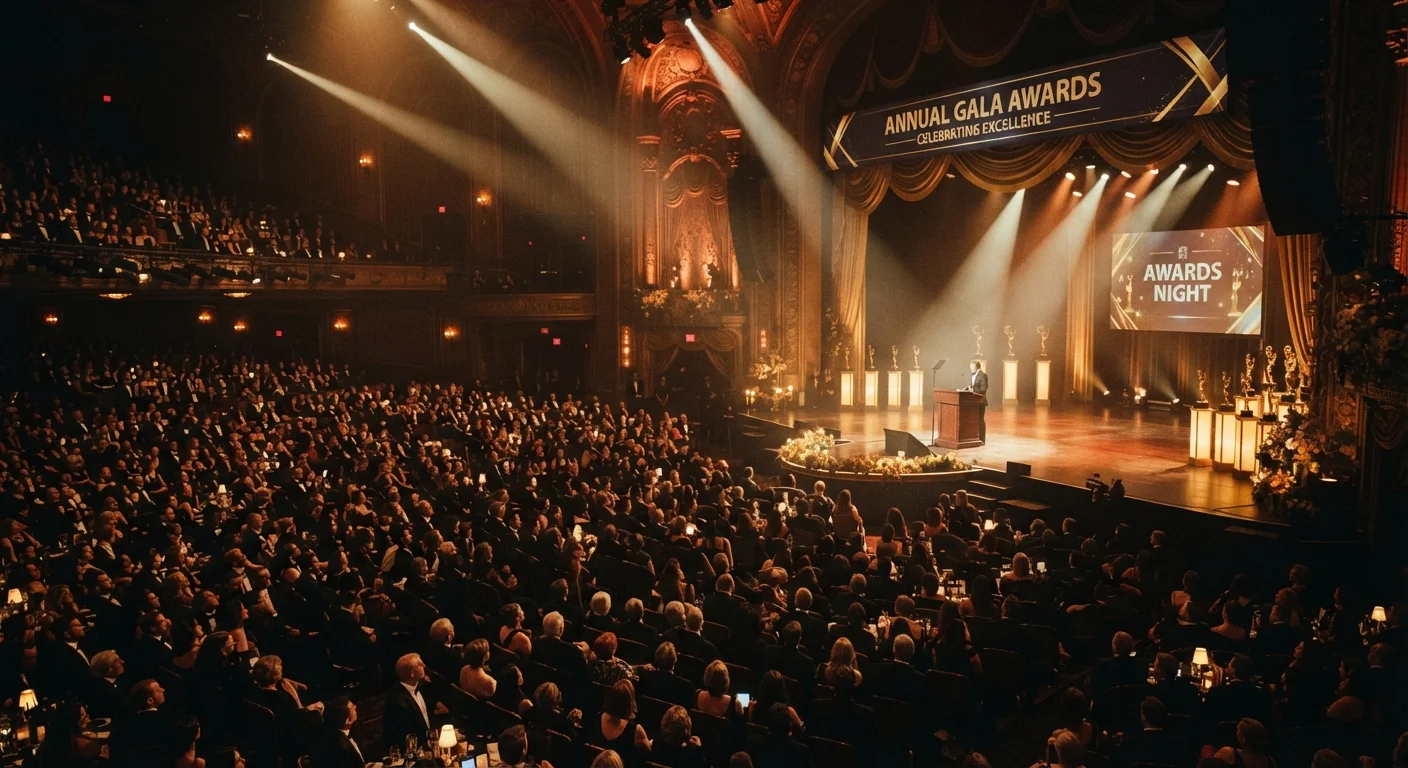
From Industry Ritual to Public Stage
For most of their early history, award ceremonies were unapologetically self-congratulatory affairs - Hollywood celebrating Hollywood, the music industry toasting itself. The politics were industry politics: who was in favor, whose film had the muscle behind it. But that began to shift as television brought these events into living rooms across the country, transforming a private industry ritual into a shared national spectacle.
The pivotal realization - that a captive audience of tens of millions was a rare and powerful thing - changed what artists felt they could, and perhaps should, do with those few minutes at the microphone. The major ceremonies that now define awards season evolved alongside this awareness, each developing its own unspoken norms around what kinds of statements felt appropriate.
~18M
Average US viewers for recent Oscar telecasts
Nielsen ratings data has tracked significant audience fluctuation over the past decade, with the ceremony still drawing tens of millions of simultaneous US viewers.
1973
Year of the first widely recognized protest moment
Marlon Brando's proxy refusal of his Best Actor Oscar is broadly cited by media historians as the moment award shows became recognized political platforms.
48hrs
Typical viral lifespan of a major award show moment
Media analysts note that social media discussion of a notable award show moment typically peaks within 48 hours, though high-profile clips can recirculate for years.
The Anatomy of a Statement Moment
Not every on-stage declaration carries equal weight. The ones that resonate tend to share a few characteristics: they arrive at moments of heightened public tension, they are specific rather than vague, and they come from a speaker with credibility on the subject. A generalized plea for peace reads differently than a direct reference to a named law, a specific community, or a concrete injustice.
The how matters as much as the what. Wardrobe has long been a quieter channel - ribbons, pins, and color choices telegraphing solidarity before a word is spoken. Red carpet moments communicate layered meanings that go well beyond fashion, and seasoned viewers have learned to read them accordingly.
“Award shows are one of the few remaining places where mass culture and individual voice collide in real time. That's why they matter beyond the trophies.”
— Stuart Hall, Cultural theorist and media studies scholar
Boycotts, Walkouts, and the Power of Absence
Sometimes the most resonant statement is the one never made from the podium. Boycotts of award shows - whether over lack of diversity in nominations, labor disputes, or political objections - have generated as much coverage as any acceptance speech. The #OscarsSoWhite conversation in 2015 and 2016, which followed two consecutive years of all-white acting nominees, is a clear example: the outrage and subsequent industry-wide response shifted hiring practices, diversity initiatives, and nomination processes in measurable ways.
Who skips, who attends wearing black instead of color, who seats themselves beside a specific guest - these choices register as deliberate acts of communication. Single moments like these can permanently reshape a public figure's image, for better or worse, in ways that follow them for years.
Reading Between the Lines at Award Shows
When watching any major ceremony, pay attention to what isn't said as much as what is. Who chooses not to attend? Who wears a specific color or pin? These deliberate absences and visual choices are often coordinated statements that predate any speech. Following entertainment journalists who specialize in awards coverage can help decode these signals in real time.
The Social Media Amplifier
Before Twitter, TikTok, and Instagram, a memorable speech lived briefly in the next morning's papers and perhaps a clip on a late-night recap. Now those moments are atomized, shared, argued over, and remixed within minutes. This new ecosystem dramatically raises the stakes of every on-stage second - and just as dramatically extends the lifespan of any given moment.
It also introduces new distortions. A speech clipped out of context can mean something entirely different from the full version. Reaction videos, parody, and counter-messaging pile onto the original at speed, sometimes drowning it. Award shows' complicated relationship with cultural authenticity is partly a product of this amplification - where perception, rather than intent, increasingly defines the lasting record of any given moment.
Frequently Asked Questions
Political statements at award shows stretch back decades. Marlon Brando famously sent Sacheen Littlefeather to decline his 1973 Oscar to protest Hollywood's treatment of Native Americans, widely considered a landmark moment. Statements before that were quieter, but that moment crystallized the format's potential as a public stage.
Award shows guarantee massive, simultaneous viewership - making them one of the last remaining live events with genuine mass-media reach. An acceptance speech can reach more people in two minutes than almost any other form of public communication available to an individual. The emotional context of winning also gives the speaker a natural platform and audience goodwill.
The evidence is mixed. Some speeches have measurably raised awareness - Patricia Arquette's 2015 Oscars remarks on wage equality, for example, trended globally and fed into ongoing legislative debates. Others fade quickly. The impact tends to depend on whether the moment lands during an already-active public conversation.
Producers typically have delay buttons for language but lack reliable tools to preempt political speech. Most major networks have policies discouraging overtly partisan content, yet enforcement is inconsistent because the live format makes intervention difficult without creating its own controversy.
Dramatically. Before social media, a memorable speech might generate newspaper coverage the next day. Now a clip can accumulate millions of views within hours, be clipped out of context, spawn counter-narratives, and remain in circulation for years. This makes every on-stage moment carry higher stakes and longer shelf life.
The content on this site is for informational purposes only and is not a substitute for professional advice. Always consult a qualified professional for guidance specific to your situation.