

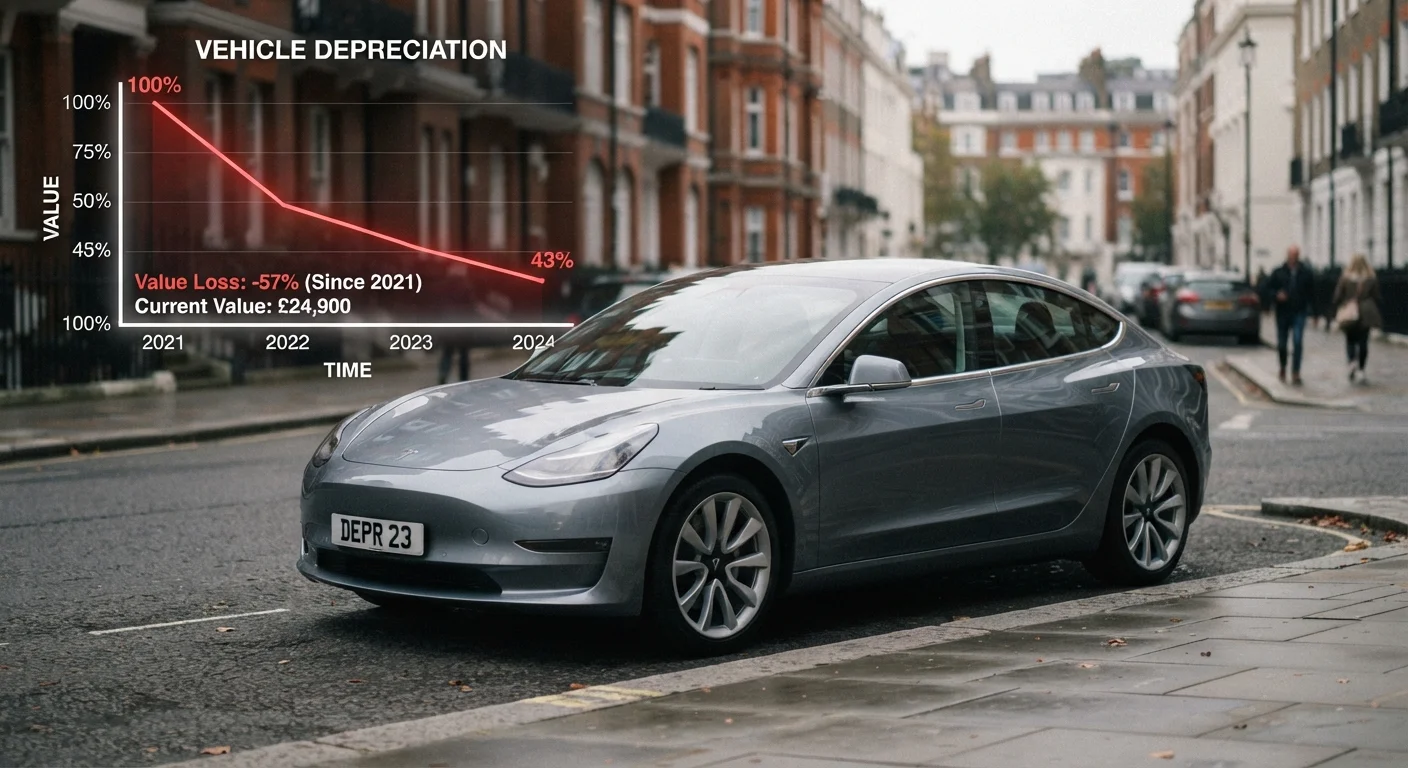
The Steepest Cliff: When Depreciation Hits Hardest
The most dramatic value loss in a vehicle's life happens early. A new car can lose close to 20% of its purchase price within the first year - not because it has been driven hard or poorly maintained, but simply because it is no longer new. By the end of the fifth year, many vehicles have lost between 40% and 60% of their original value.
This matters enormously for anyone financing a vehicle. When monthly payments are spread over a six- or seven-year loan on a rapidly depreciating asset, buyers frequently find themselves in a situation where the outstanding loan balance exceeds what the car could be sold for. This condition - commonly called being "underwater" or "upside-down" on a loan - leaves drivers with limited financial flexibility if they need to sell, trade in, or if the vehicle is totaled.
~20%
Average value lost in year one
Industry data consistently shows new vehicles lose roughly 15-20% of their purchase price within the first 12 months of ownership.
40-60%
Value lost in first five years
Most new vehicles shed between 40% and 60% of their original value over a five-year ownership period, depending on make, model, and usage.
#1
Largest single cost of car ownership
Automotive consumer research consistently ranks depreciation as the largest annual cost of owning a new vehicle, outpacing fuel, insurance, and maintenance for most drivers.
For a complete view of how depreciation fits into broader vehicle expenses, see our breakdown of the true cost of owning a car in America.
What Determines How Fast a Car Loses Value
Depreciation is not uniform across all vehicles. Several key factors influence how quickly - or slowly - a car sheds its market value:
- Mileage: Higher annual mileage accelerates value loss. Most depreciation models assume around 12,000-15,000 miles per year; vehicles driven significantly more will depreciate faster.
- Condition and maintenance history: A vehicle with documented service records and no accident history holds value better than one without. Skipping scheduled maintenance not only increases repair risk - it directly reduces resale value.
- Brand and model reputation: Vehicles with strong reliability track records and high consumer demand consistently depreciate more slowly than those with weaker reputations.
- Fuel type and powertrain: Market preferences shift depreciation rates. Changes in fuel prices or consumer interest in electric vehicles can alter how quickly certain powertrains lose value.
- Color and trim: Unpopular color combinations or sparse feature packages tend to appeal to a narrower pool of buyers, which can reduce resale prices.
Protect Resale Value From Day One
Keeping a complete service record from your first oil change creates a documented maintenance history that reassures future buyers and supports a higher resale price. Store receipts, dealer invoices, and inspection reports in a single folder - physical or digital - for the life of the vehicle.
Why Depreciation Matters More Than the Sticker Price
Most buyers focus on the purchase price - or at most, the monthly payment. But the more revealing number is how much value the vehicle will shed during the time they own it. A $45,000 vehicle that retains 55% of its value after five years costs the owner roughly $20,250 in depreciation alone. A $38,000 vehicle that retains only 40% of its value over the same period costs $22,800 in depreciation - making the nominally cheaper car the more expensive ownership choice.
“The true cost of a car isn't what you pay at the dealership - it's what you've lost by the time you sell it. Depreciation is the silent expense that most buyers never see coming.”
— Autos Editorial Team, Automotive ownership and finance analysts
This framing also shapes the leasing versus buying decision. Lease payments are largely a function of projected depreciation during the lease term. Vehicles that hold their value well tend to carry lower monthly lease costs because the residual value - what the car will be worth at lease end - is higher.
There are also costs that interact with depreciation in ways buyers may not anticipate. Hidden fees and dealer add-ons can inflate the financed amount without adding equivalent resale value, effectively accelerating the underwater risk. Thinking about total cost of ownership - including depreciation - gives a more honest picture of what a vehicle truly costs.
This article provides general financial information for educational purposes only and is not personalized financial or investment advice. Readers should consult a qualified financial professional for guidance specific to their situation.
Frequently Asked Questions
Most new cars lose approximately 15-20% of their value within the first 12 months of ownership. This makes the first year the steepest period of depreciation for the vast majority of vehicles.
Vehicles with strong reliability reputations, high demand, and limited supply tend to hold their value better. Trucks, SUVs, and certain fuel-efficient models have historically depreciated more slowly, though this varies by market conditions and model year.
Yes. If a car depreciates faster than you pay down your loan balance, you can end up "underwater" - owing more than the car is worth. This is particularly risky if the vehicle is totaled or you need to sell early.
You can reduce depreciation by keeping mileage reasonable, maintaining service records, preserving the vehicle's condition, and avoiding unpopular color or trim choices. None of these eliminate depreciation, but they do help preserve resale value.
Depreciation is central to how lease payments are calculated. Lessees essentially pay for the vehicle's expected depreciation during the lease term, plus fees and interest. Cars that depreciate slowly tend to have lower monthly lease payments.
Depreciation typically levels off after the first five years, when a car has absorbed the steepest portion of its value loss. After this point, annual declines tend to be smaller in dollar terms, though the vehicle's total value is already significantly reduced.
The content on this site is for informational purposes only and is not a substitute for professional advice. Always consult a qualified professional for guidance specific to your situation.