

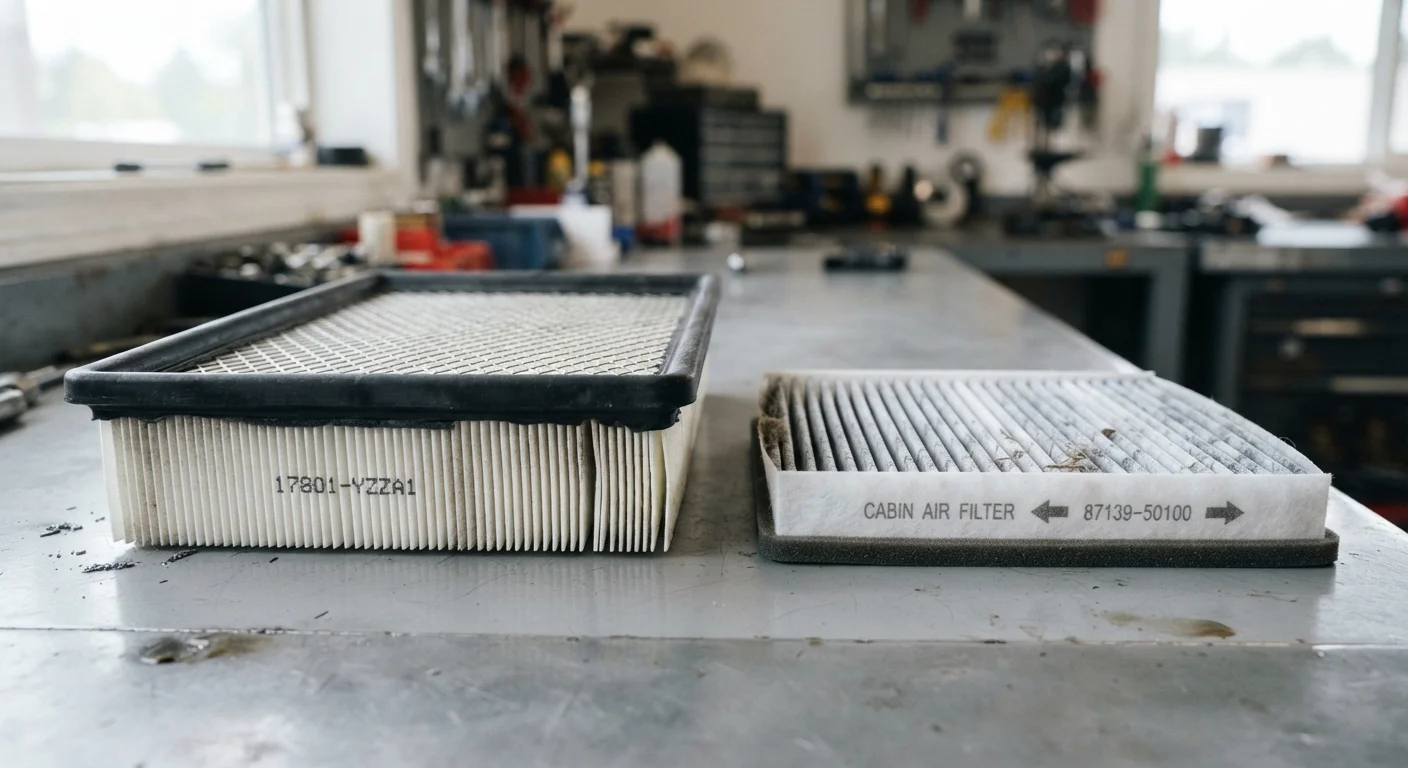
Option A
Engine Air Filter
The powertrain's first line of defense against contamination.
Best for: Protecting engine components from dust, debris, and airborne particles that enter through the intake.
Option B
Cabin Air Filter
The occupant-focused filter that cleans the air you breathe.
Best for: Removing pollen, pollution, dust, and odors from air circulated through the climate control system.
Two Filters, Two Completely Different Jobs
Many drivers are surprised to learn their vehicle contains not one but two air filters - each designed for an entirely separate purpose. Confusing them, or servicing only one while neglecting the other, is one of the most common gaps in routine car maintenance.
The engine air filter sits within the engine bay, typically housed in a plastic airbox connected to the intake system. Its job is to trap dust, dirt, insects, and airborne debris before that air mixes with fuel inside the engine. Without it, abrasive particles would wear down cylinder walls, pistons, and other precision components over time.
The cabin air filter, by contrast, has nothing to do with engine operation. It lives inside the HVAC (heating, ventilation, and air conditioning) system - usually behind the glove box, under the dashboard, or beneath a panel near the firewall - and filters the air circulated into the passenger compartment. It captures pollen, fine dust, exhaust particulates, and in some cases mold spores and odors before that air reaches you and your passengers.
Think of it this way: one filter keeps your engine clean, the other keeps your lungs cleaner. Both matter, and neither can substitute for the other.
| Criterion | Engine Air Filter | Cabin Air Filter |
|---|---|---|
| Primary purpose | Protects engine internals | Filters passenger compartment air |
| Location | Engine bay airbox | HVAC system, inside cabin |
| What it filters | Dust, dirt, debris, insects | Pollen, pollutants, fine dust, odors |
| Impact if neglected | Reduced performance, higher fuel use | Poor airflow, worse cabin air quality |
| Typical replacement interval | 12,000-15,000 miles (varies) | 12,000-15,000 miles (varies) |
| DIY difficulty | Generally straightforward | Easy to moderate, varies by model |
| Effect on fuel economy | Directly affects efficiency | No direct effect on fuel economy |
How to Know When Each Filter Needs Attention
Neither filter announces its own failure loudly, which is why they're easy to neglect. However, each leaves recognizable signs when it's overdue for replacement.
Engine Air Filter Warning Signs
- Reduced acceleration or sluggish throttle response - a clogged filter starves the engine of air, disrupting the air-fuel ratio.
- Noticeably lower fuel efficiency - the engine compensates for restricted airflow by consuming more fuel.
- Black smoke from the exhaust - an overly rich fuel mixture, caused by insufficient air intake, can produce dark exhaust.
- Visible dirt buildup - hold the filter up to light; if you can't see light through it or it's visibly gray or black, it likely needs replacing.
Cabin Air Filter Warning Signs
- Weak airflow from vents even at high fan settings - the filter is physically blocking airflow.
- Musty or stale odors when the HVAC runs - accumulated debris and moisture can produce unpleasant smells.
- More dust accumulating on the dashboard - a failing filter lets particulates pass through more easily.
- Increased allergy symptoms while driving - reduced filtration efficiency can allow more pollen and pollutants into the cabin.
Check Your Owner's Manual First
Replacement intervals printed on aftermarket filter packaging are often generic estimates. Your vehicle's owner's manual provides manufacturer-recommended intervals based on your specific engine and HVAC system design. Driving conditions - particularly dusty roads, stop-and-go city traffic, or areas with heavy wildfire smoke - can shorten both filters' effective service life considerably.
Most manufacturers suggest inspecting both filters every 12,000 to 15,000 miles, or annually - whichever comes first. Drivers in dusty climates, agricultural areas, or heavy urban traffic may need to check more frequently. Your owner's manual is the authoritative source for your specific vehicle's intervals.
DIY Access and Replacement: What to Expect
Both filters are among the more accessible maintenance items on most modern vehicles, though ease of access varies by make and model.
The engine air filter is usually reached by opening the hood and locating the airbox - a black plastic housing connected to a large duct. Most are secured with clips or a few screws requiring no special tools. Swapping the filter is typically a five-minute task once you have the correct replacement part for your vehicle.
The cabin air filter location varies more widely. On many vehicles it's accessible by opening the glove box and pressing in the sides to drop it down, revealing the filter housing behind it. On others it's beneath a panel under the dashboard or accessible from the engine side of the firewall. A quick search of your vehicle year, make, and model will usually yield clear instructions for your specific setup.
If you're comfortable with basic tool use and following your vehicle's manual, both replacements are reasonable DIY tasks for most drivers. If access is awkward or involves removing significant trim pieces, it may be worth having a qualified mechanic handle it to avoid accidental damage. This is especially relevant for older or more complex vehicles where the filter housing may be fragile.
For context on how filtration decisions differ across systems, our piece on common HVAC filter mistakes homeowners make explores similar misunderstandings in home air systems - useful reading if you're thinking about air quality more broadly.
2x
Filters in every modern passenger vehicle
All modern passenger cars include at least one engine air filter and one cabin air filter as standard equipment, yet surveys suggest many drivers are unaware the cabin filter exists.
~15,000 mi
Typical engine air filter service interval
The Car Care Council, a nonprofit automotive education organization, cites roughly 12,000-15,000 miles as a common inspection benchmark, though severe-duty driving shortens this.
The content on this site is for informational purposes only and is not a substitute for professional advice. Always consult a qualified professional for guidance specific to your situation.