

Option A
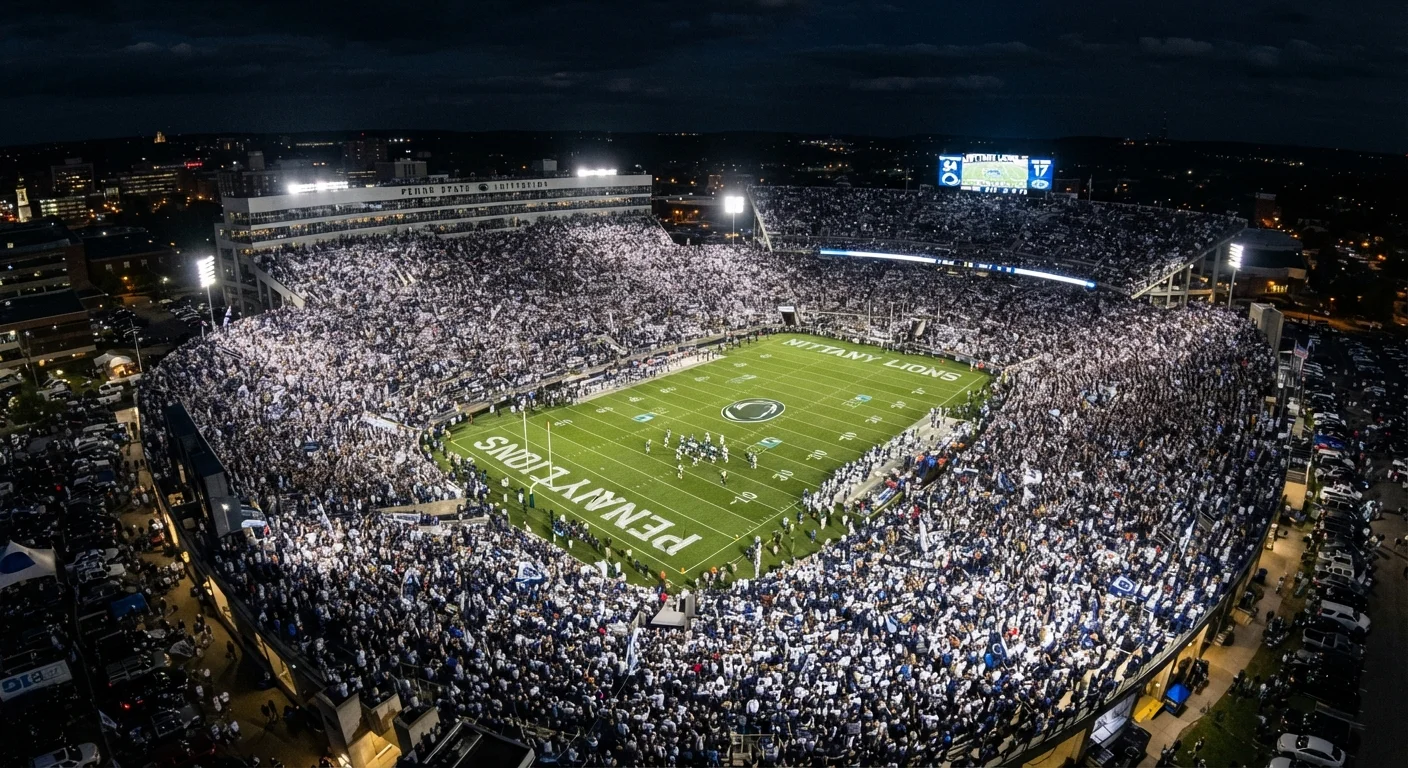
College Football (NCAA)
The passionate, regional game where traditions run deep.
Best for: Fans who love rivalries, home crowds, and watching the next generation of stars develop.
Option B
NFL (National Football League)
The polished, professional game where every snap carries enormous stakes.
Best for: Fans drawn to elite competition, complex strategy, and the highest level of athletic execution.
The Field Looks the Same - But It Isn't
Both games are played on a 100-yard field, but one detail quietly reshapes every offensive play: hash mark width. In college, the hashes sit 40 feet apart. In the NFL, they're just 18 feet, 6 inches apart - nearly centered on the field. That difference means college offenses can exploit wide field angles that simply don't exist in the pros.
A college quarterback who torched defenses by throwing into the wide side of the field often struggles at first in the NFL, where defenses don't have to account for the same spatial disadvantage. Pass rushers and cornerbacks who looked slow in college can appear dramatically faster when the geometry tightens up.
The catch rule adds another layer. College requires only one foot inbounds for a legal reception. The NFL demands two feet down (or another body part) before going out of bounds. Highlight-reel sideline grabs that count in college often get wiped out in the pros - a distinction that catches both players and fans off guard.
| Criterion | College Football | NFL |
|---|---|---|
| Hash mark width | 40 feet apart | 18 ft, 6 in apart |
| Catch rule | One foot inbounds | Two feet inbounds |
| Roster size | 85 scholarships | 53-man active roster |
| Overtime format | Alternating possession at 25-yd line | Modified sudden death |
| Clock after first down | Stops until ball spotted | Runs continuously |
| Defensive complexity | More predictable coverages | Disguised, complex schemes |
Rosters, Substitution, and the Clock
Major college programs can offer up to 85 scholarships, producing deep rosters with significant talent stacked at every position. NFL teams are capped at a 53-man active roster, with a practice squad providing a developmental buffer. That compression means there's almost no such thing as a 'soft spot' in a pro lineup - every player on an NFL field has already proven themselves against elite competition.
Clock management works differently too. In college, the clock stops after every first down until the referee spots the ball. The NFL keeps the clock running after most first downs outside the final two minutes of each half. This makes late-game situations more urgent in pro football and rewards teams with disciplined, experienced quarterbacks who understand when to spike the ball, take a knee, or call a timeout.
The Practice Squad: The NFL's Hidden Roster Layer
Beyond the 53-man active roster, NFL teams maintain a practice squad of up to 16 players who practice with the team but are not eligible to play on game day (with limited exceptions). Teams can elevate practice squad players to the active roster on a temporary basis, adding a layer of roster flexibility that has no direct college equivalent. This system serves as the primary developmental pipeline for players on the edge of making a full-time NFL roster.
Overtime: A Tale of Two Formats
Few rule gaps generate more fan confusion than overtime. College football uses an alternating-possession format: each team gets the ball at the opponent's 25-yard line and attempts to score, with no clock pressure until later rounds. Starting in the third overtime period, teams must attempt a two-point conversion instead of kicking an extra point.
The NFL has moved toward a slightly modified sudden-death format. Both teams are guaranteed a possession in the first overtime period unless the team receiving the opening kickoff scores a touchdown - at which point the game ends immediately. A field goal on the first drive allows the opposing offense a chance to respond. Understanding these structures matters when watching a close game enter extra time, and they reflect each league's very different philosophy about competitive fairness versus entertainment pace.
For fans interested in how league structures shape competition more broadly, check out our breakdown of how the NHL's playoff structure works - the design logic is surprisingly relevant across sports.
Schemes, Physicality, and the Quarterback Learning Curve
Nothing exposes the college-to-pro gap more visibly than quarterback play. College defenses frequently run simpler zone coverages that leave predictable windows. NFL defensive coordinators disguise coverages, rotate safeties post-snap, and pressure quarterbacks with exotic blitz packages. A college quarterback reading one or two progressions can look like a franchise cornerstone - then arrive in the NFL and struggle against schemes designed specifically to punish that limited reads.
The physical jump is equally real. The average NFL lineman is larger, faster, and more technically refined than his college counterpart. Routes run by NFL wide receivers are sharper and more precise. Even special teams - often an afterthought in college - becomes a genuine competitive battleground in the pros.
85
Max scholarships for FBS college programs
NCAA rules cap Football Bowl Subdivision programs at 85 scholarship players, creating rosters far larger than any NFL active roster.
~40%
First-round QBs who struggle in Year 1
Analysts and scouts have long noted that a significant portion of first-round quarterbacks take multiple seasons to adapt to NFL defensive complexity, reflecting the steep learning curve.
18 ft 6 in
NFL hash mark separation
Compared to 40 feet in college, the NFL's narrower hashes fundamentally reduce the field-width advantages that college offenses exploit every week.
Want to dig deeper into the rules that keep even longtime NFL fans scratching their heads? Our guide to the most misunderstood NFL rules breaks down the catch definition debate and more.
The content on this site is for informational purposes only and is not a substitute for professional advice. Always consult a qualified professional for guidance specific to your situation.