

Why Price Tags Contain More Than a Number
A retail price tag is a compressed communication between a retailer and its inventory system - and once you understand the conventions, you can intercept that communication as a shopper. Tags encode pricing stage, markdown history, and sometimes timing signals that most people walk right past. This kind of literacy won't replace research, but it changes what you notice and what questions you think to ask.
If you're new to thinking critically about prices and promotions, the consumer's starting point for understanding deals and pricing covers the foundational concepts worth knowing before diving into tag anatomy.
What you will need
What You'll Need Before You Start
Reading price tags doesn't require special equipment, but having a few resources on hand makes the process more effective. The tools below help you verify what the tag is telling you against independent data sources.
Price history tracking tool
Verifies whether the price shown on a tag reflects a genuine markdown or a routine pricing cycle.
Retailer loyalty app
Some retailer apps display additional tag information, markdown schedules, or clearance event details not visible on the physical tag.
Once you have these in place, follow the steps below to systematically decode what any price tag is actually communicating.
Find and read the full price - not just the large number
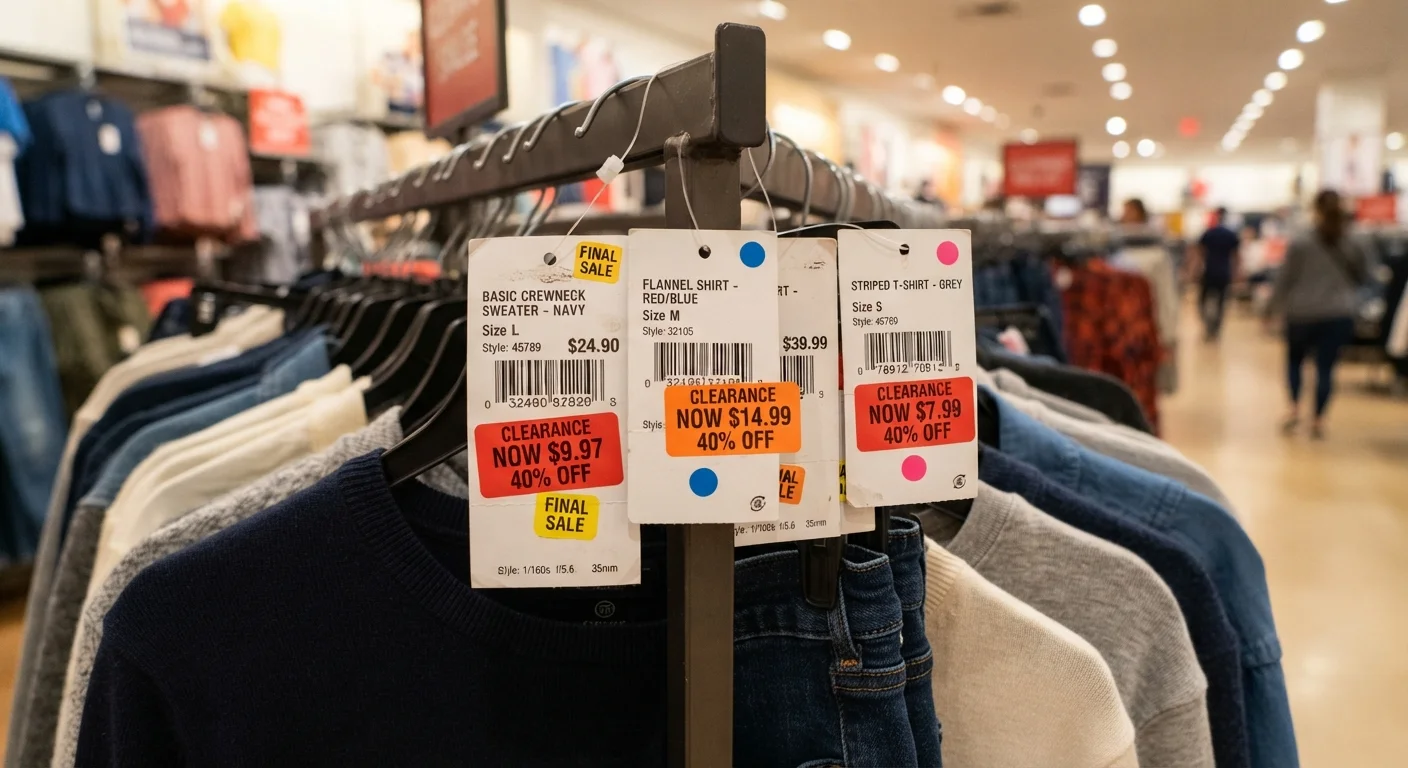
Most tags display a prominent price, but the digits immediately surrounding it carry meaning too. Prices ending in .99 or .98 typically signal a standard full-price or promotional item. Prices ending in .97, .96, or .00 often indicate a clearance or final-markdown item at many large US retailers. This isn't a universal rule - it varies by chain - but it's worth learning the convention for stores you frequent.
Decode the tag color or label type
Many retailers use a color-coded tag system to indicate markdown depth. A common structure moves through stages: white or standard tags for full price, a first-color tag for an initial markdown, and a second or third color for deeper clearance levels. The number of sticker layers on a tag can reveal how many times an item has been marked down - more layers generally mean a longer time on the floor and deeper discounting.
Look for a markdown or 'last chance' date
Some tags include a printed or handwritten date indicating when the item was last marked down or when it will be reviewed for further reduction. If a date is present and it's several weeks old, the item may be approaching a final clearance cycle. Understanding seasonal price patterns can help you estimate how long an item is likely to remain at its current price before the next cut.
Scrutinize the 'original' or strikethrough price
The crossed-out price shown above or beside the sale price is called a reference price. It's meant to signal what you're saving, but its legitimacy varies. Retailers may set reference prices based on a manufacturer's suggested retail price (MSRP), a brief prior selling period, or a price the item was offered at in a different channel. Before treating a reference price as meaningful, check whether the item has actually been sold at that price recently.
Check for additional stickers or secondary tags
Overlapping stickers are common in clearance sections. Carefully peel back (without damaging the tag) or examine the edges to see if there are older tags underneath. The sequence of prices visible across sticker layers tells a markdown story: you can often identify the original shelf price, one or more interim reductions, and the current price. This history helps you gauge how aggressively an item has been discounted and whether a further cut is likely.
Cross-reference with price history data before buying
Everything the tag tells you is more useful when paired with independent price data. A tag may show all the signs of a deep clearance discount, but if the item's online price has never moved, the in-store tag may not represent a true deal. Use a price history tool to verify the item's actual pricing trajectory. For a practical walkthrough, see our guide to tracking price history.
The Bigger Picture: Pricing Psychology and What to Watch For
Retail pricing isn't random - it follows structured patterns designed to move inventory while managing consumer perception. Understanding tag anatomy is one layer of that picture. The other is recognizing that promotional pricing often works as much on psychology as on genuine value. Prices just below a round number ($49.99 vs. $50.00) are a classic example of a pricing convention designed to influence perception.
Reference Prices Can Be Misleading
Retailers are not always required to have actively sold an item at the 'original' or 'was' price shown on a tag. Some reference prices are set artificially high to make a discount appear larger. For a deeper look at how this works, see why that 'sale' price might not be a deal at all. Always compare against price history data before assuming a markdown is meaningful.
Seasonal rhythms also shape when markdowns appear and how deep they go. Learning those patterns adds context to what you see on a tag. For a category-by-category breakdown, see when retailers actually mark things down.
When you combine tag-reading skills with price history verification, you're working from evidence rather than assumption. That's the practical difference between a shopper who benefits from markdowns and one who is managed by them. For more on reading the data behind a product - not just its price - see our guide to reading product specifications without getting lost in the numbers.
Use Price History Tools to Verify
Once you understand what a tag is telling you, cross-reference it with actual price history data before committing to a purchase. Tools that track historical pricing can confirm whether a 'sale' reflects a real drop or a routine pattern. Learn how in our guide on how to track price history before making a big purchase.
The content on this site is for informational purposes only and is not a substitute for professional advice. Always consult a qualified professional for guidance specific to your situation.