

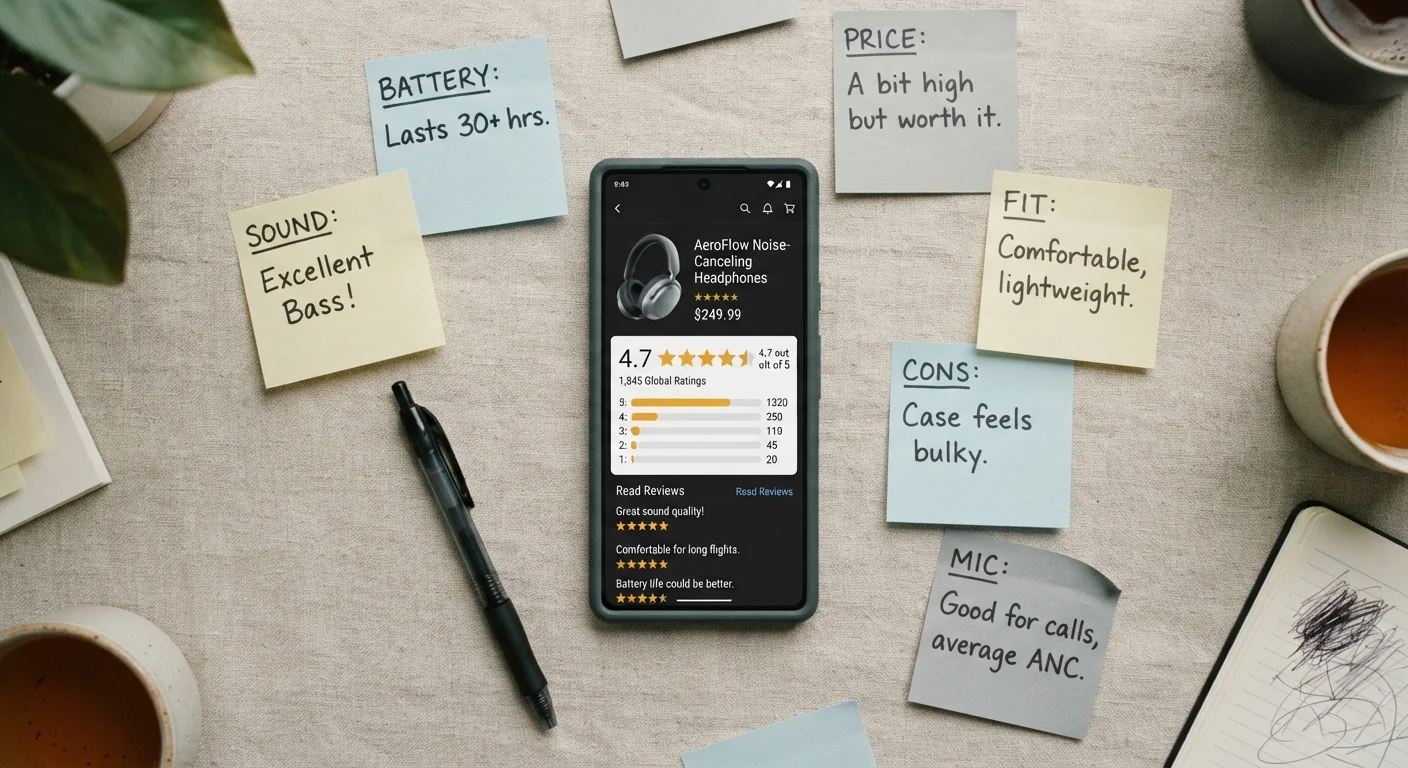
Why Review Scores Feel More Certain Than They Are
A 4.6-star rating feels precise. It implies thousands of people weighed in and a clear consensus emerged. In practice, that number is the product of incentives, self-selection, and platform mechanics that have almost nothing to do with whether the product will work for you.
Shoppers who feel neutral about a purchase rarely leave reviews. Those who felt strongly - delighted or furious - are far more likely to. That asymmetry alone distorts the average before a single fake or incentivized review enters the picture. Understanding that the system is structurally noisy is the first step to reading it accurately.
For a parallel look at how numbers that feel authoritative can mislead, see our piece on what box office numbers actually measure - the same gap between metric and meaning applies.
Myth
A higher star rating always means a better product.
Fact
Star averages are shaped by who reviews, when, and under what incentives - not just by product quality.
A product with 4.8 stars and 40 reviews from early adopters who received a discount is a fundamentally different data set than one with 4.2 stars from 3,000 verified purchasers over two years. The lower-rated product may actually reflect a more honest and representative sample. Always look at review count, recency distribution, and whether the platform marks reviews as incentivized before treating the average as meaningful.
Myth
More reviews mean a product is more reliable or popular.
Fact
Review volume reflects how aggressively a seller solicits feedback, not how broadly or consistently a product performs.
Automated post-purchase emails, in-package cards offering gift cards for reviews, and seller-funded programs can inflate review counts significantly. A product with 10,000 reviews launched by an aggressive marketing operation may have less organic signal than one with 800 reviews accumulated steadily over three years. Check the review date distribution - a sudden spike followed by a plateau often indicates a launch campaign, not sustained satisfaction.
Myth
One-star reviews are from difficult customers and can be ignored.
Fact
Low-star reviews, read in aggregate, often contain the most specific and actionable product information.
A single one-star review may reflect an outlier experience. But when 15% of reviews mention the same cracking seam or software bug, that pattern has predictive value regardless of tone. Read low-star reviews for specifics - what exactly broke, when, and how the seller responded. A company that replies constructively to complaints tells you something about post-purchase support that no star rating captures.
Myth
Verified purchase badges guarantee the review is unbiased.
Fact
Verified purchase status confirms a transaction occurred - it says nothing about whether the reviewer was compensated or influenced.
Many platforms mark a review as verified if a purchase was made through their system, but that same purchase may have been made at a steep reviewer discount or as part of a product-testing arrangement. The reviewer may genuinely like the product and still be motivated by the incentive to write positively. Treat verified badges as a mild signal of authenticity, not a guarantee of independence.
Myth
A product with no negative reviews is the safest choice.
Fact
An absence of negative reviews is as often a moderation artifact or small sample size as it is evidence of quality.
Platforms remove reviews that violate terms - and sellers sometimes report negative reviews in bulk hoping some get caught in automated filters. A product with 100% positive reviews and fewer than 50 total reviews should raise questions, not confidence. Genuine product categories almost always produce some fraction of unhappy customers due to fit, expectation mismatches, or shipping damage. A spotless record with thin volume warrants skepticism.
What Reviews Actually Measure Well
Consumer reviews aren't useless - they're just useful for narrower questions than most shoppers ask of them. They do a reasonable job of surfacing recurring, concrete problems: a zipper that fails after three uses, a blender that leaks from the base, a mattress that arrives noticeably thinner than advertised. When multiple unconnected reviewers describe the same defect in independent language, that pattern is meaningful.
Reviews also carry signal about fit and context. A reviewer who explains they used a jacket for winter hiking in the Pacific Northwest gives you information a rating number never can. Filtering by use case - rather than star level - tends to surface this. Our guide on interpreting gear ratings and claims goes deeper on category-specific signals worth looking for.
~30-40%
Estimated fake or incentivized reviews on major platforms
Independent review-analysis firms have estimated that a substantial fraction of reviews on large e-commerce platforms may be unreliable, though figures vary by category and platform.
72%
Shoppers who read reviews before purchasing
Multiple consumer surveys have consistently found that a strong majority of US online shoppers consult reviews before completing a purchase decision.
What reviews measure poorly: subjective quality judgments, long-term durability (most reviews are left within days of receipt), and comparisons against alternatives the reviewer never tried. Treat those elements of any review as opinions, not evidence.
If you want to decode the technical side of a product alongside its reviews, reading product specifications without getting lost in the numbers provides a practical framework.
Watch for Review Gating
Some sellers contact customers after purchase and only ask satisfied ones to leave public reviews, while routing negative feedback privately. This practice - called review gating - is prohibited by several major platforms but remains difficult to detect. If a product's reviews seem uniformly enthusiastic with little variation in experience, that uniformity itself is worth questioning.
The content on this site is for informational purposes only and is not a substitute for professional advice. Always consult a qualified professional for guidance specific to your situation.