
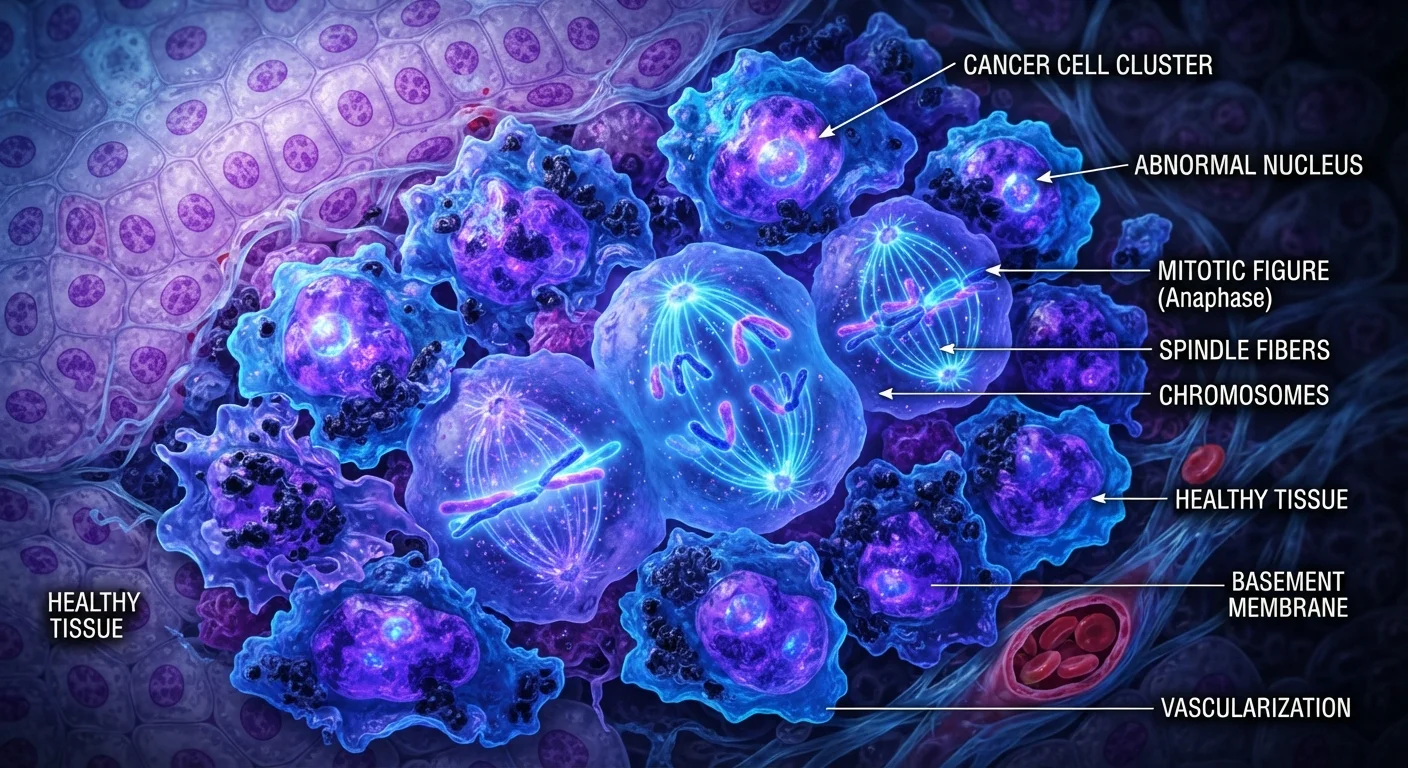
How Cancer Begins: A Cell Gone Wrong
Every cancer starts in a single cell. The human body contains trillions of cells, each governed by a precise set of instructions encoded in DNA. These instructions tell cells when to grow, divide, rest, and die - a carefully regulated cycle that keeps tissues healthy and functional.
Occasionally, errors - called mutations - occur in this DNA. Mutations can be triggered by environmental exposures such as tobacco smoke or ultraviolet radiation, by certain infections, by inherited genetic variants, or simply by random copying errors during cell division. Most of the time, the body detects and repairs these errors. When repair fails, the mutated cell is usually destroyed by the immune system through a process called apoptosis (programmed cell death).
Cancer develops when mutations accumulate in specific genes that control the cell cycle. Two categories are especially important: tumor suppressor genes, which act as biological brakes, and proto-oncogenes, which normally promote healthy cell growth but can become overactive. When enough of these safeguards are compromised, a cell begins dividing without restraint - and cancer begins.
Most Mutations Do Not Cause Cancer
The body is remarkably good at catching and correcting DNA errors. Billions of cell divisions occur every day, and the vast majority of mutations are repaired or result in cell death before any harm is done. Cancer is the exception - not the rule - that emerges when multiple protective systems fail simultaneously.
From One Cell to a Tumor
A single rogue cell divides to produce two cells, then four, then eight. Over months or even years, this uncontrolled multiplication produces a tumor - a mass of abnormal cells. Not all tumors are cancer. Benign tumors grow in one location and do not invade surrounding tissue. Malignant tumors (cancers) can penetrate neighboring tissues and ultimately spread.
As a malignant tumor grows, it also signals the body to build new blood vessels to feed it - a process called angiogenesis. This blood supply delivers oxygen and nutrients that fuel further growth. It also creates pathways through which cancer cells can eventually escape into the wider body.
~1 in 2
Lifetime cancer risk for men in the US
According to the American Cancer Society, approximately 1 in 2 men and 1 in 3 women in the US will be diagnosed with cancer during their lifetime.
Multiple
Mutations typically required to cause cancer
Research consistently shows that most cancers require the accumulation of several distinct genetic mutations - not a single event - before a cell becomes fully malignant.
>100
Distinct types of cancer recognized
The National Cancer Institute recognizes more than 100 types of cancer, each defined by the cell type from which it originates and its biological behavior.
How Cancer Spreads: Understanding Metastasis
Metastasis is the process by which cancer cells break away from the original tumor, enter the bloodstream or lymphatic system (the network of vessels and nodes that help fight infection), and travel to distant organs to form new tumors. The new tumors - called metastases - are made of the same type of cells as the original cancer, even when they appear in a different organ. For example, breast cancer that spreads to the lungs is still breast cancer, not lung cancer.
Not every cell that escapes a tumor successfully establishes a new tumor. Most are destroyed in transit by immune cells. But some cells develop adaptations that allow them to survive and colonize new environments. The likelihood and destination of metastasis varies by cancer type - certain cancers tend to spread to predictable locations, which helps oncologists monitor and treat them.
Understanding whether and where cancer has spread is central to determining its stage. Cancer staging provides a shared language for describing how far a cancer has progressed, and it directly shapes treatment planning.
What This Means for Patients and Families
A cancer diagnosis can feel overwhelming, in part because the biology is unfamiliar. Understanding even the basics - that cancer is a disease of abnormal cell growth, not a single condition, and that its behavior varies by cell type and location - can make medical conversations more meaningful.
Treatments are designed to target specific aspects of this biology: surgery removes tumors, radiation damages cancer cell DNA, chemotherapy interferes with cell division, and newer therapies such as immunotherapy work to sharpen the immune system's ability to find and destroy cancer cells. The approach depends on the type and stage of cancer as well as individual patient factors.
A cancer diagnosis affects far more than the body. The emotional experience of cancer is complex and deeply personal, and support is available. Treatment also carries practical implications - including financial ones. Families navigating costs can find helpful context in a general overview of cancer financial assistance programs.
Write Down Your Questions Before Appointments
Understanding cancer biology can help you ask more focused questions during medical consultations. Consider writing down terms you've heard - such as 'tumor grade,' 'receptor status,' or 'lymph node involvement' - so your care team can explain what they mean for your specific situation. No question is too basic to ask.
This article is for general informational and educational purposes only. It is not a substitute for professional medical advice, diagnosis, or treatment. Always consult a qualified healthcare provider with questions about a medical condition.
Frequently Asked Questions
A normal cell becomes cancerous through the gradual accumulation of DNA mutations. These mutations disable the genes that normally limit cell growth or trigger cell death. It typically takes multiple mutations over time - not just one - before a cell fully loses its normal controls.
No. DNA mutations happen constantly in the body, and the immune system eliminates most abnormal cells before they cause harm. Only when multiple protective mechanisms fail does cancer typically develop. Lifestyle, environment, and inherited genetic factors all influence risk.
A benign tumor grows in one location and does not invade surrounding tissue or spread to other parts of the body. A malignant tumor (cancer) can invade nearby tissue and may spread - a process called metastasis - to distant organs through the bloodstream or lymphatic system.
When cancer spreads, individual cancer cells break away from the original tumor, travel through the blood or lymph vessels, and form new tumors elsewhere. This is called metastasis. The new tumors are still made of the same type of cancer cell as the original, even if they appear in a different organ.
The immune system does destroy many abnormal cells before they become cancerous. However, some cancer cells develop ways to evade immune detection - for example, by disguising themselves as normal cells. This is why researchers have developed immunotherapy treatments designed to help the immune system recognize and attack cancer cells more effectively.
Cancer itself is not contagious - you cannot catch it from another person through ordinary contact. However, certain infections that can increase cancer risk, such as human papillomavirus (HPV) or hepatitis B and C, are transmissible. The cancer that may develop from these infections is still not directly passed from person to person.
The content on this site is for informational purposes only and is not a substitute for professional advice. Always consult a qualified professional for guidance specific to your situation.