

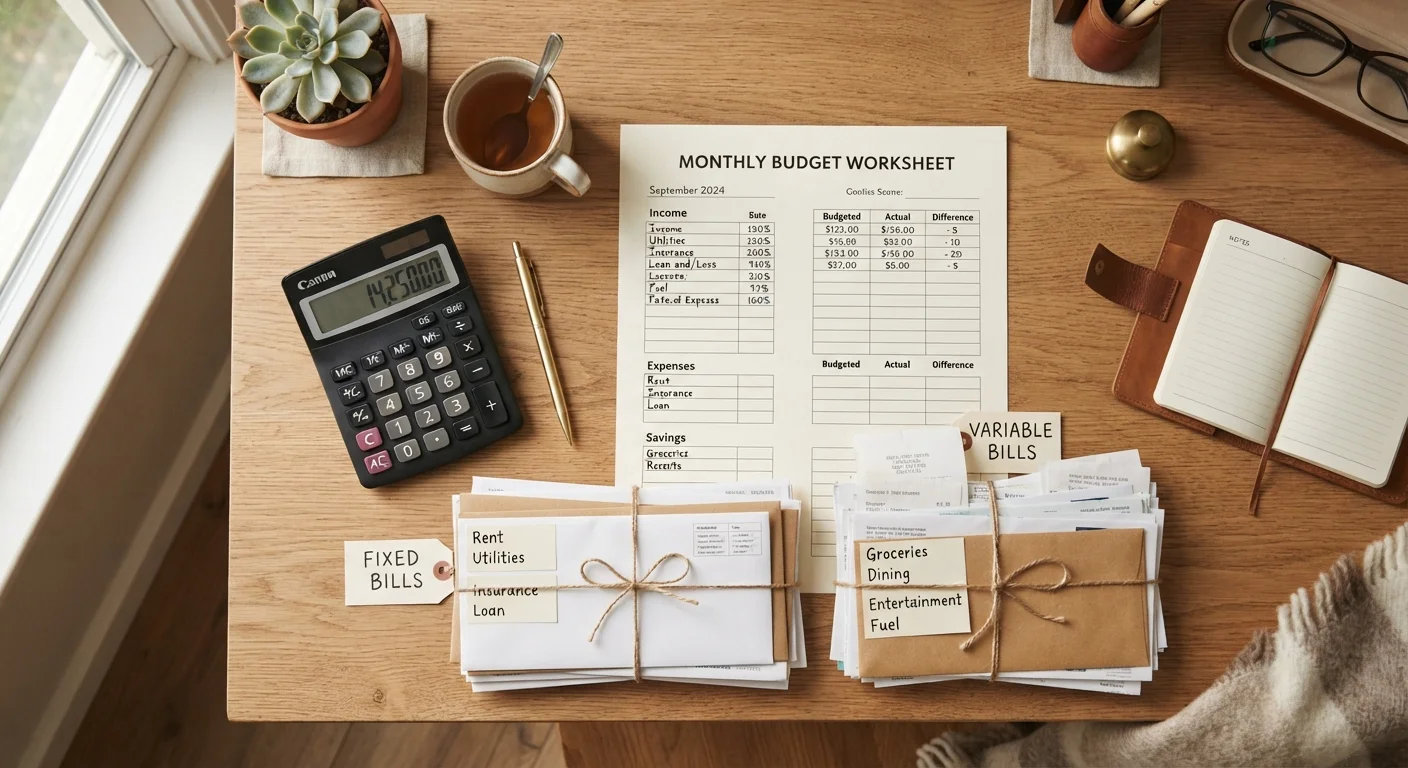
Option A
Fixed Expenses
The predictable, non-negotiable foundation of your budget.
Best for: Ideal for establishing a stable spending baseline - these costs are consistent and easy to plan around each month.
Option B
Variable Expenses
The flexible, adjustable layer where most budgeting decisions happen.
Best for: Best understood as the dynamic part of your budget - where you have real control to cut, shift, or reallocate spending.
What Makes an Expense Fixed or Variable?
At its most basic, a fixed expense is a cost that stays the same amount every billing cycle, regardless of how you live your life that month. Your rent or mortgage payment, a car loan installment, or a fixed-rate insurance premium will be the same in January as they are in August. These costs exist whether you stay home all month or travel every weekend.
A variable expense, by contrast, moves up or down depending on your behavior, usage, or circumstances. Groceries, gasoline, restaurant meals, and clothing purchases all vary from month to month. You control the dial on these categories, even if you can't eliminate them entirely.
A third category worth naming is semi-variable expenses - costs that recur monthly but change in amount. Your electricity bill is a good example: it arrives every month (fixed timing), but the total depends on how much power you used (variable amount). Understanding where these fall helps you avoid underestimating them in a budget.
Semi-Variable Expenses: A Third Category Worth Tracking
Semi-variable expenses - like utilities, phone bills with data overages, or gas for a variable commute - recur every month but do not carry a fixed price tag. For budgeting purposes, calculate the average of your last three months for each semi-variable expense and use that figure as your monthly estimate. Revisit the average every quarter to keep it accurate.
Side-by-Side: How Fixed and Variable Expenses Compare
The table below breaks down the key distinctions so you can quickly classify expenses as you build your spending plan.
| Criterion | Fixed Expenses | Variable Expenses |
|---|---|---|
| Amount each month | Stays the same | Changes month to month |
| Examples | Rent, car loan, insurance | Groceries, gas, dining out |
| Ease of tracking | Simple - amount is known in advance | Requires active monitoring |
| Control you have | Limited in the short term | High - adjustable anytime |
| Budget planning role | Establishes your monthly floor | Where spending decisions are made |
| Reduction timeline | Slow - tied to contracts or leases | Fast - can shift in days or weeks |
One important insight this comparison surfaces: fixed expenses require less month-to-month attention but are harder to reduce quickly. Variable expenses demand more active tracking but give you the most immediate control over your financial situation. Both matter - and you need to account for both to create a budget that reflects reality.
Why the Distinction Actually Changes Your Budget
When you separate expenses into these categories before you budget, something useful happens: you can immediately see your financial floor. Add up every fixed expense - rent, loan payments, insurance premiums, fixed subscriptions - and you have the minimum monthly outflow you are committed to, regardless of what else happens. That number matters enormously if your income fluctuates or if you are managing a household on one paycheck.
Variable expenses, once identified, become your primary budgeting canvas. This is where category-by-category planning pays off. Setting a monthly target for groceries, entertainment, or personal care - and then tracking against it - is how you translate a budget from a spreadsheet into an actual behavior change. The monthly budget setup checklist walks through assigning amounts to each category before the month begins, which is the most reliable way to avoid overspending.
It is also worth acknowledging that some variable expenses are irregular - they do not show up every month but are entirely predictable if you think ahead. Annual car registration, semi-annual dental visits, and holiday spending are classic examples. These often sink budgets precisely because people do not see them coming. Our guide on spending categories most people forget to budget for covers these in detail.
~33%
Average share of income spent on housing alone
The U.S. Bureau of Labor Statistics Consumer Expenditure Survey consistently shows housing as the largest single fixed expense for American households.
60%+
Americans living paycheck to paycheck at some point
Various Federal Reserve and consumer research surveys have found that a majority of U.S. adults report difficulty covering an unexpected $400 expense, underscoring why knowing your fixed floor matters.
Practical Steps to Classify Your Own Expenses
Start by pulling two to three months of bank and credit card statements. List every charge that appeared. Then ask a simple question about each one: Was this amount predetermined, or did it depend on choices I made? If predetermined - fixed. If choice-driven - variable. Flag anything that recurs monthly but fluctuates as semi-variable, and treat those like variable expenses when budgeting by using an average of the last three months as your estimate.
Once classified, total your fixed costs. Then set spending targets for each variable category based on your income minus fixed costs minus any savings goal you have committed to. If the math does not work, your variable expenses are where to look first - they are the adjustable levers. If you find certain variable spending patterns difficult to change, it may be worth revisiting whether some of those expenses are truly optional or have quietly become fixed in your habits. Common budgeting myths often center on exactly this confusion.
For context on longer-term spending decisions - where paying more upfront may reduce variable costs over time - see our piece on when paying more upfront makes sense.
This article is for general informational and educational purposes only and does not constitute personalized financial advice. Consult a qualified financial professional for guidance specific to your situation.
The content on this site is for informational purposes only and is not a substitute for professional advice. Always consult a qualified professional for guidance specific to your situation.