

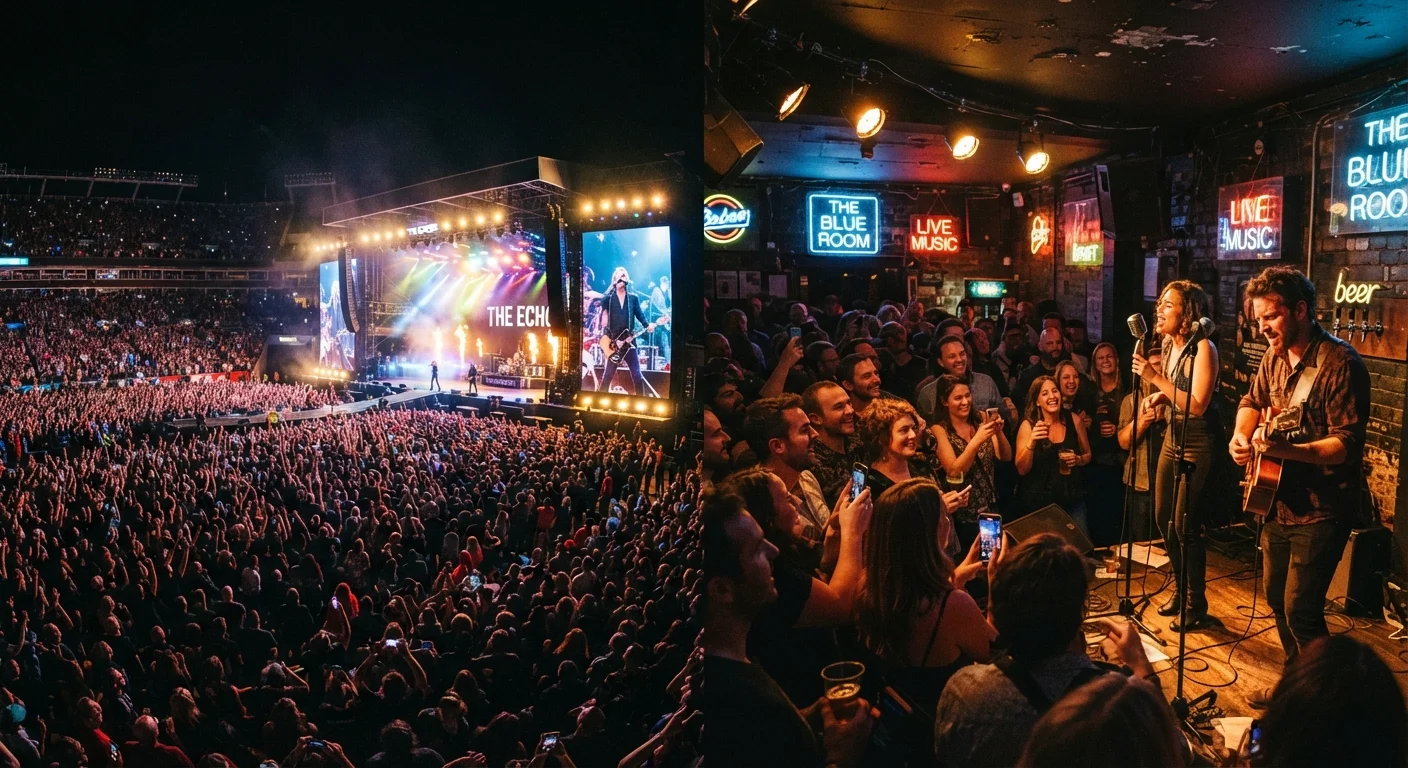
Option A
Stadium Shows
The epic, once-in-a-generation spectacle.
Best for: Fans who want massive production value, shared cultural moments, and the thrill of being part of a crowd of tens of thousands.
Option B
Intimate Venues
The up-close, unfiltered musical connection.
Best for: Music lovers who prioritize artist proximity, acoustic nuance, spontaneous setlists, and a more personal atmosphere.
The Scale Question: What You're Actually Buying
When you purchase a ticket to see an artist perform, you're not just buying access to their music - you're buying into a specific kind of experience. Stadium shows and intimate venues are essentially two different products that happen to share a category name.
A stadium concert is a logistical feat. Think of the Beyoncé Renaissance tour or Taylor Swift's Eras tour, which filled NFL stadiums across the country - these productions involve hundreds of crew members, elaborate stage sets, and lighting systems that cost more than most buildings. The music is almost secondary to the event itself. You are attending something cultural. The crowd is the show as much as the performer is.
Intimate venues - think a 500-capacity club, a 1,200-seat theater, or a small festival stage - strip all of that away. What's left is the artist, the band, the room, and you. That directness can be electric in ways that no amount of pyrotechnics can replicate.
| Criterion | Stadium Shows | Intimate Venues |
|---|---|---|
| Crowd Size | 20,000-100,000+ | 100-2,500 |
| Production Scale | Full staging, pyrotechnics, video walls | Minimal or stripped-back production |
| Sound Quality | Variable; acoustics challenging | Generally clearer and more detailed |
| Artist Proximity | Often far from the stage | Close, often within feet |
| Setlist Flexibility | Tightly scripted, rehearsed | More spontaneous, rarities possible |
| Logistics Overhead | High - transport, parking, queues | Low - walk-in friendly |
| Cultural Moment Factor | Very high - shared mass experience | Personal and niche |
Sound, Sightlines, and the Sensory Reality
Here's something no one mentions on the ticket listing: stadium acoustics are genuinely challenging. Open-air venues and cavernous indoor arenas introduce delay, echo, and frequency loss that even the best sound engineers struggle to fully tame. If you're in the upper tiers or far from the stage, you may be watching a video screen more than an actual performer.
Intimate venues tend to reward listeners who care about fidelity. A well-designed listening room or small club can deliver a warmth and presence that makes even a familiar song feel newly discovered. You can hear the pick hitting the string. You can catch the moment an artist changes their mind mid-phrase.
~45%
Concertgoers citing sound quality as top priority
A National Endowment for the Arts survey found sound quality consistently ranks among the top factors driving live music satisfaction for American audiences.
3x
Average stadium show crew vs. club show
Industry estimates suggest major stadium tours employ roughly three times the production personnel of a typical mid-size venue run.
Top 10
US music markets include cities without major stadiums
Pollstar data has long shown that several top-grossing US music markets rely heavily on mid-size theaters and arenas, not just mega-stadiums.
Sightlines follow similar logic. In a 300-person venue, there isn't a bad spot in the house. In a 70,000-seat stadium, your experience varies enormously depending on where you sit - and that variability is baked into the ticket pricing tiers.
The Cultural Moment vs. The Personal Memory
Stadium shows have a unique social power. They create shared cultural touchstones - moments that define a generation's relationship with an artist. When Bruce Springsteen plays a three-hour set at MetLife Stadium, or when Kendrick Lamar headlined Coachella and made headlines with his setlist choices, those events become part of the broader American pop culture conversation. Attending them means participating in something larger than yourself.
Intimate shows, by contrast, create intensely personal memories. Ask any music obsessive about their most cherished concert experiences and you're likely to hear stories about a 200-seat room, a support act who blew them away, or an artist who made direct eye contact during a quiet song. Those moments don't scale - and that's precisely their value.
Just as some shopping decisions come down to experience vs. efficiency, the stadium-vs.-club debate is really about what you're optimizing for on a given night.
Artists Often Choose Both Deliberately
Many major artists intentionally schedule intimate club runs or theater dates alongside their arena tours - sometimes under different billing or as warm-up shows. These smaller dates aren't afterthoughts; they're often where artists test new material, reconnect with core fans, or simply enjoy the creative freedom that a smaller room allows. Keeping an eye on an artist's full touring calendar, not just the headline stadium dates, can uncover some genuinely rare opportunities.
Practical Realities: Logistics, Cost, and Comfort
Beyond the emotional calculus, there are real-world factors that shape the experience. Stadium shows demand advance planning - parking, transportation, early arrival to navigate security, and navigating enormous concession lines. The logistical overhead is significant, and for some attendees that friction diminishes the night before it even begins.
Intimate shows are comparatively low-friction. You arrive closer to showtime, the room fills quickly, and within an hour or two the night is complete. There's a spontaneity to smaller shows that pairs naturally with last-minute decisions.
Cost is more nuanced than it appears. Stadium floor tickets for major tours can exceed several hundred dollars, while small-venue tickets for emerging or mid-career artists often run under fifty. But a nosebleed stadium seat can also be surprisingly affordable - the venue format alone doesn't determine what you'll pay. What matters is where you land within each format's seating geography.
Ultimately, neither format wins outright. The most musically passionate fans tend to value both - and know which one fits the artist and the occasion in front of them.
The content on this site is for informational purposes only and is not a substitute for professional advice. Always consult a qualified professional for guidance specific to your situation.