

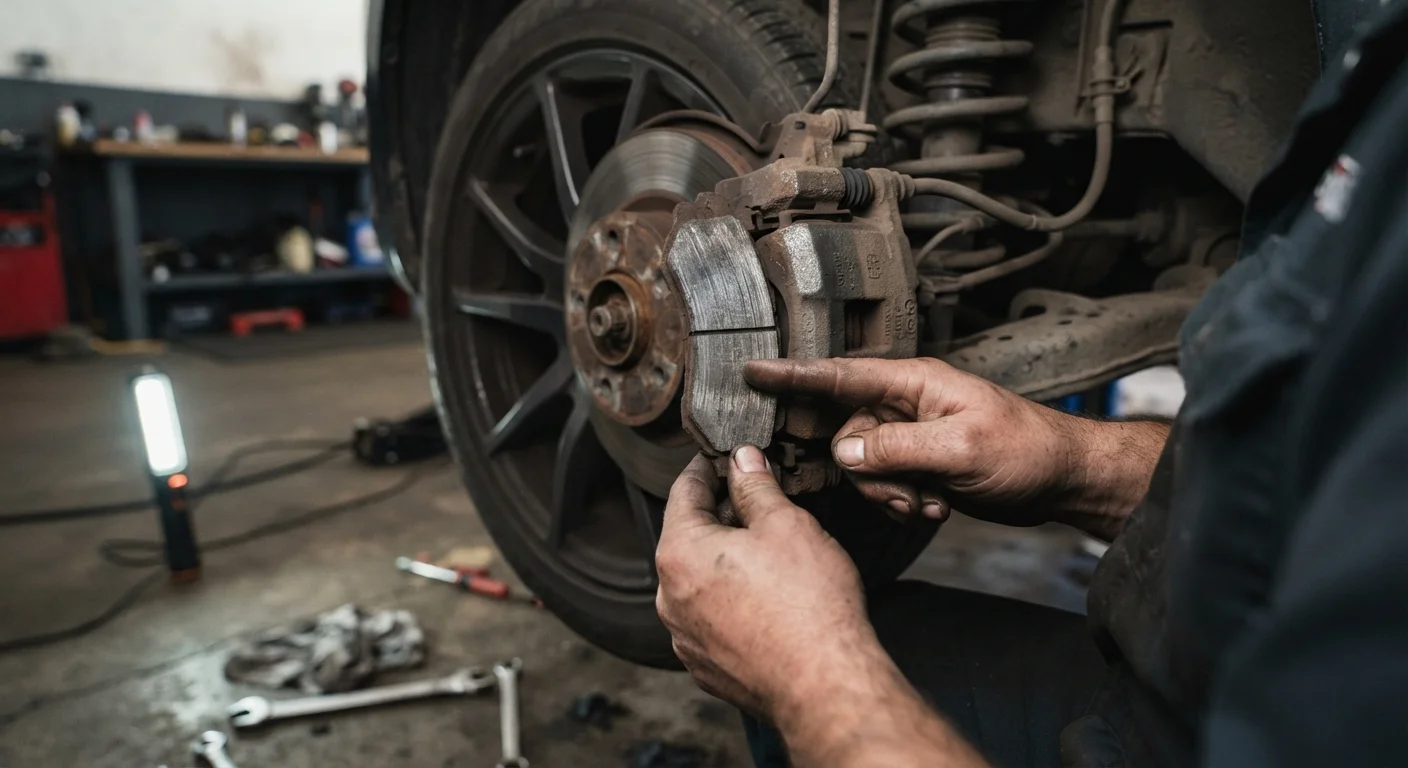
Why Brake Myths Are Particularly Dangerous
Misconceptions about maintenance are common across almost every system in a vehicle - and we've addressed similar patterns in areas like auto insurance myths that quietly cost drivers money. But brake myths carry a uniquely high cost: a poorly maintained brake system doesn't just risk an expensive repair bill, it risks lives. Because brakes typically degrade gradually rather than failing instantly, drivers often dismiss early warning signs as minor or misinterpret normal behavior as a problem. The myths below are among the most persistent - and the most worth correcting.
Myth
Brake pads last at least 50,000 to 100,000 miles, so I don't need to check them often.
Fact
Brake pad life ranges widely - typically 25,000 to 65,000 miles - and is heavily influenced by driving style, load, terrain, and pad material.
Manufacturer mileage estimates are averages derived from controlled conditions, not real-world guarantees. A driver who regularly brakes hard in city traffic, tows a trailer, or navigates steep grades can wear through pads in significantly fewer miles than a highway commuter. Pad thickness should be inspected at every tire rotation - roughly every 5,000 to 7,500 miles - rather than waiting for a mileage milestone. Most pads include a wear indicator that causes a squealing sound when they reach minimum thickness, but relying solely on that warning means you're already at the edge of safe service life.
Myth
If my brakes are grinding, I need to replace everything - rotors, pads, calipers, the works.
Fact
Grinding most commonly signals metal-on-metal contact from worn pads, but it doesn't automatically mean every brake component has failed.
When brake pads wear down completely, the metal backing plate contacts the rotor directly, producing a grinding or scraping noise. In many cases, replacing the pads - and resurfacing or replacing the rotor if it's scored - is sufficient. Calipers are far more durable and rarely need replacement at the same time unless there's evidence of a stuck piston, fluid leak, or uneven wear pattern. A qualified mechanic should diagnose the source before replacing components that may still be serviceable. That said, grinding should never be dismissed - continuing to drive on metal-on-metal contact damages rotors rapidly and compromises stopping ability.
Myth
Brake fluid is a sealed system, so it never needs to be changed.
Fact
Brake fluid is hygroscopic - it actively absorbs moisture from the air - which degrades its boiling point and braking effectiveness over time.
Most brake fluid formulations (DOT 3, DOT 4, and DOT 5.1) absorb water through microscopic permeation in brake hoses and reservoir caps. As moisture content rises, the fluid's boiling point drops significantly. Under hard braking, this can cause vapor lock - a condition where the fluid boils and compressibility increases, resulting in a spongy or fading pedal. Many vehicle manufacturers recommend changing brake fluid every two years regardless of mileage. A simple test strip can measure moisture content and help determine whether a flush is due. Check your owner's manual for the manufacturer's specific interval recommendation.
Myth
New brakes squealing is a sign of bad parts or a shoddy installation job.
Fact
Brief squealing after new brake installation is normal and typically resolves within a few hundred miles of normal driving.
New brake pads require a break-in period, often called bedding, during which the pad material transfers an even layer onto the rotor surface. During this process, light squealing or minor vibration is common and expected. Some semi-metallic pad compounds are inherently noisier than ceramic formulations, which is a characteristic of the material rather than a quality flaw. Persistent squealing after several hundred miles, or noise accompanied by vibration or pulling, does warrant a return to the shop. But dismissing functional new brakes as defective based on a brief adjustment period leads some drivers to make unnecessary and costly replacements.
Myth
Only the front brakes really matter - the rears do very little stopping work.
Fact
Rear brakes contribute meaningfully to total stopping force and play a key role in vehicle stability during braking.
Front brakes handle a larger share of stopping force because weight shifts forward during deceleration - but the rear brakes are far from passive. They help maintain directional control, prevent rear-wheel lockup, and work in coordination with the vehicle's antilock braking system (ABS). Neglecting rear brake service allows pads and rotors to deteriorate to the point of causing uneven braking, vehicle pull, or compromised emergency stopping distances. Rear drum brakes - still common on many vehicles - require their own periodic inspection and adjustment that front disc brake service does not cover. See our complete vehicle service roadmap for a milestone-by-milestone breakdown of when rear brake service typically falls due.
How to Stay Ahead of Brake Problems
The most reliable defense against brake failure is consistent, inspection-based maintenance rather than mileage-based assumptions. Have pad thickness and rotor condition checked during routine tire rotations. Test your brake fluid's moisture level every two years. Pay attention to any changes in pedal feel, stopping distance, or the presence of pulling, vibration, or noise - these are your car's early warning system.
Brakes Are a Safety-Critical System
Unlike most vehicle components, brakes directly determine whether you can stop before a collision. If you notice any unusual noise, vibration, pulling, or increased pedal travel, have your brakes inspected by a qualified mechanic promptly. Do not delay service on the assumption that the symptom will resolve itself.
For drivers who want to understand which inspection tasks are genuinely safe to perform at home versus which require professional equipment and training, our guide on DIY car maintenance for everyday drivers draws a clear line. Brake inspections can be straightforward to observe - but brake repair almost always warrants a qualified mechanic given the safety stakes involved.
Don't Judge Brakes by Mileage Alone
Many drivers assume their brakes are fine simply because they haven't hit a certain mileage threshold. Stop-and-go urban driving, towing, and mountain descents can wear pads down in half the distance of highway driving. Rely on physical inspection - not odometer readings - to determine brake health.
The content on this site is for informational purposes only and is not a substitute for professional advice. Always consult a qualified professional for guidance specific to your situation.